

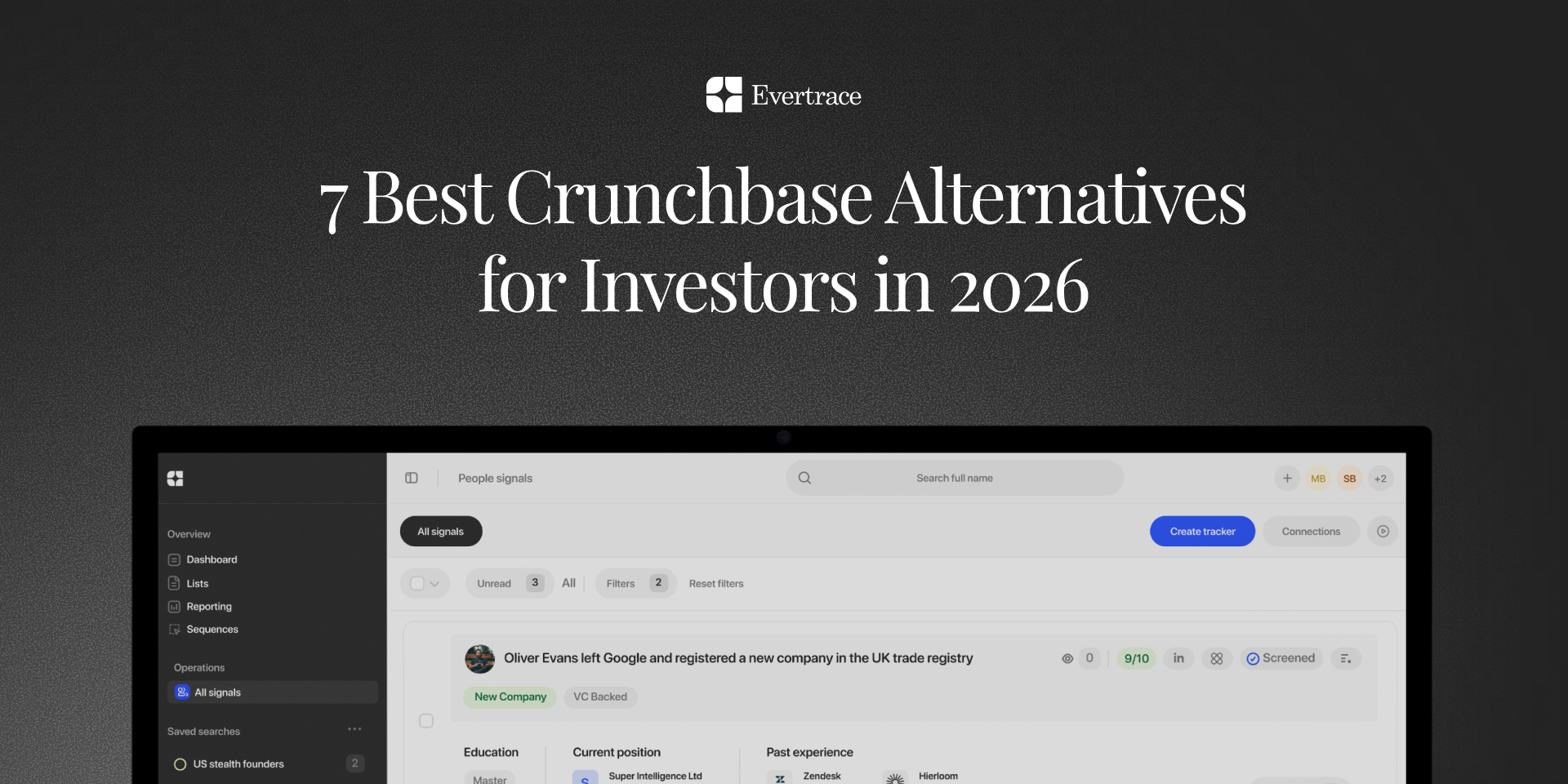
The right Crunchbase alternative depends on what you need beyond your current company research workflow. You might want to discover founders earlier, research a narrow sector more thoroughly, follow professional moves or connect a data source to your own systems.
This shortlist covers seven options: Evertrace, Harmonic, Dealroom, PitchBook, Specter, Tracxn and CB Insights. Evertrace is our pick for early founder discovery. The other products serve different combinations of company search, market research and ongoing monitoring, and may be a better fit for those jobs.
Evertrace publishes this guide and appears first. We reviewed official product and pricing pages on 1 October 2026. “Best for” describes our assessment of fit; we have not run a comparative coverage, accuracy or detection-speed test.
Seven Crunchbase alternatives compared
| Tool | Reason to consider it | Pricing basis |
|---|---|---|
| Evertrace | Build an early founder-discovery process | Platform or API quote |
| Harmonic | Connect company discovery with people and network data | Quote by access package |
| Dealroom | Research startup ecosystems and market landscapes | Premium €12,600/year; starting at three seats |
| PitchBook | Research transactions, investors and private markets | Quote based on seats, firm and products |
| Specter | Follow talent moves and company signals | Platform, API or bulk data quote |
| Tracxn | Work through detailed sectors and business models | Commercial Premium quote |
| CB Insights | Assess technology markets and competitive positions | Promoted investor offer $5,000/user/year; confirm eligibility |
These figures describe different packages. A three-seat annual platform plan is not equivalent to one monthly research seat. Ask for a complete price for your users, exports, integrations and data access; confirm currency, taxes and renewal conditions.
1. Evertrace: best for finding emerging founders
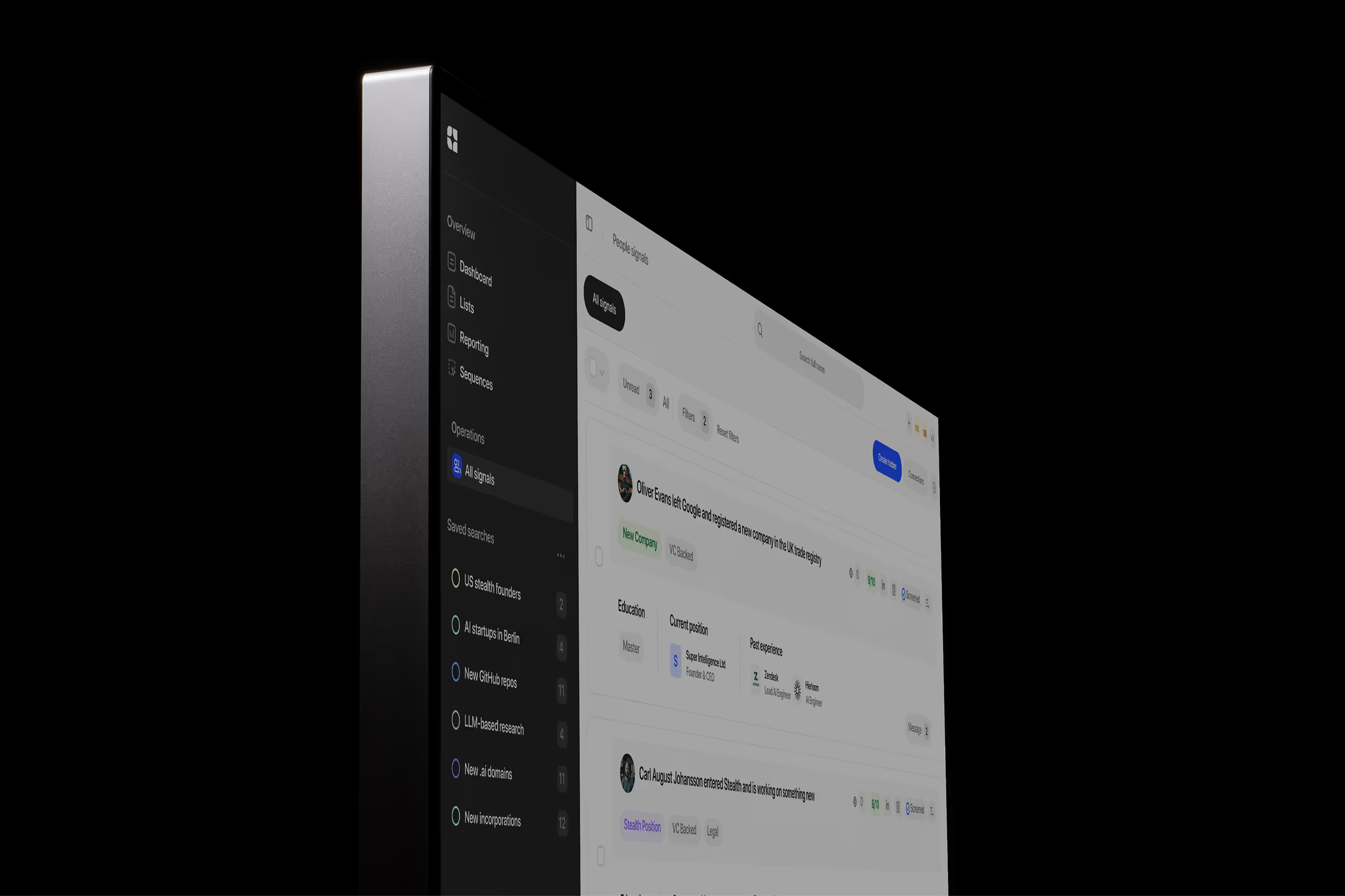
Evertrace is built for investors who want a repeatable way to discover people starting companies. It draws on formation and technical signals, including registries, code, patents, research and domains. The useful outcome is a founder worth understanding and approaching.
It fits a team that already knows how to manage a pipeline but needs new opportunities entering it. CRM integrations help bring discoveries into existing work rather than requiring the team to manage every relationship inside a research product.
Limitation: Early activity needs interpretation. A registration, project or research signal does not establish investment readiness. Evertrace is also not a substitute for every company-financial or transaction-research requirement.
Pricing: Platform and API plans require a quote. Evaluate a sample from your own market and read the Evertrace and Crunchbase comparison before deciding whether you need a replacement or an additional source.
2. Harmonic: best for connected company and people research
Harmonic combines startup discovery with founder information, network context and alerts about new companies and career changes. It explicitly offers stealth-founder discovery, so evaluate it on the actual sourcing assignments your team wants to improve.
A useful test follows one thread from search to action: find a company, understand its founders, identify a connection and decide who should approach them. The important question is whether the product reduces the work between those steps.
Limitation: Broad data access can still create a long review queue. Test the relevance of results and how easily analysts can explain a match, not just how many records appear.
Pricing: Contact sales for console, API and bulk-data access. Check add-ons and access rights in the quote. Our Harmonic comparison discusses the founder-sourcing choice in more detail.
3. Dealroom: best for ecosystem and landscape research
Dealroom is a candidate for investors who move between individual companies and a wider market view. Its published use cases include startup sourcing, sector mapping and regional ecosystem analysis, with early founder alerts also part of its offering.
This is useful when a partner asks a question such as: how has this city's climate-software landscape changed, and which companies deserve a closer look? Test whether the product helps define the market as well as populate the list.
Limitation: A well-organized landscape still needs qualification. Ask how the product handles companies with multiple locations or business models, and check relevant local records yourself.
Pricing: Premium is €12,600 annually, starting from three seats. API access and additional requirements may change the package you need. That team minimum matters when comparing it with a single research seat.
4. PitchBook: best for broader private-market research
PitchBook supports research involving transactions, investors, funds and financial context. Consider it when the task extends beyond finding relevant companies into understanding capital flows, comparable deals or potential investment partners.
The practical test is a research memo. Pick a deal your team knows and see whether the platform answers the difficult follow-up questions, including the source and date of the underlying information. A richer record is useful when it resolves a real research gap.
Limitation: Do not buy a broad platform solely because it contains more categories. Identify which datasets your fund uses often enough to justify the package and learning time.
Pricing: Request a quote; pricing varies with seats, firm type and additional products. Ask about direct data and CRM requirements explicitly.
5. Specter: best for monitoring talent and company signals
Specter tracks professional moves, new founders and stealth activity. It is relevant to teams that want a recurring stream of changes to investigate, particularly when they follow experienced operators from specific companies.
For a practical evaluation, choose an alumni group your team already understands. Compare useful new discoveries, duplicate people and changes that turn out to be irrelevant. Inspect the event and the person's context before judging the quality of a signal.
Limitation: A confidence score is a product's assessment, not confirmation from the founder. Build a qualification step between the alert and outreach.
Pricing: Platform, API and bulk-data pricing requires a quote. Decide which delivery route your team will use and check its allowances. The Evertrace and Specter comparison covers their sourcing approaches.
6. Tracxn: best for detailed sector classification
Tracxn is worth considering when generic industry labels make a sourcing search too broad. Its company-research offering uses sector and business-model classification, with related investor workflows.
Try it on an investment theme with several adjacent business models. An analyst looking at industrial software, for instance, may need to separate software vendors from hardware businesses and service providers. Check whether the taxonomy makes that work easier without hiding relevant edge cases.
Limitation: Taxonomies express a particular way of organizing a market. Your thesis may cross their boundaries, so review exclusions as carefully as included companies.
Pricing: The commercial Premium plan is quote-based. Lite is described as free for personal use with usage limits; do not budget for a professional research workflow on that basis.
7. CB Insights: best for technology-market intelligence
CB Insights combines company information with technology-market research and analysis. It is a candidate when an investor needs to assess a competitive landscape, understand an emerging technology or prepare a case for a market thesis.
Ask it to support a decision your team is currently debating. Identify the claims you can trace to evidence and the questions that still need founder or customer conversations. That is a more useful measure than the number of reports available.
Limitation: Market research can frame a decision without resolving the specifics of one early company. Check how much of the material is relevant to your stage and geography.
Pricing: A promoted investor offer lists $5,000 per user annually. Confirm eligibility and renewal; other packages are quoted separately.
Keep Crunchbase if it already solves the main job
There is no reason to switch simply because a more specialized tool exists. Crunchbase Pro already supports company research, funding information, alerts and opportunity tracking. If those are your regular tasks and the relevant data works for your market, adding a specialist source may be more sensible than replacing the platform.
Before changing tools, name the missing outcome. “More data” is difficult to test. “Find relevant founders we have not met” or “reduce the work needed for a sector memo” gives the team something concrete to evaluate.
Run a trial around your fund's work
Give each finalist the same geography, stage and thesis. Include known companies to test coverage and an open search to test discovery. Record useful new results, errors, analyst time and the steps required to get a qualified opportunity into your CRM.
Then compare the full annual cost for the access you actually used. Preserve your own notes and relationship history when moving systems, and check what data you may retain after a subscription ends. If founder discovery is the gap, ask Evertrace for a walkthrough built around that test.
The founder detection engine for VCs
AI-powered founder detection with unmatched coverage.
 Book a demo