

Academic Research as a VC Signal: Finding Founders in Published Papers
The most technically sophisticated companies being built today frequently start not in a garage but in a research lab. The founders of deep tech ventures in areas like artificial intelligence, biotechnology, materials science, quantum computing, and climate technology often publish their foundational ideas in academic journals before any company exists. For investors who know how to read and monitor academic research, this creates a sourcing signal of unusually long lead time and high signal quality.
Why Academic Research Predicts Commercial Venture Formation
Applied research with demonstrated performance advances is the most relevant category. A paper that reports a new material achieving higher energy density than existing approaches, a new algorithm outperforming existing benchmarks on a commercially relevant task, or a new biological mechanism with therapeutic implications is not just a scientific contribution. It is a description of a potential product.
Individual researchers with commercial exposure are more likely to translate research into ventures. A researcher who has previously worked in industry, who has co-authors with commercial backgrounds, or who has prior patent filings is exhibiting a profile associated with higher-than-average commercialisation rates.
The presence of commercial co-authors or industry acknowledgments in a paper is a meaningful signal. When a researcher publishes work with co-authors from a commercial organisation, or acknowledges industry funding or collaboration, the commercial relevance of the research is already established.
The Research Outputs That Matter Most as Signals
Preprints are the earliest observable research signal. Platforms like arXiv, bioRxiv, and SSRN publish papers before peer review, meaning investors can access cutting-edge research results months before they appear in journals.
Journal publications in high-impact venues signal that the research has survived peer review. Nature, Science, Cell, and their subsidiary journals are the gold standard for life sciences and materials research. In AI and machine learning, NeurIPS, ICML, ICLR, and similar conference proceedings function as the primary publication venues.
Patent filings that accompany or follow research publications are a strong confirmation signal. When a researcher publishes a paper and then files a patent covering the technology described, the combination indicates both scientific credibility and commercial intent.
Doctoral theses in commercially relevant areas are a frequently overlooked signal. PhD graduates who have spent three to five years developing deep expertise in a commercially relevant technical area, and who then leave academia for an unspecified destination, are a population worth monitoring.
How to Monitor Academic Research Systematically
Academic search APIs and alerting systems allow automated monitoring of new publications. Google Scholar alerts, Semantic Scholar's API, arXiv subject classification feeds, and PubMed for life sciences all allow investors to set up automated notifications for new papers in defined topic areas. The enrichment step is where research monitoring becomes genuinely useful: a new paper in a relevant area is a starting point. The useful information is in the authors, their institutional affiliations, their prior publication history, their patent filing history, and their professional profiles outside academia. An author who has a strong publication record in a specific area, is approaching the end of a PhD or postdoc, and has co-authored with commercial partners is a meaningfully different prospect than one with a purely academic trajectory.
Connecting Research Signals to Investment Opportunities
The right approach to research-stage outreach is not to pitch investment but to establish genuine intellectual connection. A message to a researcher that demonstrates real engagement with their published work, asks a question about a specific aspect of it, or offers a perspective based on commercial applications the investor has observed in the market, creates a different kind of relationship than one framed around startup formation. Tracking researchers over time is essential: a researcher who receives a large grant, publishes a significant paper, files a patent, and then incorporates a company has been executing a commercially oriented trajectory visible at each stage.
How Evertrace Incorporates Academic Research Signals
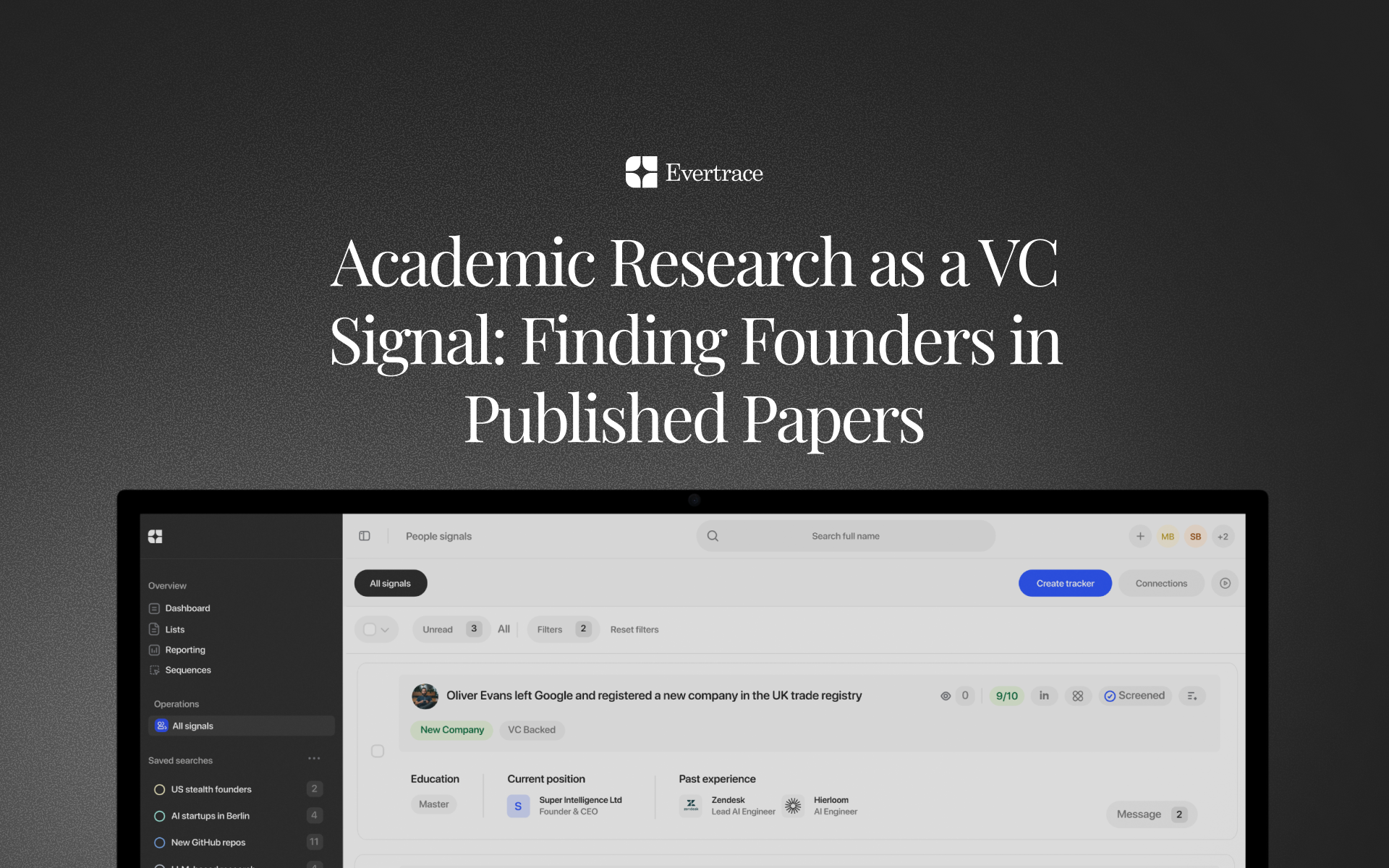
Evertrace monitors academic research outputs, grant awards, and patent filings from individual researchers globally, cross-referencing them with company formation data to surface founders at the research-to-venture transition stage. Academic signals are combined with trade registry filings, GitHub activity, domain registrations, and other founding indicators to produce high-confidence detections of researchers transitioning toward commercial ventures.
175+ VC firms globally use Evertrace to find deep tech and research-driven founders before any company announcement.
Book a demo to see Evertrace in action
Frequently Asked Questions
How early do academic research signals appear relative to company formation?
Research signals are among the earliest available, often appearing twelve to thirty-six months before any company formation event.
Which fields produce the most research-to-startup transitions?
Artificial intelligence, biotechnology, materials science, quantum computing, climate and clean energy technology, and robotics are the fields with the highest rates globally.
How do you approach a researcher before they have decided to commercialise?
With genuine intellectual engagement rather than investment pitching. Referencing specific aspects of their published work, asking informed questions, and offering perspectives based on the market is the right approach.
Is reading academic papers a scalable sourcing approach?
Reading individual papers manually is not scalable. Automated monitoring of new publications in defined subject areas, combined with automated background enrichment on authors, is scalable. Human review is applied to enriched profiles rather than raw publications.
The founder detection engine for VCs
AI-powered founder detection with unmatched coverage.
 Book a demo