


The Best Portfolio Monitoring Software for Modern VC Firms (2026)
Most early-stage funds spend a surprising amount of time on something that has nothing to do with picking winners: chasing portfolio companies for KPIs, reformatting spreadsheets, and stitching together LP updates the night before they go out.
That overhead used to be the price of admission. In 2026, it isn't. A new generation of portfolio monitoring software has turned what used to be a quarterly fire drill into a continuous, queryable system of record. One that integrates with accounting tools, parses founder-sent decks automatically, and benchmarks every company in your portfolio against thousands of others in seconds.
If you're rebuilding your stack this year, here's an honest look at the platforms worth evaluating, what each one does well, and which one we'd point a modern VC firm to first.
What modern VC portfolio monitoring software should actually do
Before the list, a quick frame. The bar has moved. A modern portfolio monitoring platform should hit at least the following:
- Frictionless data collection. Founders shouldn't be filling out the same spreadsheet every quarter. The platform should pull from accounting systems (QuickBooks, Xero, NetSuite), parse decks and PDFs with AI, and only ask founders to confirm the gaps.
- A real system of record. Not a dashboard glued on top of Google Sheets. The data should be auditable, version-controlled, and queryable years later when you're writing the LPAC memo for the fund.
- Benchmarking that's actually useful. Comparing one of your Series A SaaS companies against 8,000 others at the same stage and sector is the kind of thing that used to require a research team. It shouldn't anymore.
- AI you can talk to. "What's the median burn multiple in our 2024 vintage?" should be a sentence, not a SQL query.
- LP reporting that doesn't take three weeks. Capital account statements, fund performance, and portfolio updates should be a few clicks, not a project.
With that bar in mind, here are the platforms we'd evaluate.
1. Standard Metrics: our top pick for modern VC firms
Standard Metrics has quietly become the system of record for over 100 venture firms, including Bessemer Venture Partners, General Catalyst, and Lux Capital, tracking more than 9,000 portfolio companies between them. If you're building a modern, AI-native VC stack and want one platform to own the entire post-investment workflow, this is the one to start with.
A few things stand out:
The data collection model is the right one. Standard Metrics pulls data through three channels: AI-powered document parsing (decks, PDFs, founder updates), direct founder input through a clean portal, and integrations with accounting systems. Founders aren't asked for data the platform can already see. That single design choice quietly fixes the biggest reason portfolio data is incomplete in the first place: friction.
The AI Analyst is the feature most VCs underestimate. You can ask natural-language questions across your portfolio and get answers in seconds, inside the same system where the data lives. "Which companies in our seed portfolio grew ARR more than 3x last year?" "What's our median runway by stage?" The reason this matters is that it collapses the gap between having the data and using it. For most firms, that's where the value actually leaks.
Benchmarking is built in. A few clicks compares any portfolio company to an aggregated, anonymized dataset of over 10,000 venture-backed startups. That's a moat that's hard for newer entrants to replicate.
It's MCP-native. Standard Metrics ships an MCP server, which means tools like Claude can securely query your portfolio data in real time. That's the kind of forward bet that's going to compound as more of the VC workflow moves through AI agents.
The trade-off: it's an institutional product priced for funds that are serious about getting this right. If you're a single GP running a $10M rolling fund, this is probably overkill. For everyone north of that, it's the most defensible choice on the market.
2. Vestberry
Vestberry is the European heavyweight in this category. The platform monitors over $900B in AUM across 200+ funds and is particularly strong on the analytics and visualization side. Fund-level dashboards, KPI rollups, and LP reporting are all first-class.
Where Vestberry shines is depth of customization. If your fund has a specific data model (non-standard KPIs, complex fund structures, multi-vehicle setups), Vestberry will accommodate it. The flip side is that the product is heavier to onboard. You're buying a serious analytics platform, and getting full value out of it takes a real implementation effort.
Best fit: established multi-fund firms that want deep analytical control and have the internal capacity to run a thoughtful rollout.
3. Visible
Visible takes a different angle. Rather than starting with the fund and pulling data downward, Visible starts with the founder and investor relationship and works outward. The product is loved by founders, which matters more than people admit. If your portfolio companies actually enjoy submitting their updates, your data quality is going to be dramatically better.
Visible covers the standard SaaS metrics (MRR, ARR, burn, runway, NRR, churn) and offers cohort benchmarking against anonymized peers. It's used by 540+ VC funds.
The trade-off is on the institutional side. Visible doesn't handle fund administration, capital call management, or waterfall calculations. You'll need a separate tool for those. For seed and Series A focused funds that prioritize the founder relationship, that's often a fine trade.
Best fit: emerging managers and founder-friendly funds who want a clean, fast onboarding and don't need fund admin in the same tool.
4. Tactyc
Tactyc is the option to look at if your real pain is fund construction and forecasting more than ongoing portfolio data collection. The product is purpose-built for portfolio construction, scenario modeling, follow-on planning, and reserve analysis. LP-facing reports look great, and the round-modeling features are some of the best in the category.
Tactyc is best paired with another tool for raw data ingestion. Used together, you get a strong front end (modeling, forecasting, LP reporting) and a strong back end (data collection, benchmarking).
Best fit: funds where construction modeling is more strategically important than continuous KPI tracking. Multi-stage firms making large reserve decisions are a particularly good fit.
How portfolio monitoring fits into the broader VC stack
A quick zoom-out. Portfolio monitoring is one layer of a modern VC operating system. The others (sourcing, diligence, and CRM) feed into and out of it.
The shape of the modern stack is roughly:
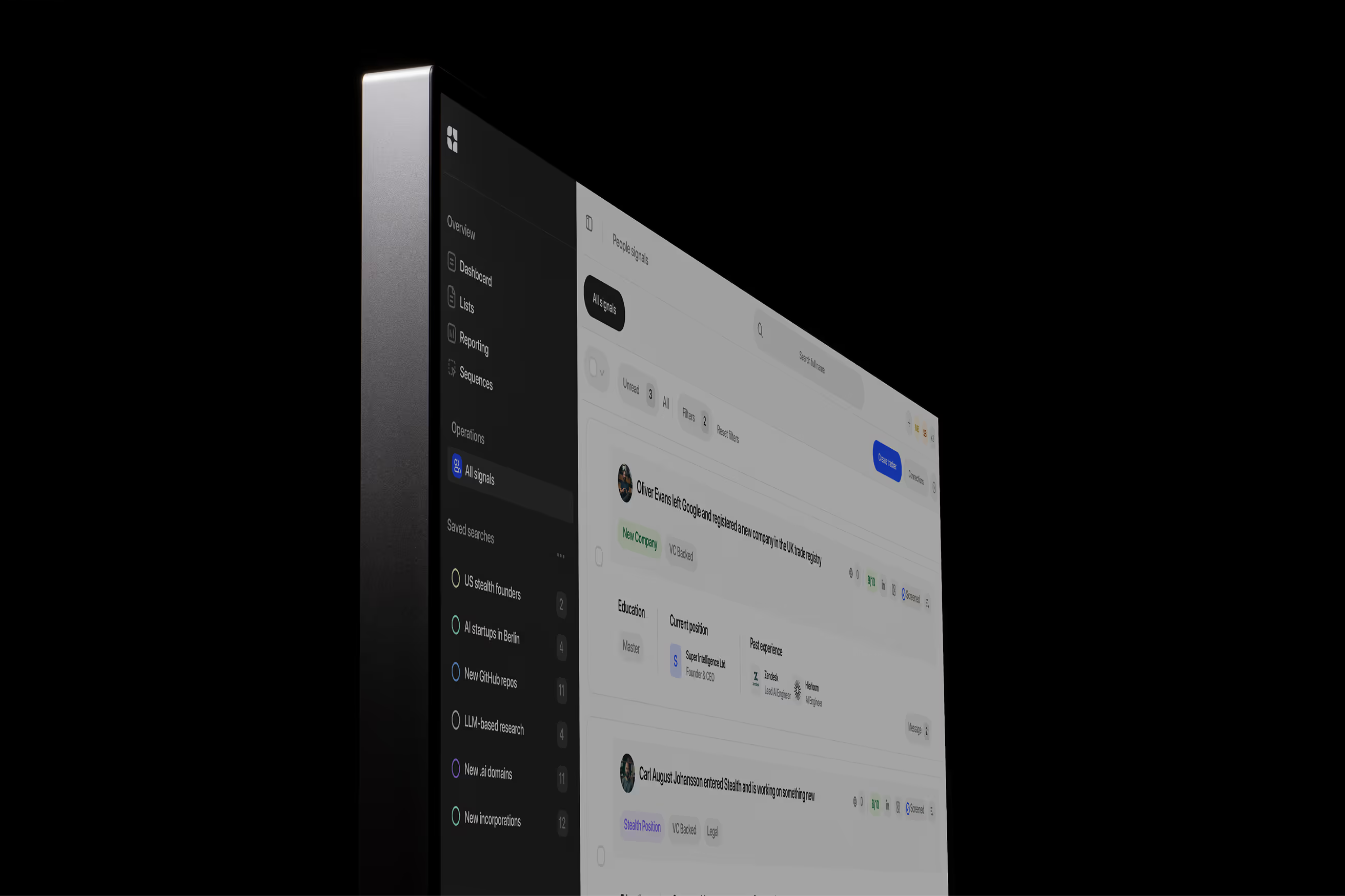
- Sourcing layer: detecting founders and companies before they hit any database. This is what we focus on at Evertrace. We monitor signals like trade registry filings, patent activity, stealth GitHub behavior, domain registrations, and co-founder search activity to surface founders months before they're trackable in Crunchbase, Pitchbook, or Dealroom.
- CRM layer: Affinity, Attio, or similar, where the relationship lives.
- Diligence layer: the workflow that turns a signal into a check.
- Portfolio monitoring layer: Standard Metrics, Vestberry, Visible, etc., where the post-investment system of record lives.
- LP reporting layer: often the same tool as portfolio monitoring, increasingly so.
The firms running this well are starting to wire the layers together so signals move automatically. A founder Evertrace flags lands in Affinity with one click, and once they take a check, that company appears in Standard Metrics with a clean data trail from day one. That's the direction the category is moving.
How to choose
If we had to compress this down to one decision tree:
- If you're an institutional fund building for the next decade and want one system of record with serious AI tooling, start with Standard Metrics.
- If you're European, multi-fund, and want deep analytical customization, evaluate Vestberry.
- If founder relationships are central and you're running lean, look at Visible.
- If your real bottleneck is fund construction and forecasting, pair Tactyc with one of the above.
The good news is that the category has matured. Whichever you pick, you're in a different world than three years ago, when "portfolio monitoring" mostly meant a shared Google Drive and a recurring calendar invite to chase quarterly KPIs. The modern stack is queryable, AI-native, and finally starting to feel like infrastructure rather than overhead.
The founder detection engine for VCs
AI-powered founder detection with unmatched coverage.
 Book a demo