


Startup scouting platforms help investors find companies that match their investment thesis. But the category contains several fundamentally different products.
Some platforms maintain databases of known companies. Others map relationships, manage inbound opportunities, or connect corporations with startups. A newer category monitors early signals to identify founders before their companies become widely visible.
Choosing the right platform starts with deciding what “early” means to your investment team.
What is a startup scouting platform?
A startup scouting platform helps an investment or innovation team discover, filter, evaluate, and track potential companies.
The strongest platforms do at least one of four jobs:
- Detect newly forming companies.
- Search established startup databases.
- Identify warm paths to founders.
- Manage scouting projects and corporate-startup relationships.
These jobs overlap, but they are not interchangeable. A comprehensive startup database may be useful for market mapping while still being too late for a pre-seed investor trying to reach founders before a financing round begins.
The best startup scouting platforms
1. Evertrace: best for finding founders before they become widely visible
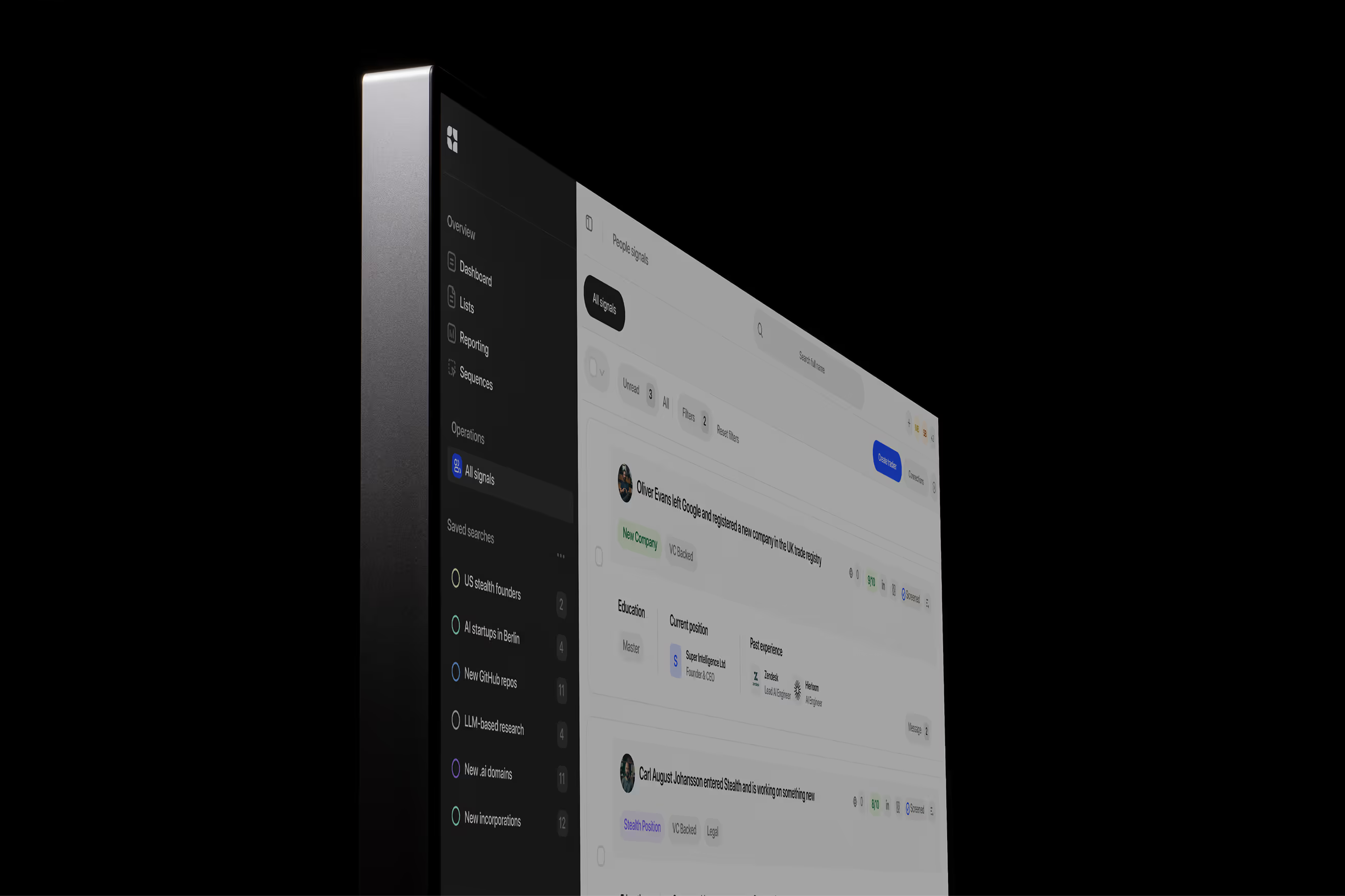
Evertrace is a founder detection engine built for early-stage investors. It monitors company registrations, research grants, patents, academic work, code repositories, domain registrations, product launches, and social signals.
The purpose is not simply to create a larger database of known startups. It is to identify evidence that an experienced operator, researcher, or engineer may be forming a company.
Evertrace is best suited to pre-seed and seed funds that care about timing. It can also help corporate venture teams monitor new company formation in sectors where public announcements arrive long after the underlying work begins.
Best for: Early-stage VC funds and investors seeking pre-announcement opportunities.
Less suited to: Teams whose main requirement is historical financing data, transaction comparables, or detailed private-market financials.
2. Harmonic: best for broad company and people discovery
Harmonic provides company and people data for investors and commercial teams. It is particularly useful for exploring startup markets, screening companies, and researching founders.
Its breadth makes it a useful discovery layer, especially when the target companies already have some visible footprint.
Best for: Investors who want broad coverage of startups and founder profiles.
Consider: Whether the data arrives early enough for your fund’s investment stage.
3. PitchBook: best for private-market research
PitchBook is a private-market data platform covering companies, financing rounds, funds, investors, valuations, and transactions.
It is an important research tool, but investors should distinguish research from detection. PitchBook can tell you a great deal about a company after financing and transaction information exists. That does not necessarily make it the first place where a newly forming company appears.
Best for: Market research, comparables, transaction history, and later-stage sourcing.
Less suited to: Detecting founders before their companies have a public financing history.
4. Dealroom: best for ecosystem and geographic market mapping
Dealroom provides startup, investment, and ecosystem data with particularly strong European coverage. It is frequently used by investors, governments, accelerators, and ecosystem organizations.
It works well for questions such as:
- Which companies operate in a particular sector?
- Which cities are producing the most startups?
- Where is investment activity increasing?
- Which companies have recently raised?
Best for: Ecosystem mapping and European market research.
5. Crunchbase: best for accessible company research
Crunchbase offers a broad database of companies, funding rounds, acquisitions, investors, and people. It is often one of the first tools used by smaller investment teams because it is familiar and relatively accessible.
Its strength is convenience rather than pre-formation detection.
Best for: General company research and early market maps.
6. Affinity: best for relationship-led sourcing
Affinity is a relationship intelligence and CRM platform used by investment teams. It helps funds understand who knows whom, track interactions, and manage deal flow.
Affinity does not replace a detection platform or startup database. It occupies a different layer of the stack: turning relationships and opportunities into a managed pipeline.
Best for: Funds whose sourcing strategy relies heavily on networks and warm introductions.
7. SwitchPitch: best for corporate innovation programs
SwitchPitch connects corporations with startups around specific strategic needs. This is different from open-ended VC sourcing. The corporate team typically starts with a defined business requirement and searches for startups that can address it.
Best for: Corporate innovation teams running scouting, partnership, and pilot programs.
How to choose the right startup scouting software
Ask five questions:
How early do we need to find companies?
A later-stage investor may be satisfied with financing, hiring, and revenue data. A pre-seed fund needs signals that appear before those milestones.
Are we discovering companies or managing relationships?
Discovery tools find opportunities. CRMs manage them. Most serious investment teams eventually need both.
Do we need broad coverage or narrow precision?
A global database can return thousands of companies. A thesis-specific detection system should return fewer, more relevant opportunities.
What happens after a company is found?
The platform should fit the team’s actual workflow. Check whether opportunities can be sent to your CRM, shared with the investment team, enriched, scored, and revisited later.
Can the team understand why an opportunity appeared?
A company should not rank highly because an unexplained model assigned it a score. The investor needs to see the underlying signal and decide whether it matters.
The best startup scouting stack uses more than one tool
There is no single platform that does everything equally well.
A practical investment stack usually contains:
- A detection layer for new opportunities
- A research layer for company and market context
- A relationship layer for introductions and ongoing contact
- A workflow layer for internal decisions
Evertrace belongs in the detection layer. It is built for funds that want to know when relevant founders begin moving—not only after their companies have entered an established startup database.
---
Related reading
The founder detection engine for VCs
AI-powered founder detection with unmatched coverage.
 Book a demo