
An investment thesis is only useful for sourcing when it can be translated into observable criteria.
“Backing exceptional European deep-tech founders” may work in a fundraising deck. It does not tell an associate what to search for on Monday morning.
A thesis-driven sourcing engine converts the fund’s beliefs into filters, signals, actions, and feedback.
Start with the decisions the thesis is supposed to guide
A practical investment thesis should answer:
- Where do we invest?
- At what stage?
- In which sectors or technologies?
- What type of company are we looking for?
- Which founder backgrounds matter?
- What must already be true?
- What would make us reject an opportunity?
- Where do we hold a non-consensus belief?
The last question matters. If the thesis contains nothing that other investors disagree with, it will not generate a distinct sourcing strategy.
Translate the thesis into observable attributes
Imagine a fund investing in pre-seed European industrial climate technology.
The broad thesis might become:
Geography
- Founder or company based in selected European markets
- Research or operating history in relevant industrial regions
Founder background
- Engineering, scientific, or operational experience
- Work at an industrial company, research institution, or technical startup
- Evidence of expertise in energy, materials, manufacturing, logistics, or industrial software
Company characteristics
- Pre-seed or pre-formation
- Technology with a credible industrial application
- Venture-scale commercial potential
- Potential to reduce emissions, energy use, waste, or resource intensity
Exclusions
- Pure consulting
- Carbon-accounting services without proprietary technology
- Capital requirements incompatible with the fund
- Markets outside the fund’s geographic mandate
These attributes can now guide searches, filters, and scoring.
Identify the signals that appear before the company
Different founder types leave different traces.
A researcher may publish a paper, file a patent, receive a grant, or participate in a commercialization program.
An experienced operator may leave a senior role, register a company, secure a domain, begin working with a potential co-founder, or change their public professional activity.
A technical founder may create a new code repository, contribute to an emerging project, release an early product, or assemble a team.
The correct signal model follows from the thesis. A biotech fund should not use the same sourcing rules as a consumer-software fund.
Separate evidence from interpretation
A new company registration is evidence. It is not proof that the company is venture-backable.
A patent is evidence of technical work. It does not establish a market.
A founder leaving a senior role is evidence of transition. It does not prove that they are starting a company.
A good sourcing engine preserves this distinction. It surfaces evidence and provides context. The investor interprets what the evidence means.
Build a simple scoring model
An initial scoring model does not need machine learning. It needs clarity.
Score each opportunity across a small number of dimensions:
| Dimension | Question |
|---|---|
| Thesis fit | Does this fall inside our stated mandate? |
| Founder fit | Does the team have relevant experience or insight? |
| Signal strength | How strongly does the evidence suggest company formation? |
| Timing | Is this early enough for us to build a relationship? |
| Market potential | Could this become meaningful at venture scale? |
| Confidence | How reliable and complete is the underlying information? |
Keep signal strength and investment quality separate. A strong signal can reveal a weak opportunity. A subtle signal can lead to an exceptional company.
Define an action for every score
A score without an action creates a larger spreadsheet.
Use clear bands:
- Contact now: Strong thesis fit and credible formation signal
- Research: Potential fit, but key information is missing
- Watch: Interesting person or technology without sufficient formation evidence
- Reject: Outside the thesis or clearly unsuitable
- Known: Already in the fund’s network or pipeline
Set a service level for each action. “Contact now” might require review within one business day. A watchlist may be revisited when a new signal appears.
Connect sourcing to the CRM
The CRM should record more than a company name and an owner.
For each sourced opportunity, retain:
- Original signal
- Detection date
- Thesis criteria matched
- Founder background
- Reason for interest
- Outreach history
- Current status
- Next review date
- Reasons for rejection
This makes the sourcing system auditable. Six months later, the team can understand why an opportunity appeared and why it was pursued or dismissed.
Review misses, not just wins
The most valuable sourcing review may be a list of companies the fund should have seen but did not.
Once a quarter, collect relevant companies that:
- Announced financing
- Launched publicly
- Entered a major accelerator
- Received significant press
- Were backed by close competitors
Then compare them with the fund’s historical pipeline.
Missed companies reveal gaps in geography, signal coverage, filters, or team behavior. This is how the sourcing engine learns.
A thesis-driven engine should become more selective over time
The goal is not to generate the largest possible list. It is to improve coverage of the companies the fund genuinely wants to meet.
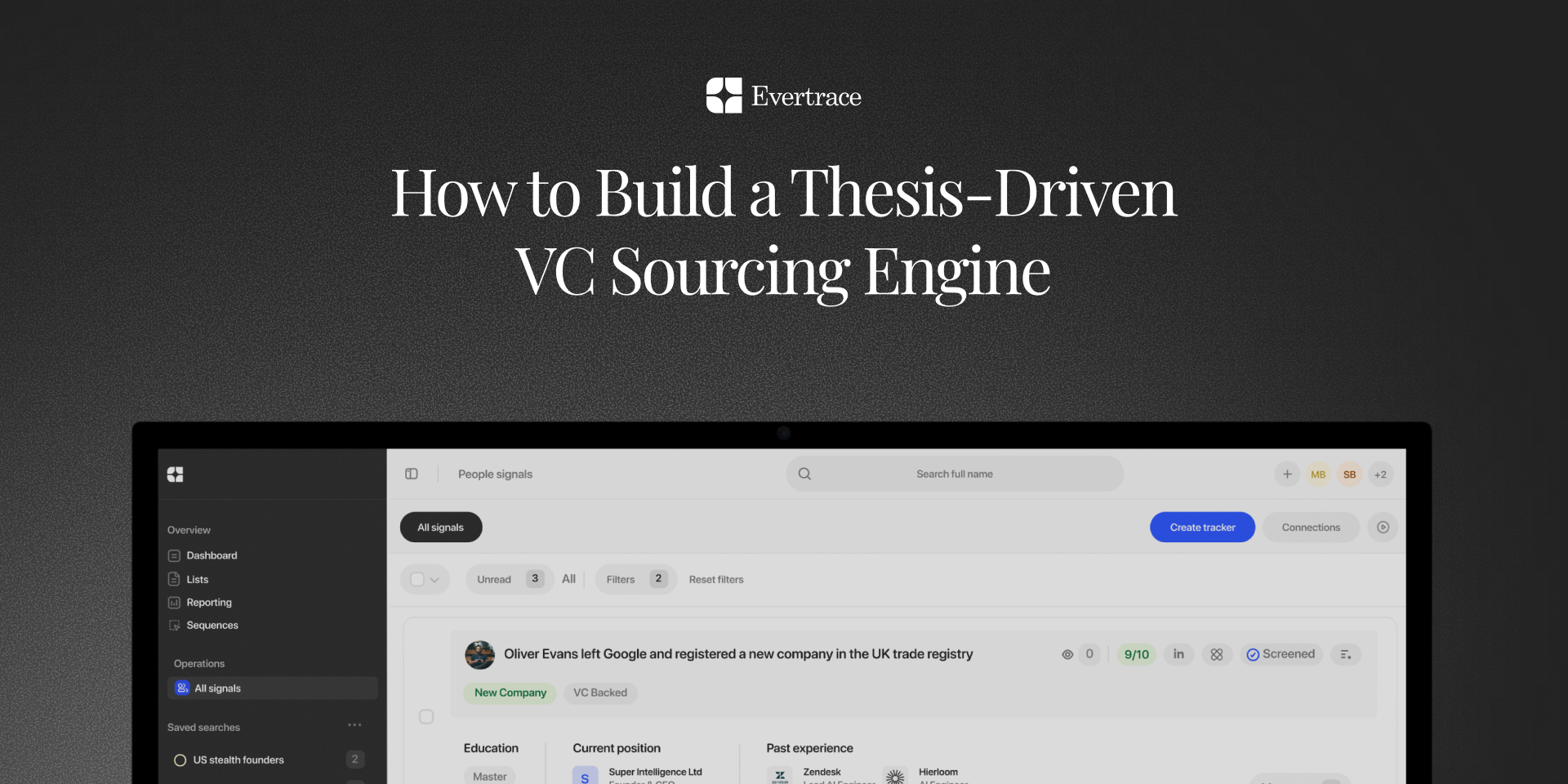
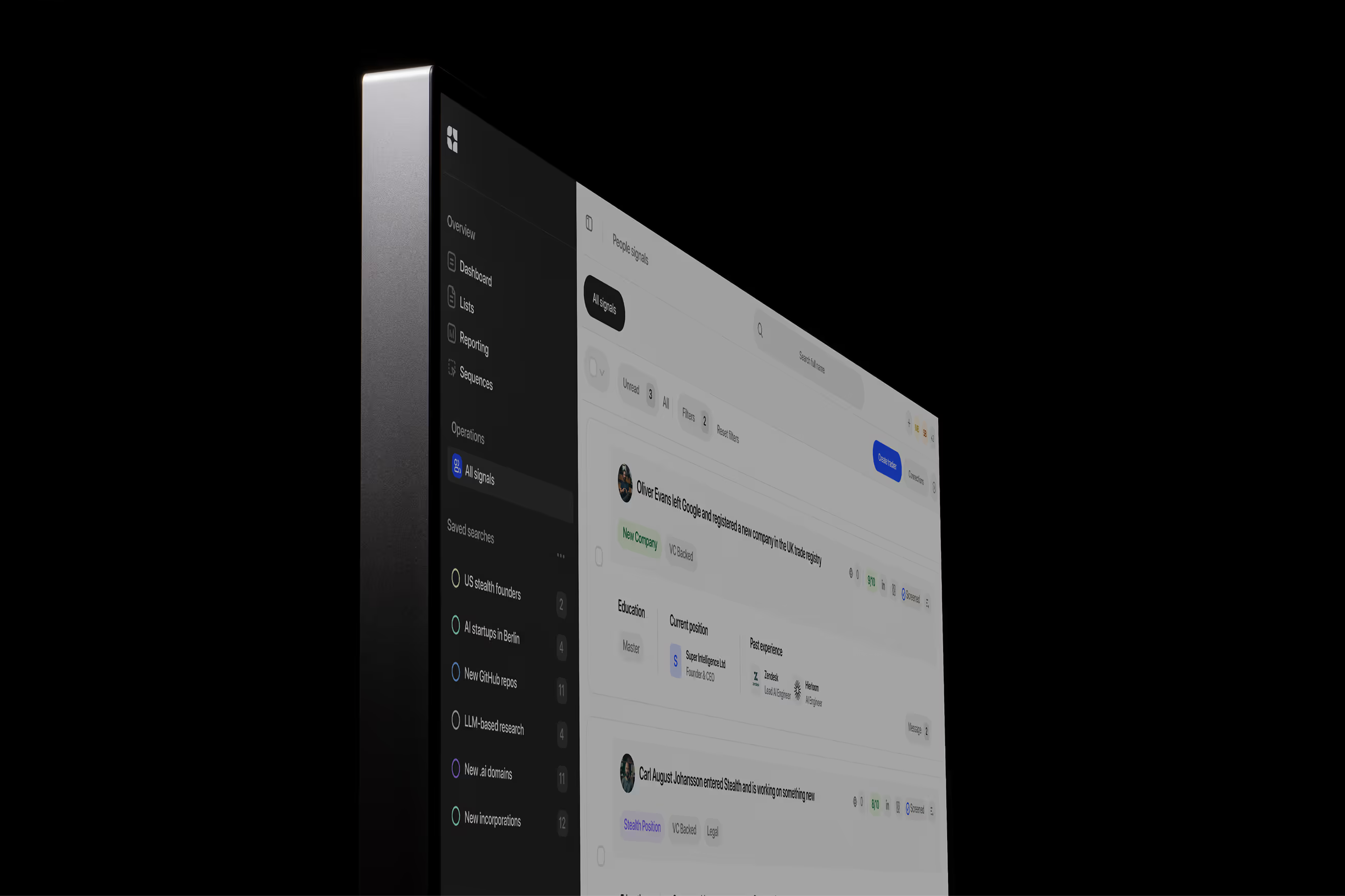
Evertrace supports this process by monitoring early founder and company signals across multiple sources. The platform provides the detection infrastructure; the fund’s thesis determines which signals deserve attention.
---
Related reading
The founder detection engine for VCs
AI-powered founder detection with unmatched coverage.
 Book a demo