


Corporate startup scouting is the process of finding external companies that could become investment targets, technology partners, suppliers, acquisition candidates, or participants in a pilot.
It resembles traditional VC sourcing, but the objective is different. A financial investor primarily asks whether a company can produce an attractive return. A corporate team must also determine whether the startup can create strategic value inside a particular organization.
That second question changes the scouting process.
Begin with a business problem
Weak scouting mandates begin with sectors:
- Find AI startups.
- Find climate companies.
- Find interesting logistics technology.
Strong mandates begin with a business requirement:
- Reduce energy use in a specific manufacturing process.
- Detect equipment failures earlier.
- Shorten the time required to inspect infrastructure.
- Automate a defined part of customer support.
- Improve traceability across a regulated supply chain.
A precise problem makes it possible to search, evaluate, and involve the right internal stakeholders.
Define the acceptable maturity range
The earliest company is not always the right company for a corporate pilot.
A corporate venture team should decide whether it wants:
- Research and technology before company formation
- Pre-seed startups suitable for investment
- Startups ready for technical validation
- Companies capable of running a pilot
- Commercial vendors prepared for procurement
- Mature targets for strategic acquisition
Different scouting platforms specialize in different parts of this timeline.
Build a scouting brief
A useful brief contains:
Strategic problem: What must improve?
Use case: Where will the technology be applied?
Technical requirements: What must the solution be able to do?
Constraints: Which security, compliance, integration, or geographic conditions apply?
Maturity: What evidence must already exist?
Engagement model: Investment, partnership, pilot, supplier agreement, or observation?
Decision owner: Who inside the corporation can move the opportunity forward?
Without an owner, even a strong scouting result becomes an unused presentation.
Search across multiple signal types
Established startup databases are useful for identifying companies with public profiles, financing, and customers.
Early-signal sources become more valuable when the corporation wants visibility into emerging technologies before a mature vendor market exists.
Relevant sources include:
- Research papers
- Patents
- Government and research grants
- University commercialization activity
- New company registrations
- Technical projects
- Product releases
- Hiring
- Domains
- Founder and social signals
This is especially important in deep technology, life sciences, advanced materials, energy, robotics, and industrial software.
Evaluate strategic and venture potential separately
A company can be strategically useful without being a strong venture investment. It can also be an excellent venture opportunity with little relevance to the corporation.
Score the two dimensions separately.
Strategic fit
- Does the company solve a recognized internal problem?
- Is the technology relevant to a strategic priority?
- Is there a credible internal user or sponsor?
- Could the relationship create learning or competitive advantage?
Venture potential
- Is the market large enough?
- Does the company have a defensible advantage?
- Is the team capable of building independently?
- Could the company grow beyond one corporate customer?
- Are the economics compatible with venture returns?
Do not force every useful startup into an investment process.
Assess readiness for engagement
Before proposing a pilot, examine:
- Product maturity
- Technical dependencies
- Security requirements
- Data access
- Implementation resources
- Procurement timeline
- Decision-making authority
- Success criteria
- Commercial terms
- Intellectual-property concerns
Many corporate-startup projects fail because the technology was interesting but the organization was not prepared to adopt it.
Protect the startup from internal complexity
A six-person company cannot attend twelve exploratory meetings with no defined outcome.
The corporate team should provide:
- One accountable sponsor
- A clear problem owner
- A short evaluation process
- Named technical stakeholders
- Defined pilot criteria
- A realistic procurement route
- A decision date
Good scouting is partly an internal coordination discipline.
Choose tools based on the mandate
A corporate scouting stack may include:
- Early-signal detection for emerging teams and technologies
- Startup databases for market mapping
- Research and patent databases
- A scouting or innovation-management platform
- CRM and relationship history
- Internal evaluation and pilot tracking
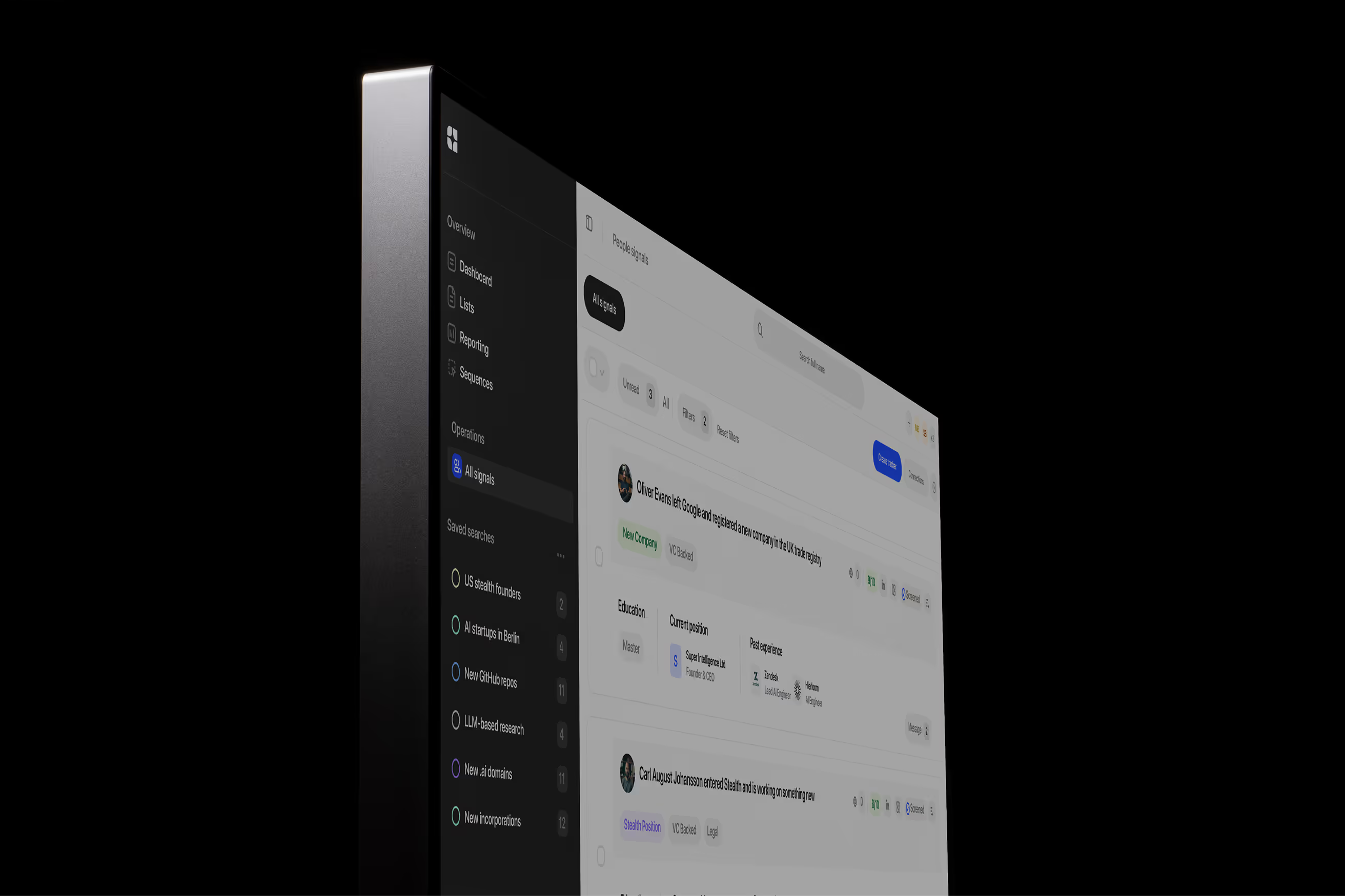
Evertrace is most relevant when the corporate team wants to discover founders, research teams, and newly forming companies before they are widely represented in conventional startup databases.
The earlier the signal, the less complete the company will be. That is not a flaw. It is the trade-off that creates time to build a relationship before the rest of the market arrives.
---
The founder detection engine for VCs
AI-powered founder detection with unmatched coverage.
 Book a demo