

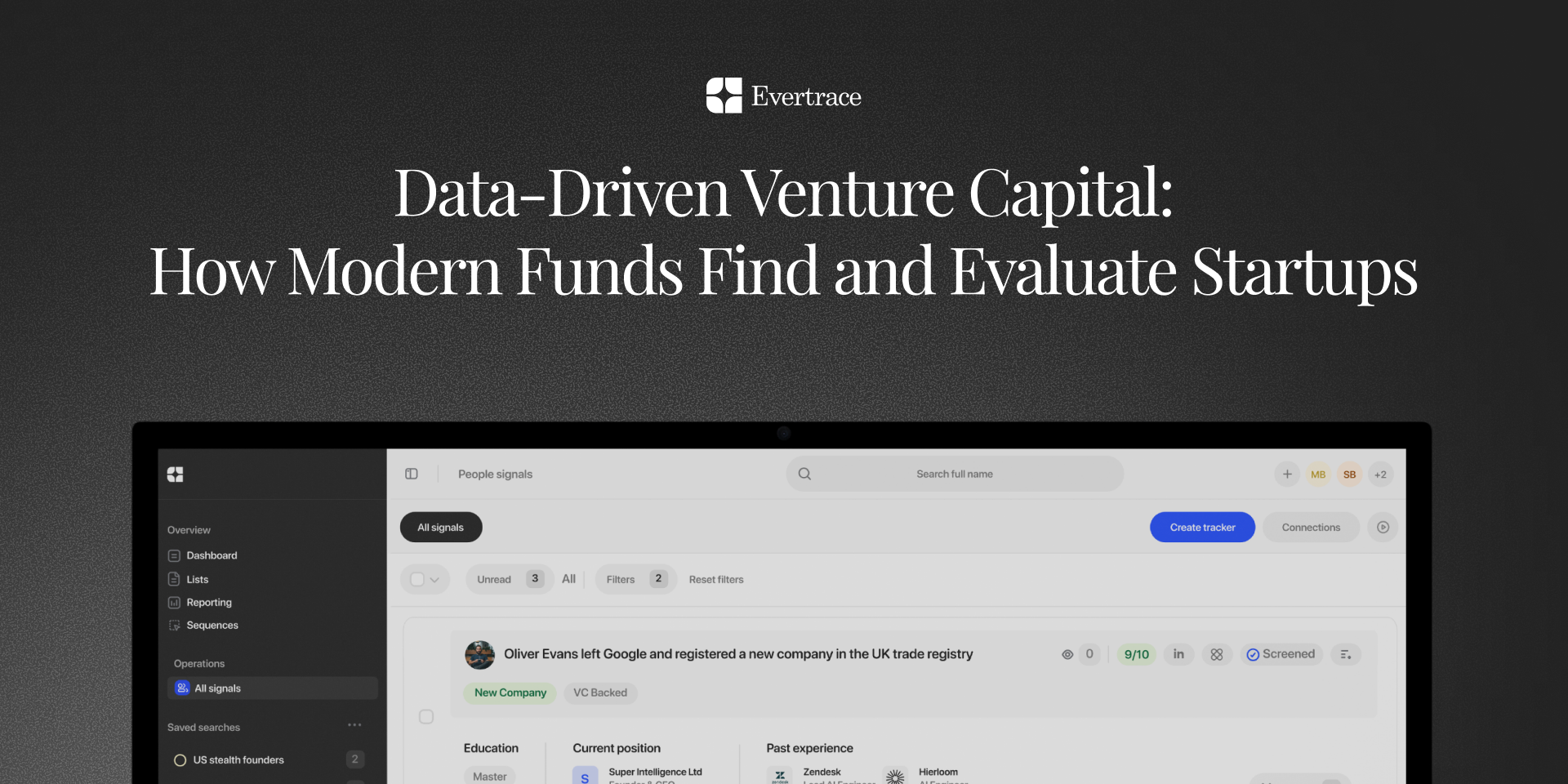
Data-driven venture capital is the use of structured information to improve how funds discover, evaluate, and support companies.
The term is sometimes used to imply that an algorithm can identify future winners. That is the least convincing version of the idea.
The practical value of data is simpler: it helps investors see more of the relevant market, notice changes earlier, make their reasoning explicit, and spend less time assembling basic information.
Where data creates the most value
Market coverage
An investor’s network reflects their history. It does not necessarily reflect the full population of founders working in a sector.
Data can expand coverage beyond familiar cities, universities, employers, and social circles. This matters most when a fund claims to search broadly but receives most opportunities through a narrow set of relationships.
Early detection
New companies leave traces before they announce themselves.
Company registrations, patents, grants, research, code activity, domains, product releases, hiring, co-founder searches, and social signals can indicate that a team is forming.
Monitoring these sources manually is possible at small scale. Monitoring them continuously across markets requires infrastructure.
Consistent screening
Structured information helps investment teams compare opportunities using the same basic questions.
This does not mean forcing every company into one formula. It means ensuring that geography, stage, founder background, market, evidence, and concerns are recorded consistently enough to support a real discussion.
Faster preparation
Investment teams spend considerable time gathering information before a first meeting.
Automated research can assemble:
- Founder history
- Company details
- Market context
- Related companies
- Technical work
- Prior financing
- Relevant signals
This gives the investor more time to form better questions.
What data cannot do reliably
Predict outlier success with certainty
Venture outcomes depend on product decisions, market timing, recruiting, financing, competition, and luck. Much of the information that matters does not exist when the first investment is made.
A score can prioritize attention. It should not be mistaken for a forecast.
Evaluate founder quality as a single number
Founder assessment is context-dependent. The right background for a drug-discovery company is different from the right background for consumer software.
Models trained on historical outcomes can also reward familiar patterns and overlook unconventional founders.
Replace conversations
Data can identify a founder and prepare an investor. It cannot reveal everything a thoughtful conversation can: intellectual honesty, speed of learning, motivation, judgment, or the dynamics between co-founders.
The four layers of a data-driven VC stack
1. Detection
Find new founders and companies through observable signals.
2. Enrichment
Add company, founder, market, technical, and financing context.
3. Relationship management
Track introductions, conversations, ownership, and history.
4. Analysis and workflow
Summarize information, prioritize work, document decisions, and move opportunities through the investment process.
Confusion arises when one platform is expected to perform all four jobs equally well.
How AI changes the workflow
AI is useful where the task involves processing large amounts of unstructured information.
It can:
- Summarize research and patents
- Classify companies against a thesis
- Draft initial research notes
- Identify missing information
- Compare an opportunity with known companies
- Prepare meeting questions
- Update structured records
- Help investors query a large signal dataset
The output still requires review. A polished summary can contain an incorrect inference just as easily as a clumsy one.
The right standard is not whether the text sounds confident. It is whether the underlying evidence can be inspected.
Build for auditability
A data-driven investment process should make decisions easier to examine.
For every opportunity, preserve:
- The source
- The underlying signal
- The date it appeared
- The thesis criteria it matched
- The reason it was prioritized
- The information used in evaluation
- The final outcome
This lets the team learn from false positives, missed companies, and inconsistent decisions.
Data should widen judgment, not narrow it
The strongest use of data in venture capital is not replacing investors. It is challenging the limits of what they happen to see.
A well-designed system expands the set of relevant founders, exposes the evidence behind each opportunity, and lets the investment team apply judgment earlier.
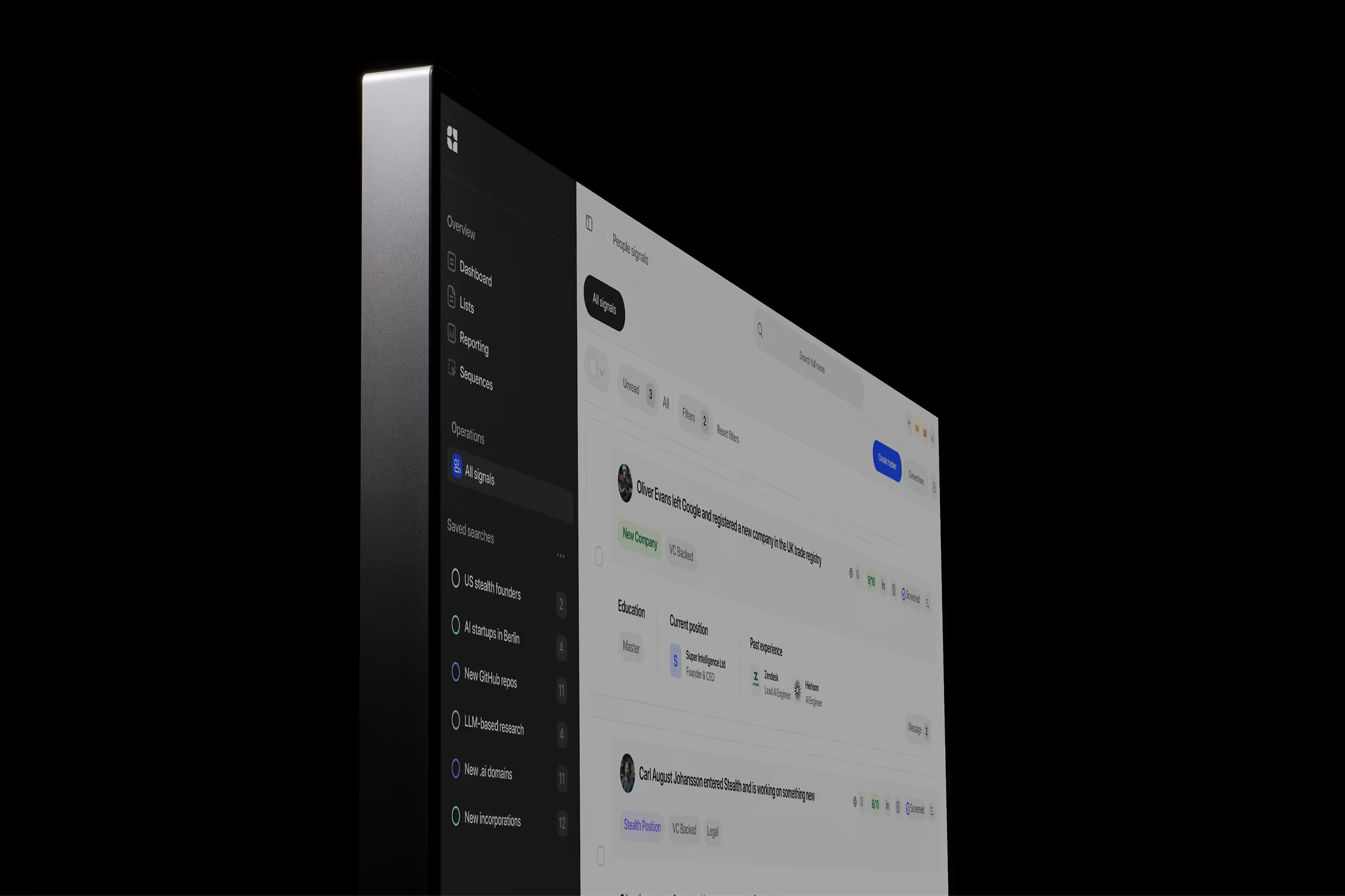
Evertrace focuses on the detection layer. It monitors early founder and company signals so investors can find relevant teams before those teams become obvious through funding announcements or established company databases.
---
The founder detection engine for VCs
AI-powered founder detection with unmatched coverage.
 Book a demo