

Trade Registries: A VC's Guide to Monitoring New Incorporations
Every week, thousands of new companies are incorporated around the world. Most are freelance entities, holding structures, or small local businesses. A small but significant number are the earliest legal expressions of what will become venture-backed technology companies.
For early-stage investors, the challenge is not access. Most trade registries are publicly available. The challenge is filtering, linking, and acting on the data in real time. This guide explains how trade registries work, what information they contain, which countries have the most useful data, and how investors are using them as a systematic sourcing signal.
What Is a Trade Registry?
A trade registry, also called a commercial registry or companies register, is a government-maintained database of legal business entities. When a new company is formed, its founders submit incorporation documents to the relevant national or regional registry. These documents typically include the company name, registered address, company type, founding date, and the names and roles of directors and shareholders. In most countries, this information becomes publicly accessible shortly after filing.
Key Trade Registries for VC Sourcing
United Kingdom: Companies House
Companies House is the UK's registrar of companies. New incorporations are publicly accessible within days of registration and include detailed director and shareholder information, making it one of the richest sources for founder identification globally.
Germany: Handelsregister
The Handelsregister is Germany's commercial register, maintained at the regional court level. Germany incorporates over 70,000 new companies per year, making it one of the largest sources of incorporation data in Europe.
Netherlands: Kamer van Koophandel (KVK)
The KVK maintains the Dutch Business Register. The Netherlands has a high density of technology startups relative to its size, making KVK data particularly valuable for investors focused on the Benelux ecosystem.
Nordic Registries
Sweden's Bolagsverket, Denmark's Erhvervsstyrelsen (VIRK), Norway's Brønnøysundregistrene, and Finland's PRH all maintain publicly accessible commercial registries. The Nordic startup ecosystem produces a disproportionate number of venture-backed companies relative to population size.
France: Registre National des Entreprises (RNE)
France's national enterprise register provides publicly accessible data on new company formations. France has the third largest startup ecosystem in Europe after the UK and Germany.
United States
Company registrations in the US are handled at the state level, with Delaware being the most common incorporation state for startups. State-level registries vary in accessibility and data richness.
The Filtering and Linking Challenge
At scale, trade registry monitoring produces enormous volume. The UK alone registers approximately 700,000 new companies per year. The overwhelming majority of these registrations are irrelevant to venture capital investors. Effective use of registry data requires three capabilities: real-time monitoring so data is ingested as it is published, identity linking to connect a registration record to a founder's professional background, and noise filtering to remove holding structures and non-commercial entities.
How Evertrace Monitors Trade Registries
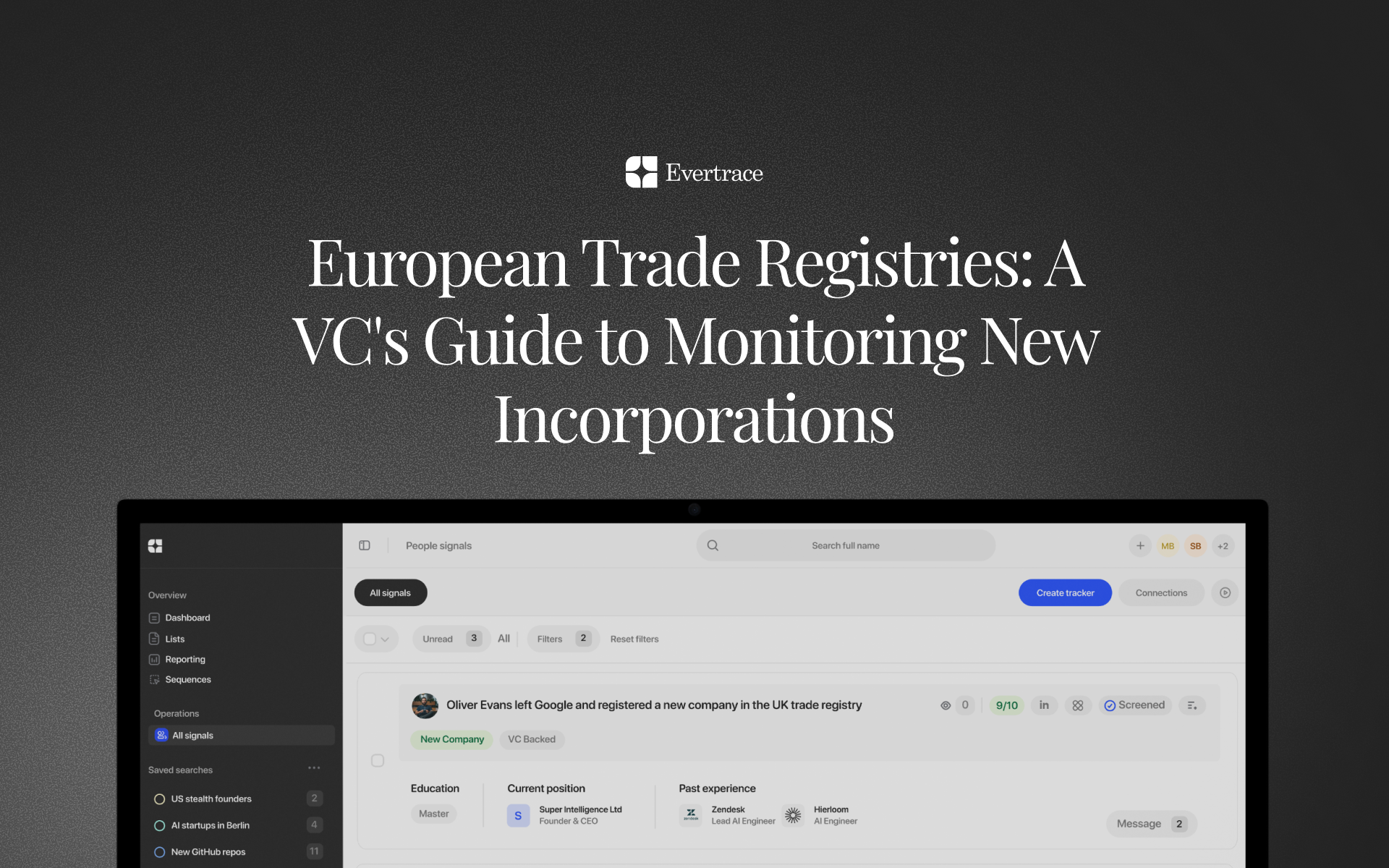
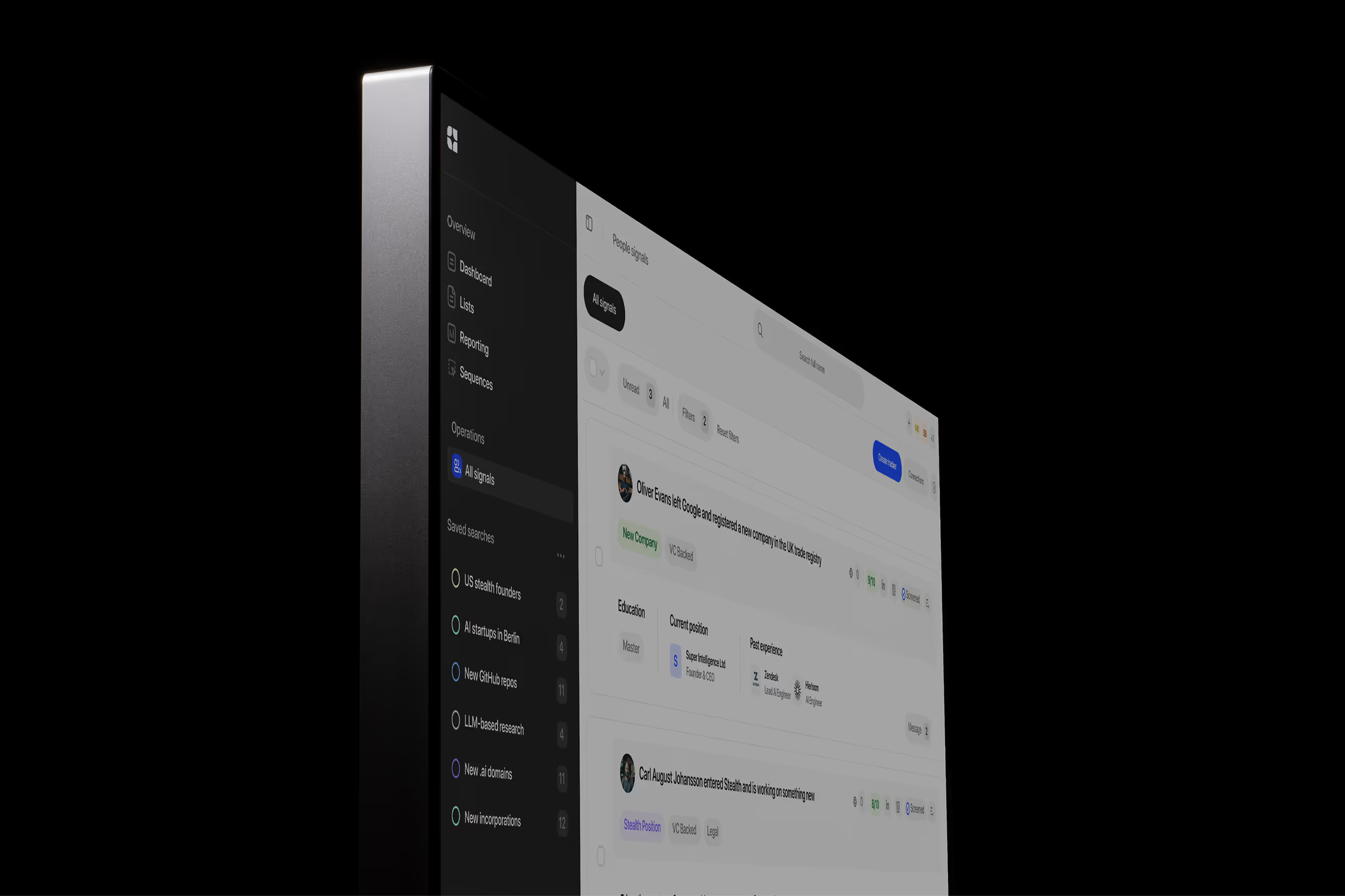
Evertrace monitors trade registries in real time across the UK, Germany, Netherlands, Denmark, Sweden, Norway, Finland, France, and many other markets globally. New registration data is automatically linked to individual founders through background enrichment, filtered to remove non-venture-relevant entities, and scored based on how closely founding profiles match the characteristics of venture-backed founders.
High-confidence signals are delivered into Affinity, Attio, Slack, or connected AI agents in real time. 175+ VC firms globally use Evertrace to find founders from trade registry data and other signal sources before their competitors do.
Book a demo to see Evertrace in action
Frequently Asked Questions
Are trade registries publicly accessible?
Most trade registries are publicly accessible, though ease of access, data richness, and update frequency vary significantly by country. Some registries offer free bulk data access, while others require paid API subscriptions or manual searching.
How quickly are new incorporations available in trade registries?
Update speed varies by country. The UK Companies House publishes new incorporations within hours to days of filing. Some registries take longer, with updates appearing weekly or in batches.
Can trade registry data alone identify good startup investments?
No. Trade registry data identifies new company formations, not investment-quality opportunities. Filtering and enrichment are required to separate relevant signals from noise.
Which country has the most useful trade registry data for VC sourcing?
The UK Companies House is widely considered the most accessible and data-rich, with detailed director and shareholder information available through a free API. Germany, Netherlands, and the Nordic countries also have high-quality, accessible registries.
How do investors link a registry filing to a founder's background?
Linking requires cross-referencing the name and address in a registry filing against external data sources such as professional profiles, academic records, and employment history. This enrichment step is the core value-add of a founder detection platform.
How many new companies are incorporated globally each year?
The number runs into the millions across all countries. The subset that are venture-backable technology startups is a small fraction of that total, making filtering and enrichment essential for practical use.
The founder detection engine for VCs
AI-powered founder detection with unmatched coverage.
 Book a demo