

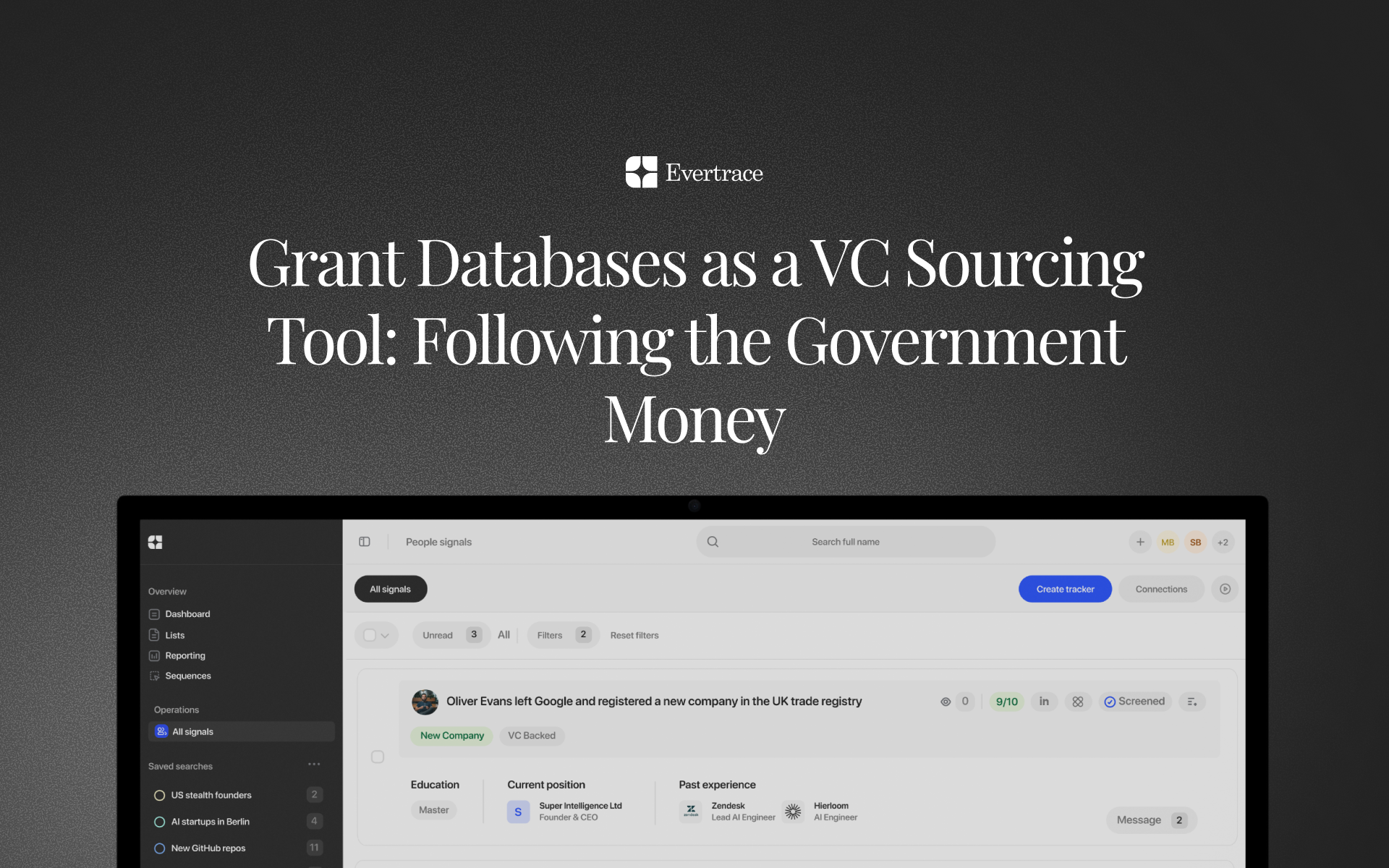
Grant Databases as a VC Sourcing Tool: Following the Government Money
Government grants are one of the most underused signals in early-stage venture capital. When a researcher, engineer, or domain expert receives a competitive government grant to develop a commercially relevant technology, they have done something significant: they have convinced a panel of experts that their idea is worth funding with public money. For investors who monitor these awards systematically, that judgment provides a valuable early filter, often appearing one to three years before any company formation event.
Why Government Grants Are a Sourcing Signal
The connection between government grant funding and eventual startup formation is well-established. Research programs at SBIR, Innovate UK, Horizon Europe, the European Research Council, national research councils, and equivalent bodies globally are specifically designed to fund early-stage commercial innovation. Recipients of these grants are, by definition, working on problems with potential commercial applications.
The timing advantage is significant. A researcher who receives a grant to develop a novel battery chemistry or a new approach to protein folding may not form a company for another twelve to twenty-four months. An investor who begins monitoring grant databases systematically will identify these individuals at the research phase, well before any company exists, and well before any other sourcing channel would surface them.
The quality filter is also meaningful. Competitive grant programs, especially those that require demonstrated technical merit and commercial potential, involve expert review. The grant award is not a guarantee of commercial success, but it is a meaningful signal that at least one panel of informed evaluators found the work compelling.
Key Grant Databases for VC Sourcing
SBIR and STTR (United States)
The Small Business Innovation Research and Small Business Technology Transfer programs are among the largest sources of pre-commercial innovation funding globally. SBIR grants are awarded to small businesses developing technologies with commercial potential across virtually every sector. The SBIR.gov database is publicly searchable and updated regularly, allowing investors to filter by technology area, agency, award year, and recipient.
Innovate UK
Innovate UK is the UK's national innovation agency, funding business-led innovation projects across sectors including advanced manufacturing, health technology, clean energy, and digital technologies. Innovate UK maintains a publicly searchable database of funded projects with recipient names, project descriptions, and award amounts.
Horizon Europe
Horizon Europe is the European Union's primary research and innovation funding programme, with a budget exceeding 95 billion euros for the period 2021 to 2027. The CORDIS database provides publicly accessible records of all Horizon-funded projects, including principal investigators, research institutions, project descriptions, and funding amounts. European Research Council grants, which fund individual researchers at early career and established researcher stages, are particularly relevant for identifying individuals who may transition from academic to commercial roles.
National Research Councils
Each major European country maintains a national research council. The Research Council of Norway, the Swedish Research Council, the Danish Independent Research Fund, the Finnish Research Foundation, and equivalents in Germany, France, and the Netherlands all maintain searchable databases. For investors focused on specific markets, these national databases provide the most granular coverage of local research talent.
Defense and Dual-Use Programs
DARPA in the United States and equivalent programs in other countries fund research at the frontier of what is technically possible. DARPA award recipients are disproportionately represented among founders of deep tech companies in defense, AI, biotechnology, and advanced materials.
Climate and Energy-Specific Programs
The US Department of Energy's ARPA-E program, the UK's Faraday Battery Challenge, the EU's EIC Accelerator, and national climate technology programs in multiple countries all provide searchable award databases specifically relevant for climate tech investors.
How to Read a Grant Signal
Not all grant awards are equally useful as sourcing signals. The identity of the recipient matters most: a grant awarded to an individual researcher rather than a large institution is a significantly stronger signal. The commercial framing of the project description matters: programs that require market analysis or business plan components, such as SBIR and Innovate UK, produce award descriptions that explicitly reveal commercial intent. The stage of the grant matters: SBIR Phase II recipients in particular are strong candidates for venture outreach, because they have demonstrated both technical merit and sustained commitment to commercialisation. The recipient's background adds critical context: prior commercial experience, patent filing history, or prior employment in relevant roles strengthens the signal significantly.
Building Grant Monitoring Into a Sourcing Process
Effective grant database monitoring requires a combination of automated data collection and human-led enrichment. Automated monitoring involves setting up regular queries or data feeds from the grant databases most relevant to your investment thesis. Enrichment is the step that transforms a grant award record into an actionable lead: a grant recipient's name and institution need to be cross-referenced against professional background data, existing publications, and patent filing history. The monitoring cadence depends on the database; setting up database alerts or scheduled query runs ensures new awards are captured promptly.
How Evertrace Incorporates Grant Signals
Evertrace monitors research grant awards from major funding bodies globally as part of its multi-signal founder detection system. Grant signals are combined with trade registry filings, GitHub activity, patent filings, domain registrations, and other signal types to surface research-driven founders before any company announcement.
175+ VC firms globally use Evertrace to find research-driven and deep tech founders at the pre-formation stage.
Book a demo to see Evertrace in action
Frequently Asked Questions
Why are government grants a useful VC sourcing signal?
Government grants identify researchers and engineers working on commercially relevant technologies, often one to three years before any company formation. The competitive selection process provides a quality filter, and many grant programs explicitly require commercial potential as part of the application criteria.
Which grant database is most useful for early-stage VC sourcing?
SBIR is the most comprehensive and accessible for US-focused investors. Innovate UK is most useful for UK-focused investors. CORDIS covers the full Horizon Europe portfolio for pan-European investors.
How early do grant signals appear relative to company formation?
The gap typically ranges from six months to three years, depending on the sector and grant stage. Deep tech and life sciences grants are at the longer end.
What sectors benefit most from grant-based sourcing?
Deep tech, biotechnology, advanced materials, climate and clean energy, defense and dual-use technologies, and health technology are the sectors where grant funding is most prevalent and where the grant-to-startup pipeline is most active.
The founder detection engine for VCs
AI-powered founder detection with unmatched coverage.
 Book a demo