

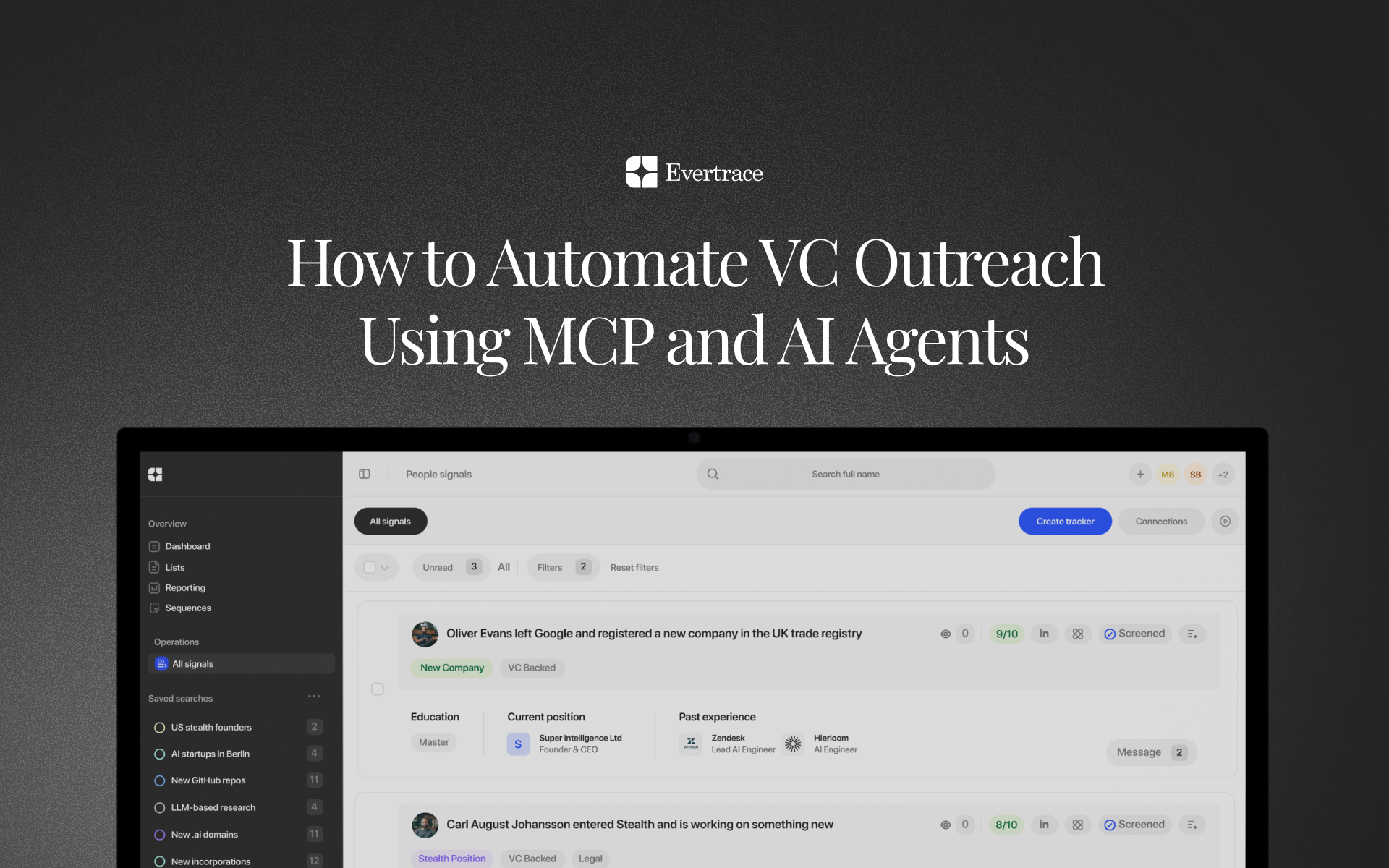
How to Automate VC Outreach Using MCP and AI Agents
The way early-stage investors reach founders is changing faster than most funds have adapted. Manual outreach, one message at a time, drafted from scratch for each new signal, is being replaced by a new workflow layer that uses AI agents connected to live data sources. The result is not impersonal automation but personalised, contextual outreach at a speed and scale that manual processes cannot match.
Model Context Protocol, known as MCP, is the infrastructure that makes this possible. This guide explains what MCP is, how it connects AI agents to VC sourcing data, what an automated outreach workflow actually looks like in practice, and how to build one without sacrificing the relationship quality that early-stage investing depends on.
What MCP Is and Why It Matters for VCs
MCP is an open standard, developed by Anthropic, that defines how AI assistants connect to external tools and data sources. Before MCP, an AI assistant could only work with information you manually copied into a conversation. With MCP, an AI agent can directly query live databases, read CRM records, pull founder profiles, and take actions like drafting and logging outreach, all within a single conversation interface.
For VC investors, this matters because the sourcing workflow spans multiple tools that previously required manual switching. A new founder signal appears in a detection platform. An analyst opens the signal, researches the founder in a separate tab, opens the CRM to check if there is existing context, drafts a message in email or another tool, sends it, and then logs the activity back in the CRM. Each handoff is a point of friction and a source of delay.
MCP collapses this workflow. An AI agent connected to a founder detection platform, a CRM, and an email tool can do all of this in a single natural language interaction. The analyst reviews and approves at each step. The AI does the research, drafting, and logging.
What a Full MCP-Enabled Outreach Workflow Looks Like
A practical MCP-enabled VC outreach workflow has five stages, most of which can be handled by the AI with human review at critical points.
Signal ingestion is automatic. A founder detection platform like Evertrace continuously monitors trade registries, GitHub, patent databases, domain registrations, and social platforms and surfaces new signals as they appear.
Signal review is the first human step. The investment analyst reviews the scored and filtered signal queue, typically in a morning session. High-scoring signals in the fund's target sectors and geographies get approved for outreach.
Background enrichment happens automatically when a signal is approved. The AI agent queries available data sources to build a profile of the founding individual: prior employment, education, previous companies, relevant technical background, and any existing relationship context from the CRM. This step, which would take fifteen to thirty minutes manually, takes seconds.
Outreach drafting is AI-generated and human-approved. The AI agent uses the enriched founder profile, the fund's investment thesis, and a style template to produce a personalised first-contact message. The analyst reads it, makes edits if needed, and approves. The message references something specific about the founder's background and asks a genuine question about their work.
CRM logging happens automatically after send. The founder is added to the CRM with all relevant enrichment data, the outreach message is attached, and a follow-up reminder is set based on the fund's relationship management cadence.
What Makes Automated Outreach Not Feel Automated
Specificity of enrichment drives quality of drafting. An AI agent that knows a founder spent five years at a specific company in a specific role, published research in a specific area, and recently registered a domain with a name suggesting a product in that space, will produce a fundamentally different message than one working from a name and job title alone.
Human review of the draft is non-negotiable. The analyst reads every message before it is sent. This is the step where generic phrases get replaced with genuine observations, where a line about the founder's prior work is adjusted to reflect actual knowledge, and where the tone is checked to match the fund's voice. The AI writes the first draft. The human makes it good.
Honest sourcing attribution builds trust. A message that says "I noticed you recently incorporated and your background in X caught my attention" is more effective than one that obscures how the investor found them. Acknowledging this honestly is not intrusive; it is credible.
The Technical Setup
MCP integration requires connecting an AI assistant that supports MCP, such as Claude, to the data sources relevant to your workflow. Your founder detection platform needs to expose an MCP server. Evertrace supports this natively, allowing AI agents to query founder signals, retrieve enriched profiles, and filter by geography, sector, and signal type through a natural language interface. Your CRM needs to be queryable. Both Affinity and Attio have integration capabilities that allow AI agents to check existing records, add new contacts, and log interactions. For funds already using compatible tools, the workflow can be operational in days.
What Automation Does Not Replace
Automated outreach is a first-contact infrastructure tool. Everything that happens after the first message is sent remains a human activity. The follow-up conversation, the relationship development over months, the judgment call about whether a founder is the right person to back at this stage, none of this is automated. The funds that get the most value from MCP-enabled outreach are those that use the time saved in the triage and drafting stages to invest more deeply in the relationships that result.
How Evertrace Enables MCP Workflows
Evertrace exposes a native MCP server that allows AI agents to query real-time founding signals, retrieve enriched founder profiles, filter by geography, sector, and signal type, and trigger outreach workflows directly from a natural language interface. New signals flow into Affinity, Attio, Slack, and AI agents simultaneously, enabling the unified workflow described in this guide.
175+ VC firms globally use Evertrace as the signal detection layer in their automated sourcing workflows.
Book a demo to see Evertrace in action
Frequently Asked Questions
What is MCP and how does it apply to VC outreach?
MCP (Model Context Protocol) is an open standard that allows AI assistants to connect to external data sources and tools. In VC outreach, it enables AI agents to query founder detection platforms, CRM records, and email tools in a unified workflow, reducing the time from signal detection to personalised outreach from hours to minutes.
Does automated outreach produce worse results than manual outreach?
Not if the enrichment is specific and the human review step is maintained. Automated drafting from rich founder profiles, reviewed and edited by a human before sending, produces messages that are as personal and contextual as manual outreach, at a fraction of the time cost.
Which AI assistants support MCP?
Claude, developed by Anthropic, has native MCP support and is the most widely used AI assistant for MCP-enabled VC workflows. Other assistants are adding MCP support as the standard matures.
How long does it take to set up an MCP-enabled outreach workflow?
For funds already using Evertrace, Affinity or Attio, and Claude, the core workflow can be operational within days. The main setup time is configuring the MCP server connections and defining the outreach templates and style guidelines for the AI drafting step.
What happens after the first AI-drafted message is sent?
All subsequent interactions are human-led. The automated workflow handles first contact and CRM logging. Relationship development, follow-up conversations, and investment evaluation are done by the investment team.
The founder detection engine for VCs
AI-powered founder detection with unmatched coverage.
 Book a demo