

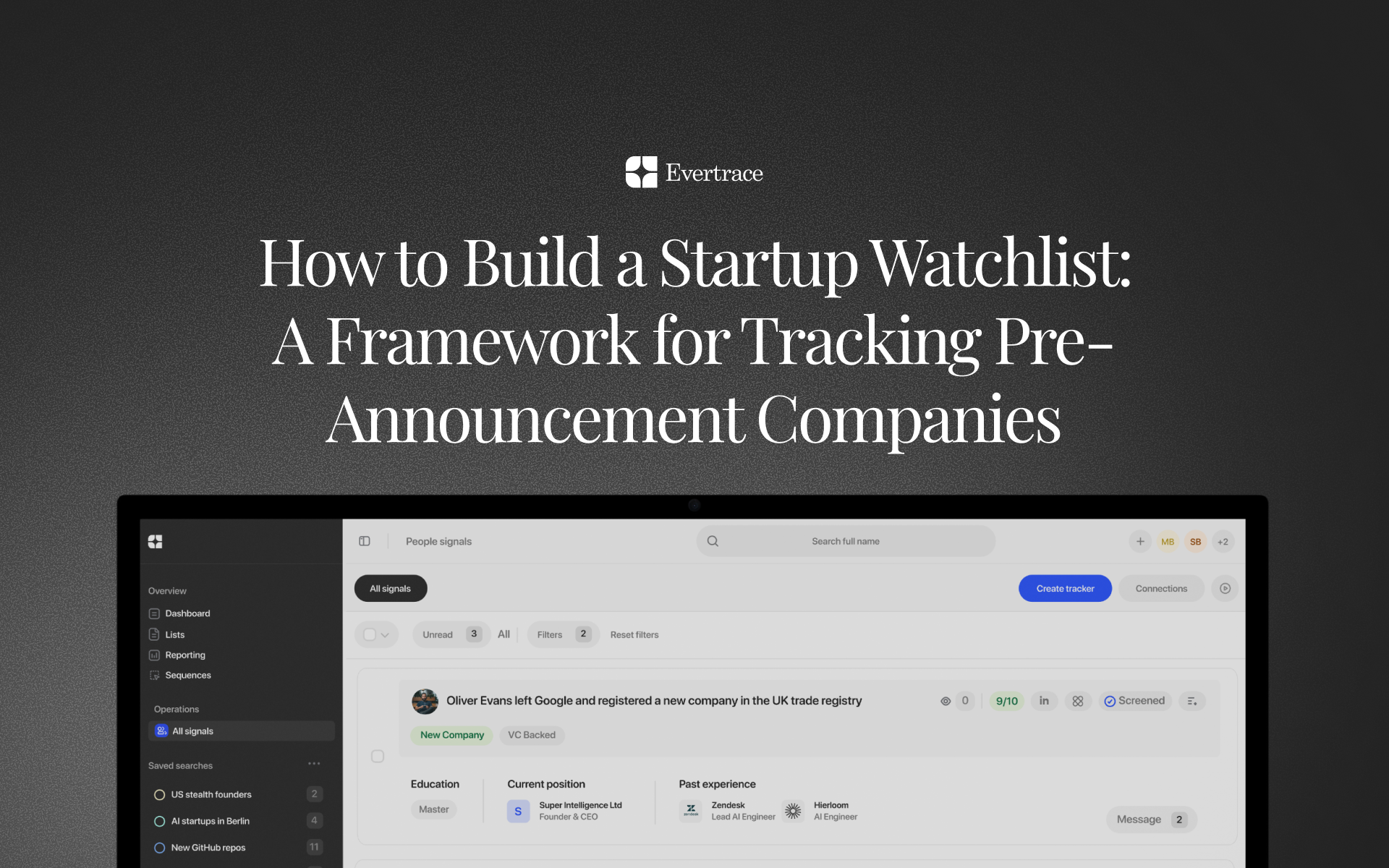
How to Build a Startup Watchlist: A Framework for Tracking Pre-Announcement Companies
A startup watchlist is a structured, actively maintained list of companies and individuals that an investor is monitoring before they become publicly visible investment opportunities. Unlike a deal pipeline, which tracks companies that are actively being evaluated for investment, a watchlist tracks entities that are interesting but not yet ready for investment, capturing them at the earliest observable stage and maintaining awareness of their development over time. The funds that systematise this practice have a compounding sourcing advantage that informal approaches cannot replicate.
What a Watchlist Is For
The watchlist solves a specific problem: the gap between first detection of an interesting person or company and the moment when investment is appropriate. For a pre-seed fund using signal-based detection, this gap is often six months to a year or more. Without a watchlist, the most common failure mode occurs: a company that was detected early is forgotten, rediscovered later when it is in a competitive process, and invested in at worse terms than would have been available if the relationship had been maintained from detection.
The Types of Entries on an Effective Watchlist
Pre-formation individuals are people who have not yet started a company but whose background and professional transition signals suggest they are likely to do so. Early-formation companies are those that have taken one or more founding steps but have not yet raised external funding or made any public announcement. Stealth-stage companies are those known to exist but deliberately maintaining limited public visibility. Research-stage opportunities are academic or industrial research projects with commercial potential that have not yet transitioned into company formation.
How to Structure a Watchlist
The most effective watchlists are integrated into the fund's primary CRM rather than maintained as separate spreadsheets or documents. Each entry should capture: the individual or company name, the signal that triggered the entry, the date of entry, the next review date, the assigned owner within the fund, background enrichment data, and a notes field for ongoing observations. The next review date is the most operationally important field: without it, watchlist entries age without review and become stale records. Review triggers should also be set up for automatic updating when a watchlisted individual or company produces a new observable signal.
The Follow-Up Framework
For pre-formation individuals and early-formation companies, a light-touch approach works best: a brief, relevant message every four to eight weeks, timed around something specific and useful, maintains presence without creating the impression of pressure. The intensity should increase as the founder moves toward fundraising readiness.
How Evertrace Supports Watchlist Management
Evertrace provides the signal layer that feeds and updates startup watchlists in real time globally. When a watchlisted individual or company produces a new observable signal across trade registries, GitHub, patent databases, or other monitored sources, that signal is automatically surfaced in the relevant CRM record. New potential watchlist entries are continuously generated from Evertrace's founding signal detection and can be added directly into Affinity, Attio, or connected AI agents via MCP.
Book a demo to see Evertrace in action
Frequently Asked Questions
What is a startup watchlist in venture capital?
A startup watchlist is a structured, actively maintained list of companies and individuals that an investor is monitoring before they become active investment opportunities. It bridges the gap between first detection and investment readiness, ensuring that early-detected opportunities are not lost during the development period.
How is a watchlist different from a deal pipeline?
A deal pipeline tracks companies being actively evaluated for investment. A watchlist tracks entities that are interesting but not yet investment-ready, typically because they are too early-stage, not yet formed, or still in a development phase before any fundraising is appropriate.
How often should watchlist entries be reviewed?
Review cadence should reflect the entry type. Pre-formation individuals might be reviewed quarterly. Early-formation companies monthly. Entries that produce new observable signals should trigger an immediate review regardless of scheduled cadence.
How large should a startup watchlist be?
The right size is the maximum number of entries the team can meaningfully review and engage with on an ongoing basis. For most early-stage funds, this is between fifty and two hundred active entries at any given time.
The founder detection engine for VCs
AI-powered founder detection with unmatched coverage.
 Book a demo