

How to Build a VC Thesis Around Early Detection
Most VC theses are built around what to invest in. The best early-stage theses are also built around when and how to find it. A fund that has defined clear investment criteria but relies on the same sourcing channels as every other fund will consistently find itself competing for the same deals. Building a thesis around early detection means making systematic founder discovery a central part of the fund's competitive strategy, not an operational afterthought.
What an Early Detection Thesis Actually Means
An early detection thesis has a specific claim at its core: the fund's ability to find founders before competitors generates a systematic return advantage. Many funds claim early detection as a competitive advantage without having a repeatable mechanism behind it. They rely on partner networks, conference relationships, and referrals, and describe this as being early. These are reactive sourcing channels that consistently produce shared deal flow. A genuine early detection thesis requires a defined mechanism that is not dependent on the founder initiating contact.
The Four Components of an Early Detection Thesis
1. Geographic and sector focus
Early detection at scale requires focus. A fund that tries to find all interesting founders in all sectors globally will be overwhelmed by volume. A fund that focuses on deep tech spinouts from specific universities, or B2B software companies founded by engineers in a particular region, can build signal monitoring infrastructure that is genuinely comprehensive for its defined scope.
2. Signal monitoring infrastructure
The operational heart of an early detection thesis is real-time monitoring of the data sources where founder activity leaves observable traces before any announcement: commercial registry filings, code repository activity, patent databases, domain registration data, academic research and grant awards, and social signals. Building this in-house requires significant data engineering investment. Most funds subscribe to platforms that have already built it.
3. Relationship development capacity
Early detection creates opportunities but does not close them. The gap between detecting a founder at the formation stage and making an investment is often six months to two years. Funds that detect founders early but have no relationship development process end up in the same position as funds that arrive during a process: they are one of many options, evaluated on terms and brand rather than on relationship and trust.
4. Thesis credibility in the target market
Early detection works most effectively when the founder, upon hearing from the fund, recognises it as relevant to their space. Thesis credibility is built through published writing, conference participation, and the track record of portfolio companies in the relevant sector.
What Differentiates Execution
The difference between funds that genuinely execute an early detection thesis and those that describe one is primarily operational. Execution requires consistency: reviewing signal feeds and following up every week, not when bandwidth permits. It requires patience: early detection relationships typically take twelve to twenty-four months to convert to investments. And it requires team alignment: early detection is not the job of one partner.
How Evertrace Supports an Early Detection Thesis
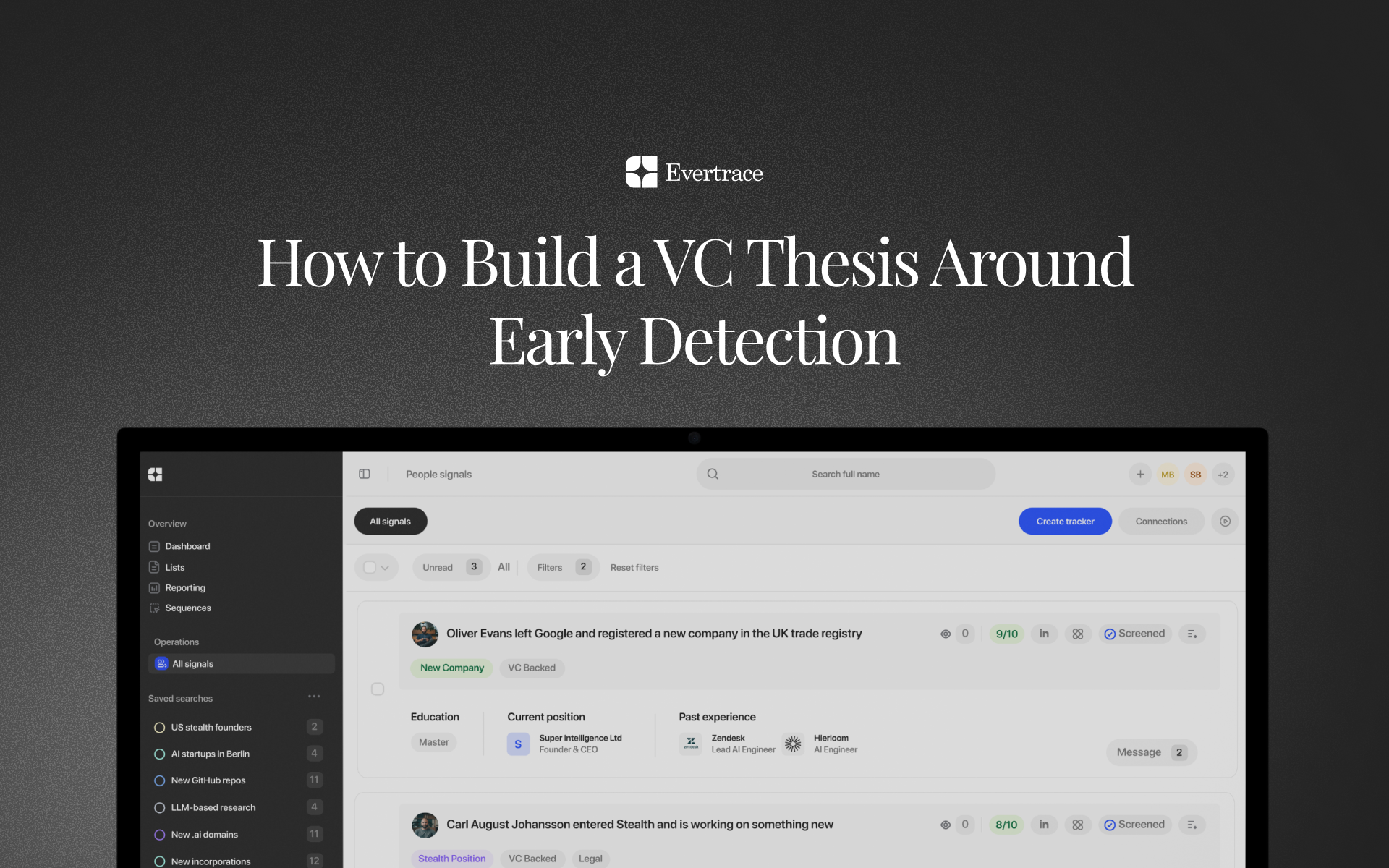
Evertrace provides the signal monitoring infrastructure that makes an early detection thesis operationally executable. Real-time coverage of trade registries, GitHub activity, patent filings, academic research, domain registrations, app stores, and social platforms globally delivers a scored, filtered signal feed to investment teams across Affinity, Attio, Slack, or connected AI agents via MCP.
175+ VC firms globally have built their early detection thesis on Evertrace's signal infrastructure.
Book a demo to see Evertrace in action
Frequently Asked Questions
What does it mean to build a VC thesis around early detection?
It means making systematic, pre-announcement founder discovery a central element of the fund's competitive strategy, with a defined, repeatable mechanism for reaching founders before they are raising and before any competitive process exists.
What is the difference between early detection and being first to a process?
Being first to a process means arriving at the start of a competitive fundraising round. Early detection means reaching a founder before they have decided to raise, often months before any other investor is aware of the company.
How long does it take for an early detection thesis to show results?
The relationships built through early detection typically convert to investments twelve to twenty-four months after first contact. The compounding effect is typically visible in fund performance after two to three years.
The founder detection engine for VCs
AI-powered founder detection with unmatched coverage.
 Book a demo