

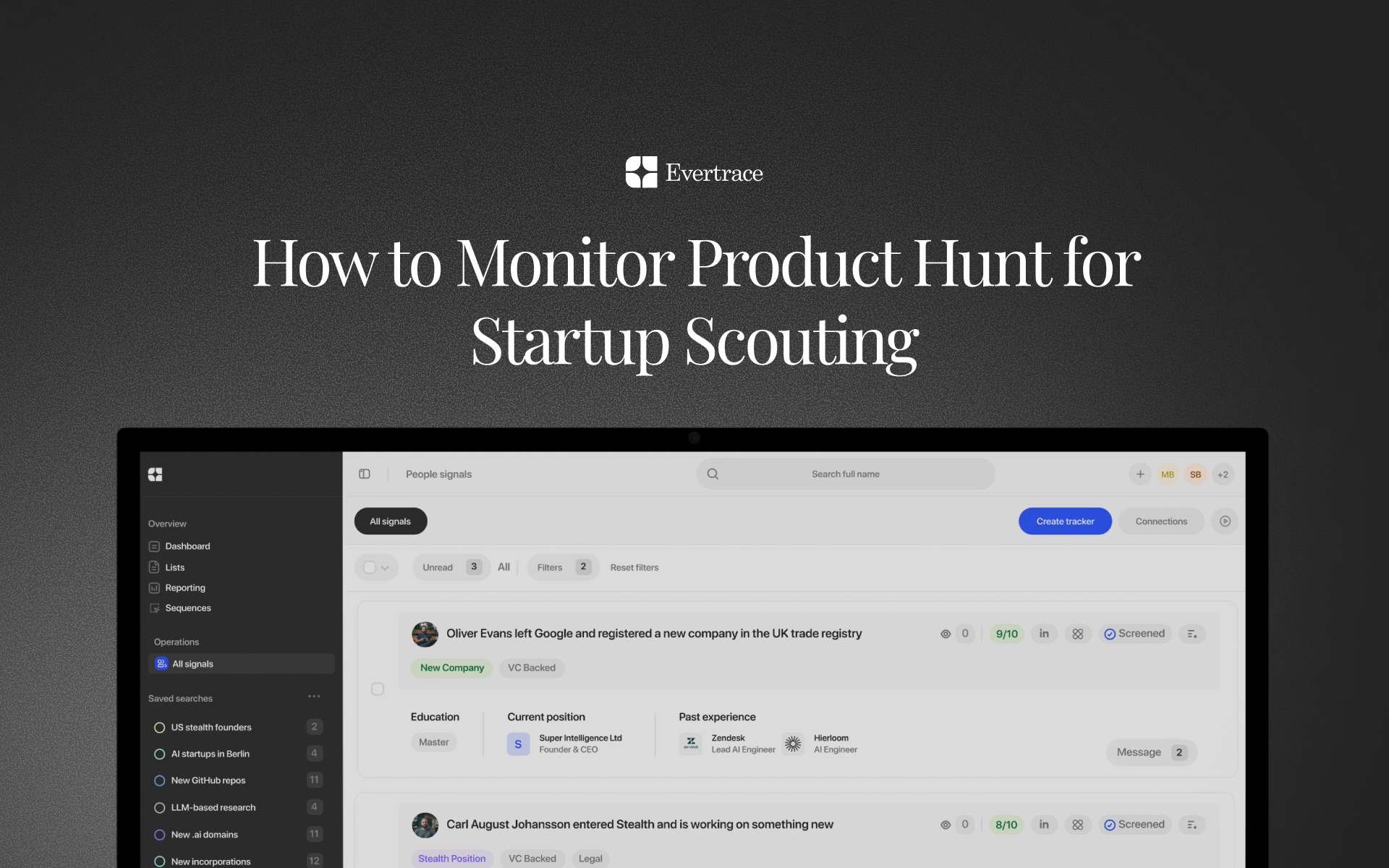
How to Monitor Product Hunt for Startup Scouting
Product Hunt is one of the most consistently useful public signals available for early-stage investors. Every day, new products are launched by founders who are, by definition, building something and putting it in front of the world for the first time. The question is not whether Product Hunt is worth monitoring, but how to do it systematically enough to extract genuine sourcing value rather than just browsing interesting launches.
This guide explains what Product Hunt reveals about early-stage companies, how to interpret the signals it generates, what its limitations are, and how to build a monitoring approach that produces actionable leads rather than interesting reading.
What Product Hunt Actually Reveals
A Product Hunt launch is a deliberate act of public visibility. A founder who lists a product on Product Hunt has made a decision to announce their existence to a specific, engaged community of early adopters, operators, and investors. This is meaningfully different from a company registration or a domain purchase, which are passive traces of founding activity. A Product Hunt launch is an active signal of intent.
What the launch tells you varies significantly based on what you are looking at. The product listing reveals the problem being addressed, the approach being taken, and the positioning the founder has chosen. The founder's profile reveals their background, any prior products, and the degree to which they have prior Product Hunt history. The launch metrics, upvotes, comments, and the quality of the commentary, reveal early market reception. All of these are observable, and all of them are meaningful.
The Timing Advantage
The most important thing to understand about Product Hunt as a sourcing signal is its timing. A launch on Product Hunt typically precedes any press coverage, any institutional funding announcement, and in many cases any accelerator application. For investors who care about reaching founders before competitive processes begin, Product Hunt launches represent a window of genuine opportunity.
The window is short. A successful Product Hunt launch generates immediate attention. Investors who are monitoring consistently and acting quickly can reach founders within days of their first public visibility. Those who check monthly or reactively are arriving well after the moment of first-mover advantage has passed.
How to Monitor Product Hunt Systematically
There are several practical approaches to monitoring Product Hunt, ranging from manual and time-consuming to automated and scalable.
The simplest approach is using Product Hunt's own notification infrastructure. Setting up a Product Hunt account and following specific topics, makers, and categories generates email notifications for new launches in areas you care about. This works reasonably well for high-level monitoring but produces high volume and requires significant triage.
Product Hunt has an API that allows programmatic access to launch data. Investors with engineering resources can build simple scripts that pull new launches in defined topic categories, filter by launch date and upvote count, and surface relevant founders for further research. The API is well-documented and the barrier to using it is relatively low for anyone comfortable with basic API calls.
Product Hunt's weekly and daily digests provide a curated view of top launches without requiring active monitoring. These are useful for catching breakout launches but miss the long tail of launches from less prominent founders who may nonetheless be building interesting things.
Third-party tools that aggregate and filter Product Hunt data exist and are increasingly common in the VC toolbox. These range from simple newsletter digests to more sophisticated platforms that score launches against investment thesis criteria.
What to Look For in a Launch
Not every Product Hunt launch warrants follow-up. The filtering criteria that matter most depend on your investment thesis, but several patterns consistently indicate higher-value opportunities.
The founder's background matters. A launch from someone who previously worked at a relevant company in the sector they are building in, who has domain expertise in the problem they are solving, is a meaningfully stronger signal than an anonymous launch with no visible founding team.
The problem framing matters. Launches that describe a specific, well-articulated problem with a clear sense of who the customer is are more interesting than those framing a generic solution. A founder who can describe exactly who has the problem and why existing solutions fail demonstrates a level of customer insight that is a positive signal for investment potential.
The comment quality matters. The discussion on a Product Hunt launch often reveals whether the product is resonating with the specific audience it is targeting. Genuine questions from potential users, detailed feedback from domain experts, and strong signals of intent to use the product are all more informative than generic encouragement.
The launch timing matters. A Product Hunt launch shortly after a company incorporation, domain registration, or GitHub repository creation is a stronger combined signal than a standalone launch with no other observable founding activity.
What Product Hunt Does Not Tell You
Product Hunt is a consumer-facing distribution platform. Its population of active users skews toward technology enthusiasts, designers, and developers. This makes it a strong signal source for consumer applications, developer tools, and productivity software. It is a weaker signal source for deep tech, enterprise software sold to large organisations, climate technology, and other sectors where the target customer is not typically active on Product Hunt.
Product Hunt also does not surface stealth founders. By definition, a founder building in stealth is not launching on Product Hunt. For companies in pre-announcement mode, trade registry filings, GitHub activity, and patent filings are more relevant signal sources.
And Product Hunt launches are public. Every investor who is paying attention sees the same launches at the same time. The window for first-mover advantage is real but short, and it narrows quickly once a product starts accumulating upvotes and social sharing.
Building Product Hunt Monitoring Into a Sourcing Process
The most effective use of Product Hunt in a sourcing process treats it as one layer in a multi-source signal approach rather than a standalone sourcing channel. A practical implementation might involve daily monitoring of Product Hunt launches in defined topic categories, automated filtering based on founder background and product framing, and a triage process that moves the most relevant launches into a CRM for follow-up. The goal is same-day or next-day outreach to the most interesting founders, before broader investor attention generates competitive dynamics.
Product Hunt monitoring works best when it is integrated with other signal sources. A founder who launches on Product Hunt, whose company was recently incorporated, and who has been active on GitHub in the preceding weeks is a much higher-confidence signal than a Product Hunt launch alone.
Frequently Asked Questions
Is Product Hunt a reliable sourcing channel for early-stage investors?
Product Hunt is a useful one of several sourcing channels rather than a standalone solution. It is particularly valuable for consumer applications, developer tools, and productivity software. Its limitation is that it only surfaces founders who have chosen to announce publicly, missing the significant population building in stealth.
How quickly should investors act on a Product Hunt launch?
Within 24 to 48 hours of a launch is the optimal window for first-mover outreach. A founder who launched yesterday has not yet been overwhelmed with investor messages and is likely to be responsive to thoughtful outreach.
What is the best way to monitor Product Hunt without spending hours on it daily?
Combining Product Hunt's API or topic notification system with a simple triage process produces manageable daily volume. Following specific topics, filtering by minimum upvote thresholds, and focusing on launches where the maker profile reveals relevant background reduces the noise significantly.
Does Product Hunt coverage overlap with what you would find through trade registry monitoring?
Partially, but not substantially. A founder who incorporates and then launches on Product Hunt generates signals in both places, but the two channels are complementary rather than redundant.
How do I approach a founder I found through Product Hunt?
Reference the launch directly and specifically. A message that says you saw the launch, describes something specific about the problem or approach that resonated, and asks a genuine question about their thinking is far more likely to get a response than a generic investor introduction.
Are all Product Hunt launches from fundable companies?
No. Product Hunt attracts a high volume of side projects, freelance tools, and personal projects alongside genuine company formation activity. The filtering criteria described above, particularly founder background and problem framing, are essential for separating the signal from the noise.
The founder detection engine for VCs
AI-powered founder detection with unmatched coverage.
 Book a demo