

How to Reduce Time-to-First-Contact With Founders Using Automation
Time-to-first-contact is the gap between a founding signal appearing and an investor making their first outreach to the detected founder. In early-stage VC sourcing, this metric matters more than almost any operational variable. A fund that detects a founder two days after incorporation and contacts them within the week is in a fundamentally different competitive position than one that acts two weeks later. As signal volumes increase and more funds monitor founding activity, speed of action on detected signals becomes a genuine differentiator. Automation is the primary lever for reducing time-to-first-contact without proportionally increasing human analyst time.
Where Automation Has the Most Impact
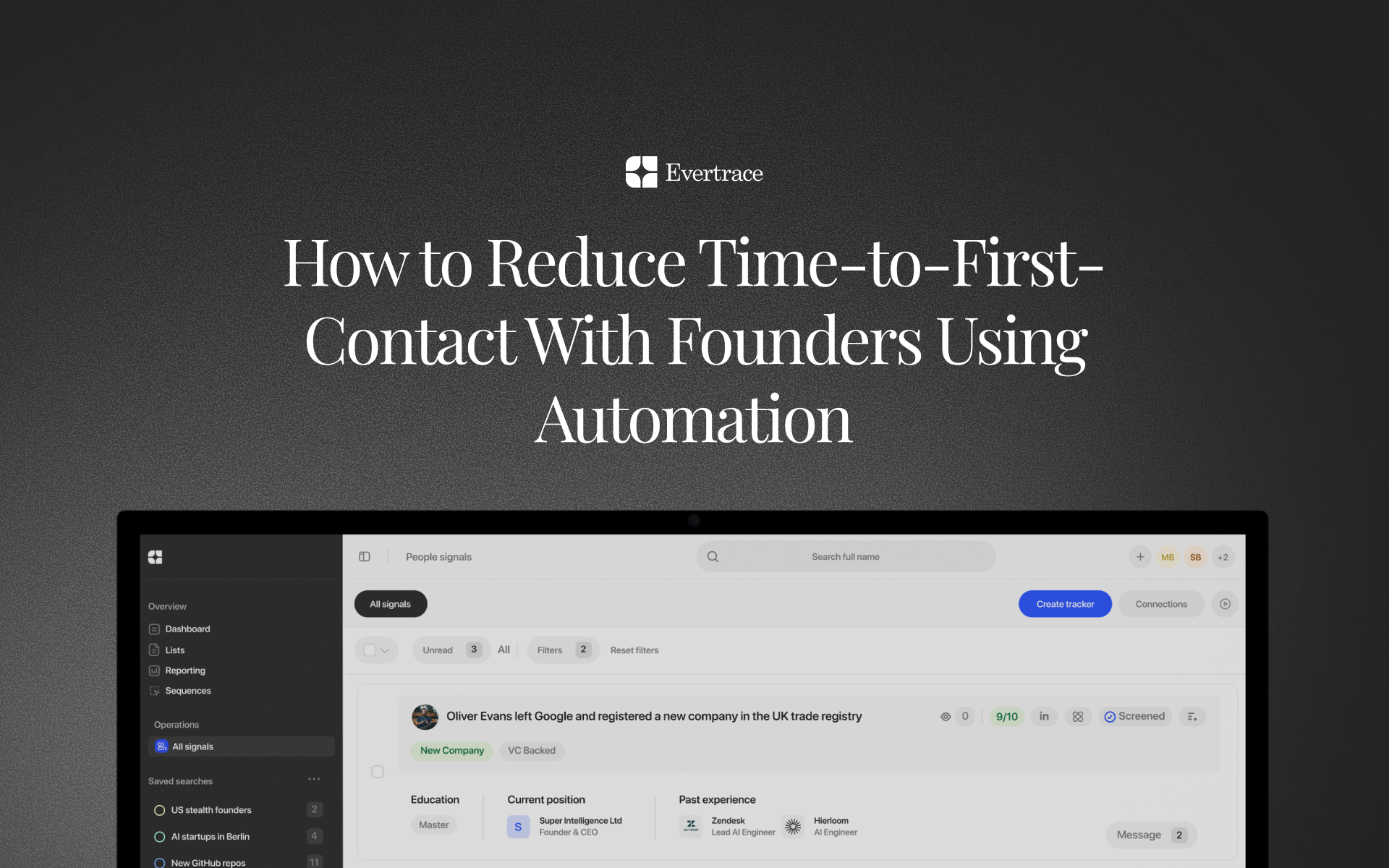
Signal triage and scoring: automated scoring that ranks signals by thesis alignment, founder background relevance, and signal combination quality reduces the manual review time required to identify the signals worth acting on. Background enrichment: the research on a founding individual's public records in trade registries, which might take fifteen to thirty minutes per signal manually, can be largely automated by enrichment tools that pull together background data from multiple sources. Outreach drafting: AI-assisted drafting using the enriched founder profile and the fund's thesis context can produce a high-quality first draft in seconds that the analyst reviews and refines rather than writing from scratch. Together these three automation steps can reduce the time from signal detection to a personalised outreach message from hours to minutes.
What an Automated Sourcing Workflow Looks Like
Signal ingestion runs continuously with no manual action required. Automated scoring and filtering runs immediately after ingestion, producing a prioritised review queue. Automated enrichment runs in parallel, assembling background context before the analyst opens a signal for review. Human review and approval is the first mandatory human step. Automated draft generation runs when the analyst approves outreach. CRM logging runs automatically on send. The total elapsed time from signal detection to sent outreach can be reduced from several days to under an hour with a well-implemented workflow.
The Risks of Automated Outreach
Automation that reduces quality rather than just time is worse than no automation. The most common failure mode is personalisation that feels generic despite being technically customised. An outreach message that inserts the founder's name and a summary of their background, but does not demonstrate genuine knowledge of their space, reads as an automated template. The human review step is critical precisely because it prevents this failure mode. A second risk is speed without accuracy: enrichment data from automated sources is not always accurate or current, and the human review step should include a quick check on data quality.
MCP and AI Agent Integration
The most advanced current implementation of automated sourcing workflows uses MCP-compatible AI agents that can query founder signal data, retrieve enriched profiles, generate outreach drafts, and log results in CRM systems through a single natural language interface. Platforms that support MCP integration, including Evertrace, enable this workflow natively.
Book a demo to see Evertrace in action
Frequently Asked Questions
Why does time-to-first-contact matter in VC sourcing?
Founders who have just formed a company are at their most accessible before they have received other investor outreach. A fund that contacts a founder within days of formation is having a qualitatively different conversation from one that arrives weeks later. The relationship that begins earliest has the most time to develop before any fundraising process.
What parts of the sourcing workflow benefit most from automation?
Signal triage and scoring, background enrichment, and outreach drafting are the three areas where automation delivers the most time savings without requiring significant human judgment. Together they can reduce the time from signal detection to sent outreach from days to under an hour.
Does automated outreach reduce the quality of investor-founder relationships?
Only if the automation replaces the human review step rather than supporting it. Automation that produces a personalised draft for human review and refinement maintains quality while dramatically increasing speed.
How quickly should a fund respond to a high-quality founding signal?
Same-day is achievable and worth targeting for the highest-scored signals. For lower-priority signals, within three to five days is a reasonable target.
The founder detection engine for VCs
AI-powered founder detection with unmatched coverage.
 Book a demo