

How to Source Biotech and Life Sciences Startups Before They Raise
Biotech and life sciences investing operates on a different timeline than almost any other venture sector. Companies take longer to form, longer to develop, and longer to reach inflection points. The founding signals appear earlier relative to investment-ready stage than in software, and the population of potential founders is more concentrated in specific academic and research institutions. For investors who understand these characteristics and build sourcing processes around them, the return on early relationship-building is exceptional.
The Biotech Founding Pipeline
Biotech and life sciences companies almost always begin in a research setting. The founding moment is typically preceded by a significant body of research, usually including multiple published papers and often one or more patent filings. The timeline from first significant research output to company formation is commonly two to five years in academic biotech. This extended timeline is both a challenge and an opportunity: the signals are very visible to those who know where to look, and the competitive window before a company becomes known is much longer than in any other sector.
Where Biotech Founders Come From
The population of biotech founders is highly concentrated. In the United States, MIT, Stanford, Harvard, UCSF, Johns Hopkins, and a handful of other research universities have produced the majority of high-value biotech spinouts. The Broad Institute, Whitehead Institute, Koch Institute, and similar research centres are particularly active commercial pipelines. In the United Kingdom, Oxford and Cambridge account for a significant share of European biotech spinout formation. The Oxford-AstraZeneca collaboration history, the Cambridge biotech cluster around Cambridge Science Park, and proximity to NHS clinical networks are all structural advantages. In continental Europe, ETH Zurich, Karolinska Institutet in Stockholm, and research institutions in Basel, Munich, and the Netherlands have strong biotech spinout pipelines.
The Signals That Matter for Biotech Sourcing
Patent filings are the primary early signal. A patent filed by individual named inventors rather than assigned entirely to a university, covering a novel therapeutic mechanism, diagnostic approach, or drug delivery technology, is a strong indicator of commercial intent. Life sciences patents typically surface eighteen months after the initial filing date. Research publications with commercial framing are the earliest observable signal: papers describing in vivo efficacy data, human clinical observations, or novel therapeutic mechanisms in terms of disease treatment, from researchers at institutions known for spinout activity, are worth monitoring. Grant awards from NIH, ERC, Wellcome Trust, Cancer Research UK, and equivalent bodies for translational or clinical research indicate external validation of commercial or clinical relevance. Clinical trial registrations are later but highly actionable: a research team that registers a phase I trial has committed significant resources to commercial development.
The Specific Biotech Sub-Sectors Worth Monitoring
Oncology remains the largest sector for biotech venture formation globally. Novel therapeutic mechanisms including CRISPR-based approaches, cell therapies, targeted protein degradation, and RNA therapeutics are all active areas. Rare diseases attract significant commercial interest because of orphan drug designation benefits and the relative clarity of clinical trial design. Longevity and aging biology has attracted significant capital and is producing increasing spinout formation from academic research on cellular senescence, epigenetic reprogramming, and metabolic aging. Digital health and med tech have lower capital requirements and shorter development timelines, forming at high rates from clinical and engineering backgrounds.
How to Approach Biotech Founders
Life sciences founders, especially those from academic research backgrounds, respond poorly to generic investor outreach. The investors who build the best early relationships in biotech demonstrate genuine scientific understanding of the specific research area. This means reading the papers, understanding the specific mechanism being targeted, and asking questions that show genuine engagement with the science. Patience is especially important: a researcher who is three years from forming a company and has a conversation with an investor who treats them as a future founder, helps connect them with clinical advisors or potential collaborators, and maintains contact without pressure, will remember that investor when the time comes.
How Evertrace Covers Biotech and Life Sciences
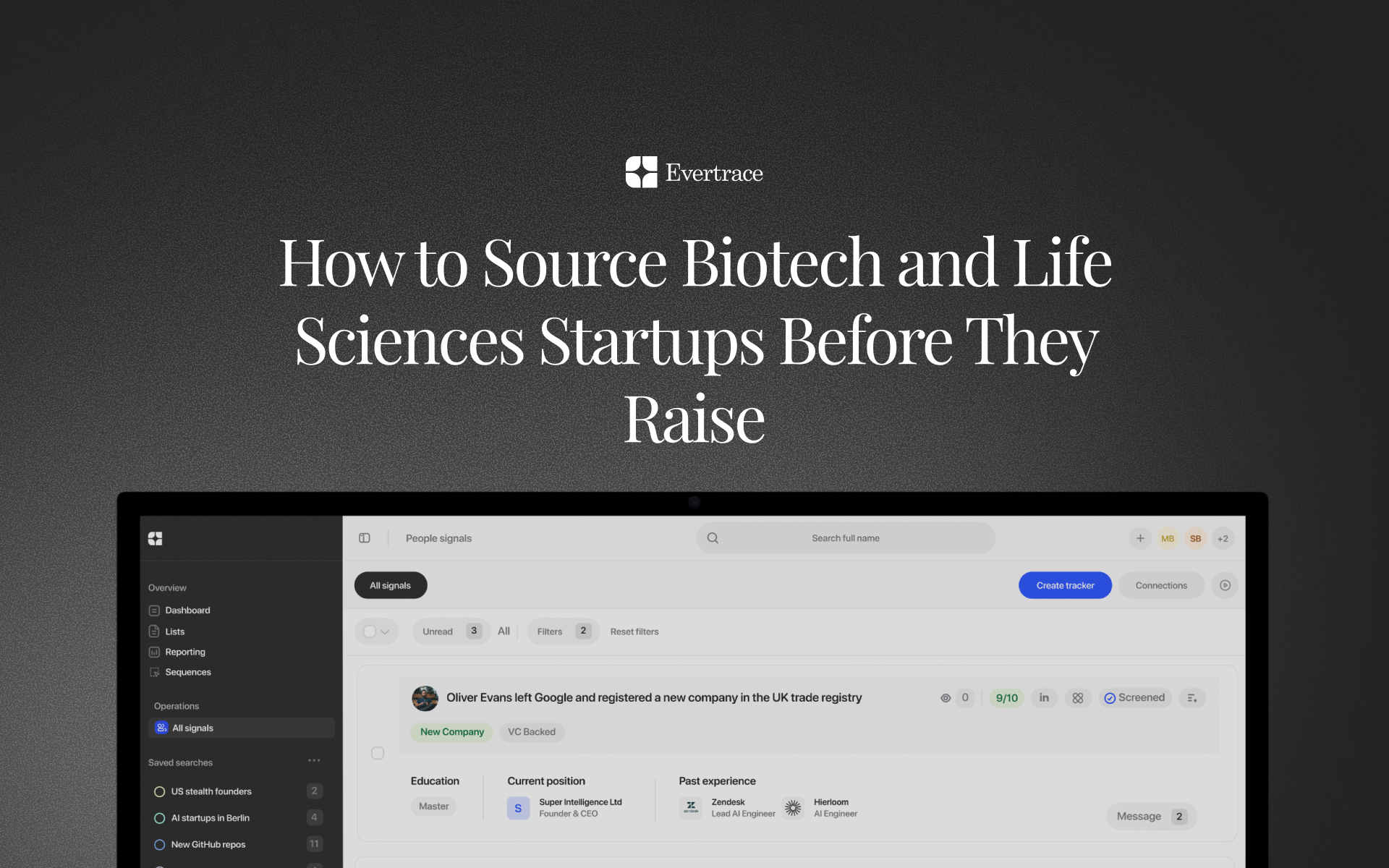
Evertrace monitors patent filings from individual life sciences researchers, research publications with commercial framing, grant awards from major translational and clinical research funding bodies, and company formation events from individuals with life sciences backgrounds globally. Signals are combined and scored to surface biotech and life sciences founders at the research-to-venture transition stage, before any public announcement.
175+ VC firms globally use Evertrace to find biotech and life sciences founders before their competitors do.
Book a demo to see Evertrace in action
Frequently Asked Questions
Why is early sourcing especially important in biotech?
Development timelines in biotech are long, which means the difference between finding a founder at the research stage versus the fundraising stage is measured in years. Investors who build relationships at the research stage have dramatically better information and stronger relationships than those who arrive during a competitive fundraising process.
Which institutions produce the most biotech spinouts globally?
MIT, Stanford, Harvard, UCSF, Johns Hopkins, Oxford, Cambridge, ETH Zurich, and Karolinska Institutet are among the most consistently productive globally.
What type of patent signals are most relevant for biotech sourcing?
Patents filed by individual named inventors rather than assigned to large institutions, covering novel therapeutic mechanisms, drug delivery approaches, or diagnostic methods. The combination of individual inventor patents with recent publication activity is a particularly strong signal.
How long is the typical lead time between first observable signal and company formation in biotech?
Twelve months to three years is typical. The benefit of this long lead time is that investors who engage early have a large relationship window before any competitive dynamics emerge.
How do you maintain a relationship with a pre-formation biotech researcher?
By being genuinely useful at intervals over an extended period. Connecting them with relevant clinical advisors, facilitating introductions to potential collaborators, sharing relevant market observations, and checking in at natural moments such as new paper publications or grant awards, without creating fundraising pressure.
The founder detection engine for VCs
AI-powered founder detection with unmatched coverage.
 Book a demo