

How to Source Climate Tech Deals Before They Hit the Market
Climate technology is one of the fastest-growing sectors in venture capital globally, and one of the hardest to source effectively at early stage. The founders building the most interesting climate companies are often researchers, engineers, and domain experts whose path to company formation looks different from software founders. They are less likely to announce publicly, less likely to be in mainstream startup networks, and more likely to have spent years in academic or industrial research before any commercial venture exists.
Why Climate Tech Sourcing Is Different
Climate technology ventures are disproportionately research-driven. The innovations underlying climate tech companies, novel battery chemistries, carbon capture approaches, green hydrogen production methods, materials for solar cells, often emerge from years of academic or industrial R&D before any commercial intent is articulated. This means the founding signals for climate companies appear in different places and at different times than for software companies. A climate tech founder who has spent five years developing a novel material in a university lab does not announce on a startup forum that they are building a company. They file a patent. They publish a paper. They receive a research grant. They incorporate a company to license the IP they have developed. These signals are all observable, but they require different monitoring infrastructure.
The Signal Types That Matter Most for Climate Tech
Patent filings are the earliest and most reliable signal for climate tech spinouts. A researcher who files a patent on a novel clean energy process, carbon capture method, or advanced material outside the context of an established corporate employer is signaling the existence of commercialisable IP. The European Patent Office, national patent offices across Europe and globally, and the USPTO all provide visibility into new IP being developed in commercially relevant climate areas. The most interesting patent signals are those filed by individual inventors or small research teams, rather than large corporate assignees.
Research grants are another early signal layer. Bodies including the European Research Council, Horizon Europe, Innovate UK, national equivalents, and US bodies like the DOE and NSF fund climate research at various stages of commercial maturity. Grant recipients working in areas with clear commercial applications are often months to a year away from forming a company.
Company formations in climate sectors can be filtered from trade registry data by combining founder background enrichment with incorporation timing and company description. A new company formed by someone with a doctorate in electrochemistry and prior employment at a battery research institute is a strong combined signal.
The Specific Climate Sectors Worth Monitoring Most Closely
Energy storage, green hydrogen production, carbon capture and utilisation, and novel materials for clean energy applications are all active areas for climate tech spinout formation globally. Research institutions across Europe, North America, and Asia are all producing commercially relevant innovations in these areas.
How to Approach Climate Tech Founders
Climate tech founders at the earliest stage are often not thinking of themselves primarily as entrepreneurs. They are scientists or engineers considering whether their work has commercial applications. The investor who approaches them needs to demonstrate genuine domain knowledge, not just investment appetite. Patience is also particularly important: development timelines are typically longer than in software, and an investor who begins the relationship at formation and maintains it through the development phase has a very different position than one who arrives when the company is ready to raise.
How Evertrace Monitors Climate Tech Signals
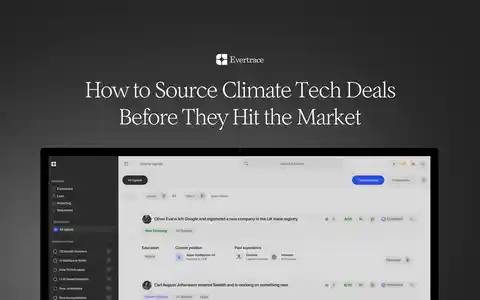
Evertrace monitors patent filings from the European Patent Office, national patent offices, and global patent databases, filtering for climate-relevant technology areas and individual inventors with relevant backgrounds. Research grant data, academic publication patterns, and company formation events are combined to surface climate tech founders at the earliest observable stage globally.
175+ VC firms globally use Evertrace to find climate tech founders before they raise.
Book a demo to see Evertrace in action
Frequently Asked Questions
Why is climate tech sourcing different from software sourcing?
Climate tech ventures are disproportionately research-driven, with founders who come from academic or industrial research backgrounds. The signals that precede climate company formation, patent filings, research grants, and academic publications, appear in different data sources and at different times than the signals that work for software-focused funds.
What are the strongest early signals for climate tech investment opportunities?
Patent filings from individual inventors in commercially relevant climate areas are among the earliest and most reliable signals. Research grants from commercialisation-focused bodies, academic publications describing applied performance rather than theoretical advances, and company formations by individuals with relevant research backgrounds are all strong indicators.
What should investors offer climate tech founders at the earliest stage?
Domain expertise, technical credibility, and specific industry introductions are more valuable than capital at the pre-seed stage for many climate founders. An investor who can connect a deep tech spinout with a potential industrial partner or pilot customer is providing something that is genuinely hard to find elsewhere.
The founder detection engine for VCs
AI-powered founder detection with unmatched coverage.
 Book a demo