

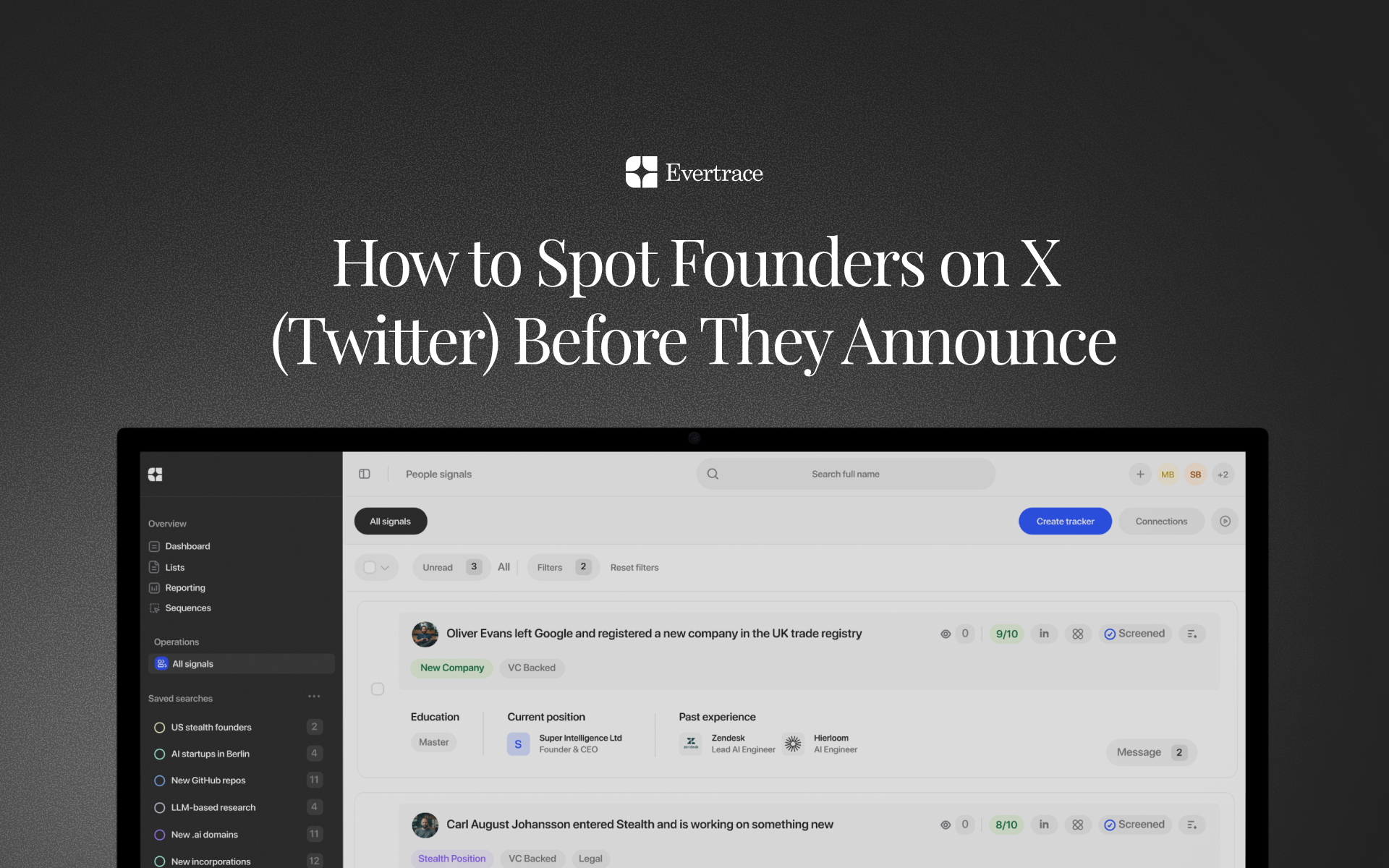
How to Spot Founders on X (Twitter) Before They Announce
X, formerly Twitter, remains one of the most valuable and underused early-stage sourcing surfaces available to investors. The platform is where a specific and important population of potential founders publicly works through ideas, signals professional transitions, shares technical perspectives, and exhibits founding intent before any company formally exists.
The challenge is not access. The challenge is filtering. X produces enormous volumes of content, and the useful signals are buried in noise. Investors who have built systematic approaches to filtering and monitoring X for founding-intent signals consistently find leads that no other channel surfaces at the same stage.
What Founding Intent Looks Like on X
The population of people who will start companies is not uniformly distributed across X. It concentrates in specific communities: technical builders, domain experts in specific industries, researchers and academics, operators from technology companies, and people who have a demonstrated habit of building things independently. Monitoring these communities produces a much higher signal-to-noise ratio than monitoring X broadly.
Explicit departure announcements are the most direct signal. When someone with a relevant background announces they are leaving a role, with vague or absent information about what comes next, the probability of company formation is meaningfully elevated for the right population.
Problem-space exploration posts are an early-stage signal that often predates any explicit founding decision. When a domain expert begins publicly exploring a specific problem, describing its dimensions, asking for input from people who experience it, and building a public record of their thinking about why existing solutions fall short, they are exhibiting a pattern that precedes company formation.
Recruiting and co-founder searches on X are explicit founding-intent signals. A post explicitly seeking a technical co-founder, a first engineer, or an early operator is a declaration that the person is building something, even if no company exists.
Technical building posts reveal founders in active build mode. Technical founders especially tend to build publicly on X, documenting their progress before any company is formally announced.
Critique of existing solutions in a specific domain often precedes founding activity. Someone who develops and publicly articulates a detailed critique of the incumbent approaches in a sector they know well, who begins exploring whether there is a better way, is exhibiting a pre-founding pattern.
How to Monitor X Systematically for Founding Signals
Manual monitoring of X is only practical at very small scale. The platform is too high-volume for a consistent, comprehensive approach without some degree of systematic infrastructure.
Lists are the most basic useful tool. Creating curated X lists of individuals who have the characteristics of likely future founders, and monitoring those lists regularly, produces a much more manageable and relevant signal feed than monitoring X broadly.
Search operators allow targeted monitoring of specific signal types. Searching for phrases like "leaving X to build," "looking for a co-founder," "anyone working on Y problem," or "just shipped my first product" in combination with relevant technical or domain keywords surfaces founding-intent content.
X's own notification system, following specific accounts and setting up notifications for their posts, provides real-time alerts for activity from high-priority individuals. Third-party X monitoring tools allow keyword and account monitoring with filtering and alerting capabilities.
The Limitations of X as a Sourcing Channel
X is a strong signal source for a specific type of founder: the technical operator who thinks and builds publicly, who has an established presence on the platform, and who uses it as a professional rather than personal channel. It is a weak signal source for founders who do not use X professionally. Many deep tech founders, researchers, and domain experts in non-technology industries have minimal X presence.
X signals are also inherently delayed. The founding intent signal that appears on X has been processed through the founder's decision to post about it. The earliest signals, the private conversations, the decision to start, the first lines of code, appear before any X activity. For investors who want to be truly first, X represents a somewhat later-stage signal than the founding traces that appear in trade registries, GitHub, and domain registration records.
What to Do When You Find a Founding-Intent Signal on X
The approach to outreach on X should match the medium. A direct message that is brief, specific about what caught your attention, and genuinely curious about what the person is working on is appropriate and likely to generate a response. Engaging with the person's public content before sending a direct message is a natural way to establish context. A thoughtful reply to a post about a problem they are exploring, that demonstrates genuine domain knowledge rather than just general encouragement, creates a visible interaction that gives a subsequent direct message a warmer context.
Integrating X Monitoring With Other Signal Sources
The highest value use of X as a sourcing channel is as a corroborating and enriching layer on top of other signal sources. A founder who has recently incorporated a company and registered a domain, whose X profile then shows a departure announcement and a problem-space exploration thread, is a much more complete picture than any individual signal. X can also function as the enrichment layer for signals from other sources: finding a founder's X profile and reviewing their recent posting history adds significant context to a raw company registration signal.
How Evertrace Incorporates Social Signals
Evertrace monitors social platform activity alongside trade registry filings, GitHub activity, patent filings, domain registrations, and other signal sources. Social intent signals, including founding-intent activity on public platforms, are weighted and combined with formal founding signals to produce higher-confidence detections of founders at the earliest observable stage.
175+ VC firms globally use Evertrace to find founders before their competitors do.
Book a demo to see Evertrace in action
Frequently Asked Questions
Is X actually useful for finding early-stage founders?
Yes, for a specific population. Technical founders, operators, and domain experts who think publicly tend to signal founding intent on X before making any formal announcements. For founders who are less active on the platform, other signal sources are more reliable.
What are the most useful search terms and operators for finding founding-intent signals?
Phrases like "leaving to build," "looking for a co-founder," "working on a problem," and combinations of domain-specific terms with startup-related language surface relevant content. Account list monitoring of a curated target population is more reliable than keyword search alone.
How do you approach someone on X without being intrusive?
By engaging with their public content first, demonstrating genuine knowledge of the domain they are exploring, and sending a direct message that is specific, brief, and curious rather than transactional.
Are X signals earlier or later than other founding signals?
Generally later. Trade registry filings, GitHub activity changes, and domain registrations often appear before any X activity indicating company formation. X signals are most useful as corroborating and enriching information on top of formal founding signals rather than as primary early detection.
What types of founders are most likely to be found through X monitoring?
Technical founders building developer tools, consumer applications, and B2B software, who are active in the technical community on X. Domain experts who think publicly about industry problems.
How do you avoid spending hours on X daily?
By maintaining a focused curated list rather than monitoring X broadly, setting up alerts for specific activities from high-priority individuals, and treating X as one layer in a multi-source signal process rather than a standalone sourcing channel.
The founder detection engine for VCs
AI-powered founder detection with unmatched coverage.
 Book a demo