

How Top VC Funds Source Deals: A Data-Driven Look
Venture capital has matured significantly over the past decade. The most competitive early-stage funds are building sourcing infrastructures that would have seemed unnecessary five years ago. This guide examines how leading VC funds approach deal sourcing, what separates the funds with the strongest proprietary pipelines from those relying on shared deal flow, and what the shift toward data-driven sourcing looks like in practice.
The Evolution of VC Sourcing
The previous generation of VC sourcing was built almost entirely on network. As the startup ecosystem has scaled globally, that model has become insufficient. More companies, more investors, more geographies, and more sectors mean that personal network alone cannot provide comprehensive coverage. The shift is visible in hiring patterns: funds that historically hired for investment judgment are increasingly also hiring for data capabilities.
What the Best Funds Do Differently
They find founders before pitch decks exist
The funds with the strongest performance records consistently describe the same insight: the best investments are the ones where the fund was the first institutional investor to have a serious conversation with the founder. That first-mover position is achieved by being the only investor who knew the founder existed before they were raising, not by being fast at responding to inbound.
They treat sourcing as infrastructure, not activity
The most consistent sourcing advantage comes from treating sourcing as infrastructure: something built, maintained, and operated consistently. This manifests in a defined weekly process for reviewing new signals, a CRM that is genuinely maintained, a documented qualification process, and a relationship development practice that keeps the fund in front of interesting founders between detection and investment.
They invest in geographic breadth
The strongest founders are not all concentrated in a few major hubs. Increasingly, they are building across a wide range of cities and regions globally. The funds that have built monitoring coverage across broader geographies are finding opportunities that more geographically concentrated approaches miss.
They use data to reduce bias in early evaluation
Data-driven sourcing does not eliminate bias, but it can surface a broader population of potential founders for consideration, including those who would not have appeared through network-based sourcing. A systematic process that detects all new incorporations in a geography is more likely to surface diverse founder populations than one that relies on warm introductions.
The Role of Data Infrastructure in Modern VC
The shift toward data-driven sourcing is not about replacing judgment with algorithms. The best investors are using data to generate more and better inputs for their judgment. A fund that reviews fifty founder signals per week, filtered and scored to the most relevant subset, is making better use of its investment team's judgment than one that reviews five random inbound emails.
How Evertrace Supports VC Sourcing
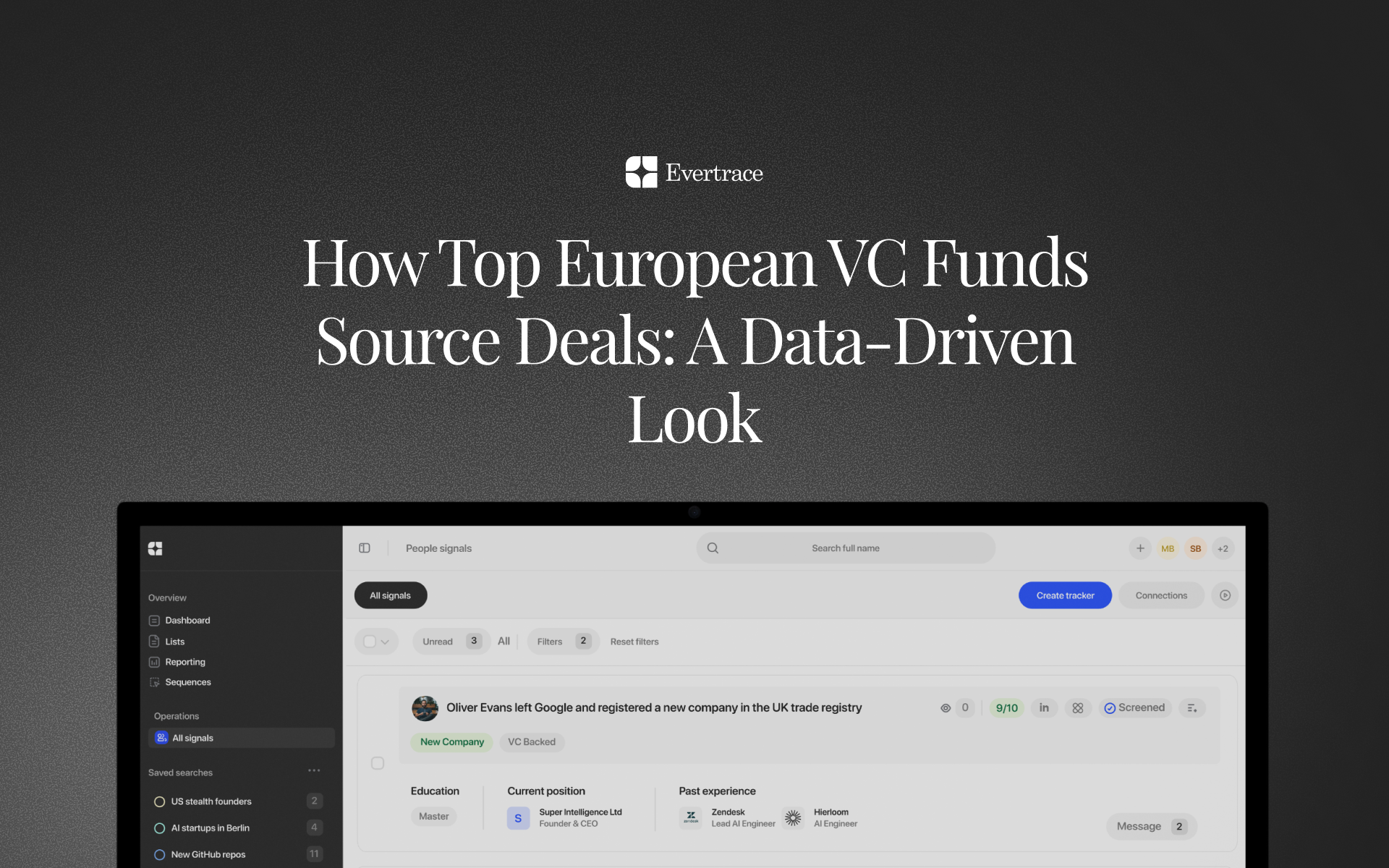
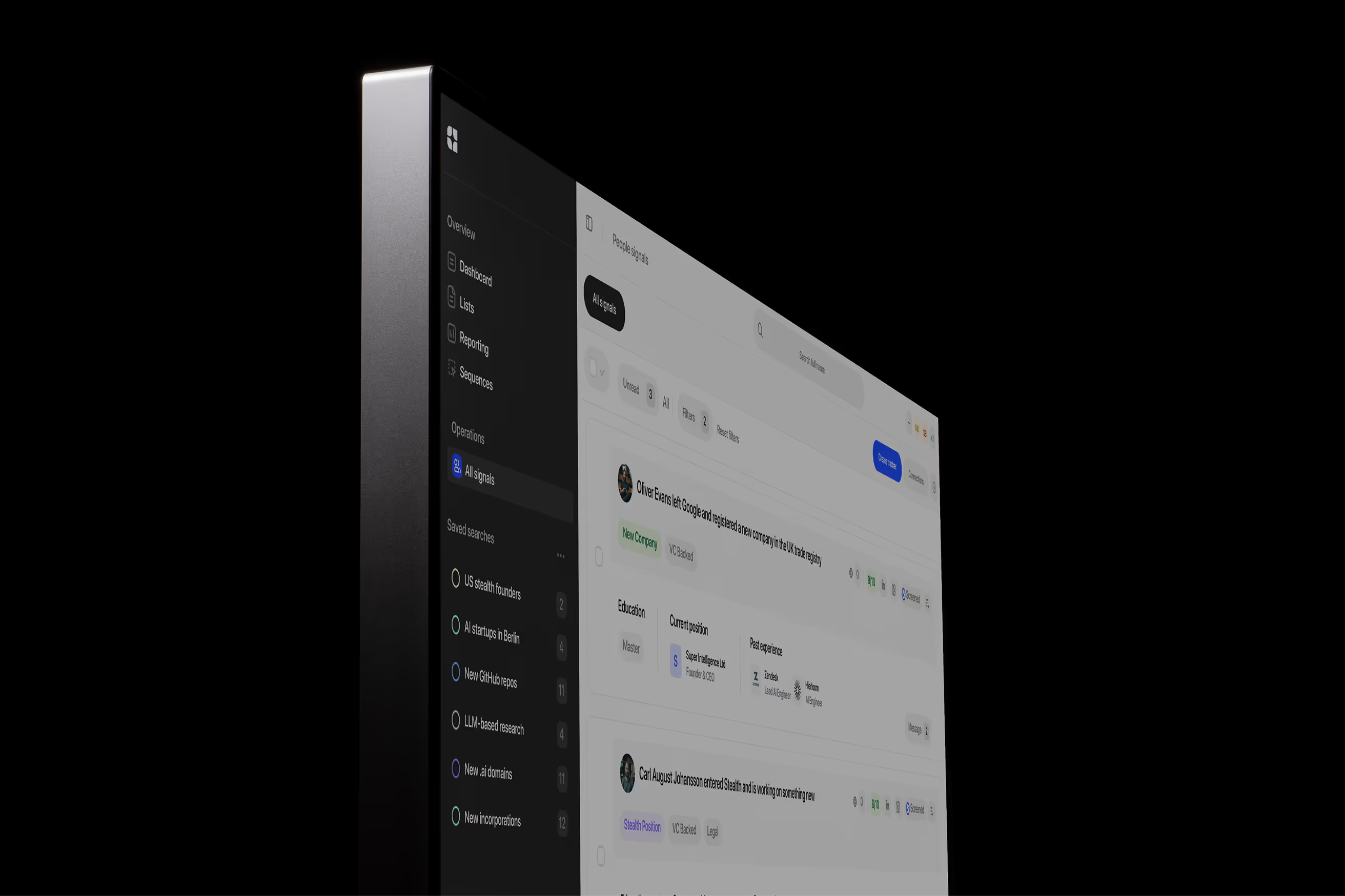
Evertrace monitors real-time founding signals across trade registries, GitHub, patent filings, academic research, domain registrations, app stores, and social platforms globally. Signals are scored, filtered by geography, sector, and founder profile, and delivered directly into Affinity, Attio, Slack, or connected AI agents via MCP.
175+ VC firms globally use Evertrace to find founders before their competitors do.
Book a demo to see Evertrace in action
Frequently Asked Questions
How do top VC funds find deals before other investors?
The most competitive early-stage funds combine real-time signal monitoring of founding activity with systematic relationship development. They reach founders before any public announcement by detecting founding signals such as trade registry filings, code activity, and patent filings.
What is proprietary deal flow in VC?
Proprietary deal flow refers to investment opportunities that a fund sees before they are broadly visible to the market. It is generated through systematic early detection and strong founder relationships rather than brand reputation alone.
What data sources do VCs use to find founders early?
The most common data sources include commercial registries, GitHub and other code repositories, patent databases, domain registration data, and academic research and grant databases. Combining multiple sources produces higher-confidence signals than any individual source alone.
The founder detection engine for VCs
AI-powered founder detection with unmatched coverage.
 Book a demo