

How University Spinouts Work: From Research to Venture
University spinouts are among the most consistently interesting companies in early-stage venture capital. They emerge from research that has often taken years or decades to develop, they are built by people with deep technical expertise in a specific domain, and they address problems that are frequently too hard for generalist founders without that research background to tackle. They are also among the hardest companies to find at the right stage.
What Is a University Spinout?
A university spinout is a company formed to commercialise intellectual property or expertise developed at a university. The founding team typically includes one or more researchers who originated the underlying technology, and the company is often formed with involvement from the university's technology transfer office.
How Spinouts Form
The formation of a university spinout rarely follows a clean, linear path. The research phase produces the underlying innovation through papers, patents, and grant applications. The exploration phase is when researchers begin to assess commercial viability and consider whether and how to form a company. The formation phase is when a legal entity is incorporated, a founding team is assembled, and initial funding is secured. The funding phase is when the company actively seeks external venture capital. Investors who want to find spinouts at the earliest stage need to engage before the funding phase.
The Signals That Precede a Spinout
Patent filings from university research groups are the earliest and most reliable signal for deep tech spinouts. A research team that files a patent on a commercially relevant technology, particularly one filed by individual named inventors rather than assigned entirely to the university, is signaling the existence of protectable IP that someone may want to commercialise. Research grants awarded to specific individuals from bodies like the European Research Council, national research councils, and government innovation programs often precede company formation by months or years. Academic publications describing commercial applications rather than purely theoretical advances suggest the researchers are thinking about the real world.
What Spinout Founders Need From Investors
Spinout founders are usually technically exceptional but often have limited commercial experience and limited familiarity with fundraising norms. The investors who succeed with spinouts consistently describe the same dynamic: the relationship begins with genuine expertise exchange rather than evaluation. Domain expertise, introductions to potential early customers, help navigating university technology transfer relationships, and access to technical validation networks are all more valuable than capital alone at the earliest stage.
How Evertrace Tracks University Spinout Signals
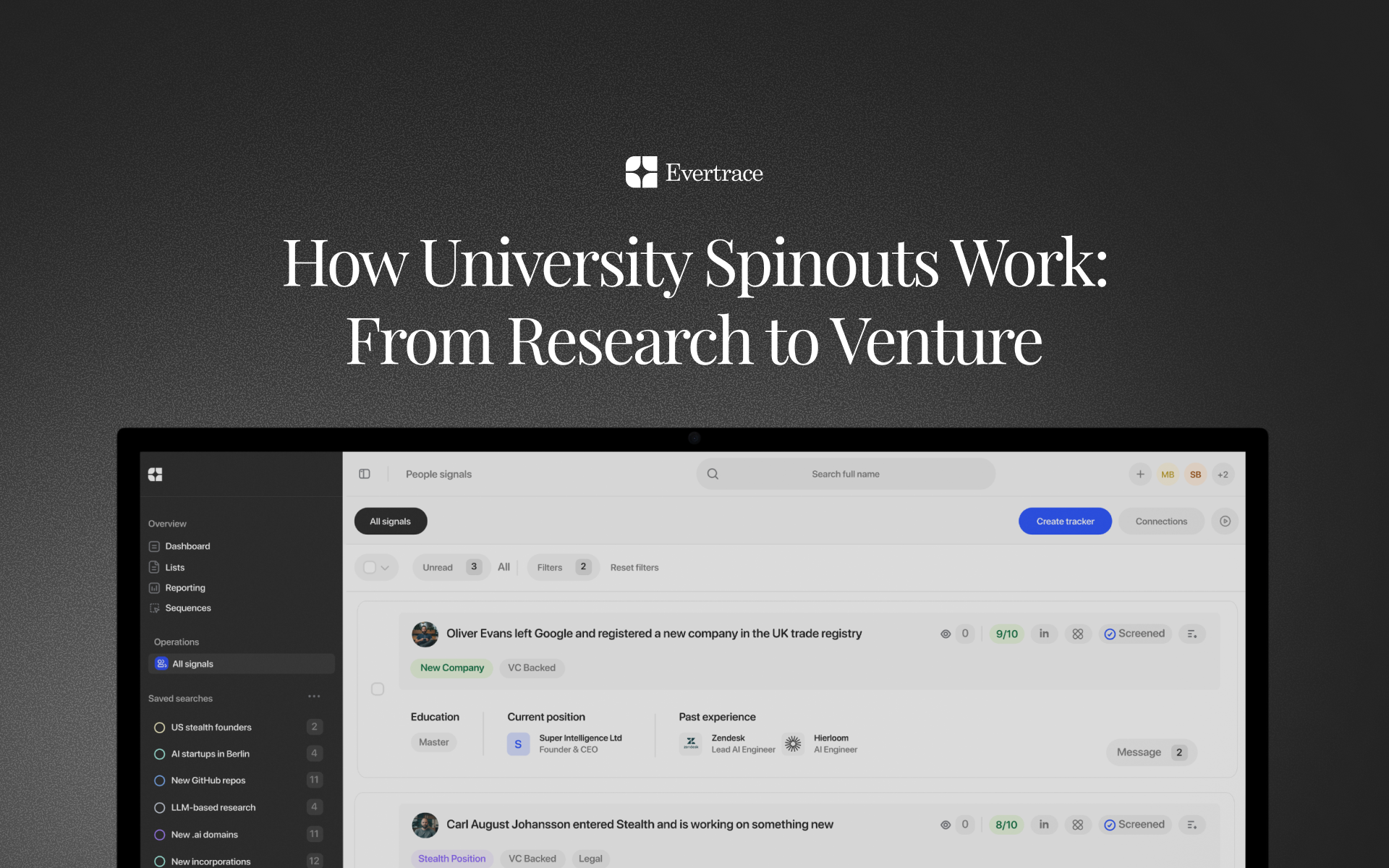
Evertrace monitors patent filings from individual researchers and university-affiliated groups, research grant awards in commercially relevant fields, company incorporations linked to academic institutions, and academic publication patterns that indicate pre-commercial research activity. These signals are combined and scored to surface spinout candidates before any public announcement.
175+ VC firms globally use Evertrace to find deep tech and university spinout founders at the research-to-venture transition stage.
Book a demo to see Evertrace in action
Frequently Asked Questions
What is a university spinout?
A university spinout is a company formed to commercialise intellectual property or expertise developed at a university. It typically involves a licensing or assignment arrangement with the university and is often founded by the researchers who developed the underlying technology.
What signals indicate a spinout is forming?
Patent filings from individual researchers, research grant awards for commercialisation-focused programs, company incorporations linked to academic institutions, and academic publications describing commercial applications are all signals that a research-to-venture transition is underway.
How early can investors find university spinouts?
The earliest visible signals, patent filings and research grants, can appear one to three years before a company is incorporated and seeking external funding. Investors who monitor these signals can initiate contact at a stage when most other investors have no visibility.
Which universities produce the most venture-backable spinouts?
Oxford, Cambridge, Imperial College London, UCL, ETH Zurich, TU Munich, KTH Stockholm, Aalto University Helsinki, MIT, Stanford, and DTU Copenhagen are among the most consistently productive sources of deep tech and life sciences spinouts globally.
The founder detection engine for VCs
AI-powered founder detection with unmatched coverage.
 Book a demo