

How VC Funds Manage Deal Flow at Scale: Tools, Processes, and Pitfalls
Managing deal flow at scale is one of the most underestimated operational challenges in venture capital. As funds grow and sourcing becomes more systematic, the operational infrastructure required to manage the pipeline without losing deals or diluting quality becomes a genuine competitive factor.
The Scale Problem in VC Deal Flow
The fundamental tension in deal flow management is between volume and quality. Triage failure happens when the volume of incoming signals exceeds the team's capacity to evaluate them consistently. Relationship loss happens when the gap between first contact and investment is long, as it should be for funds that source at the pre-announcement stage. Stage drift happens when the fund loses track of where each opportunity is in its development and misses the moment when a founder is ready to raise.
The Tools That Support Scale
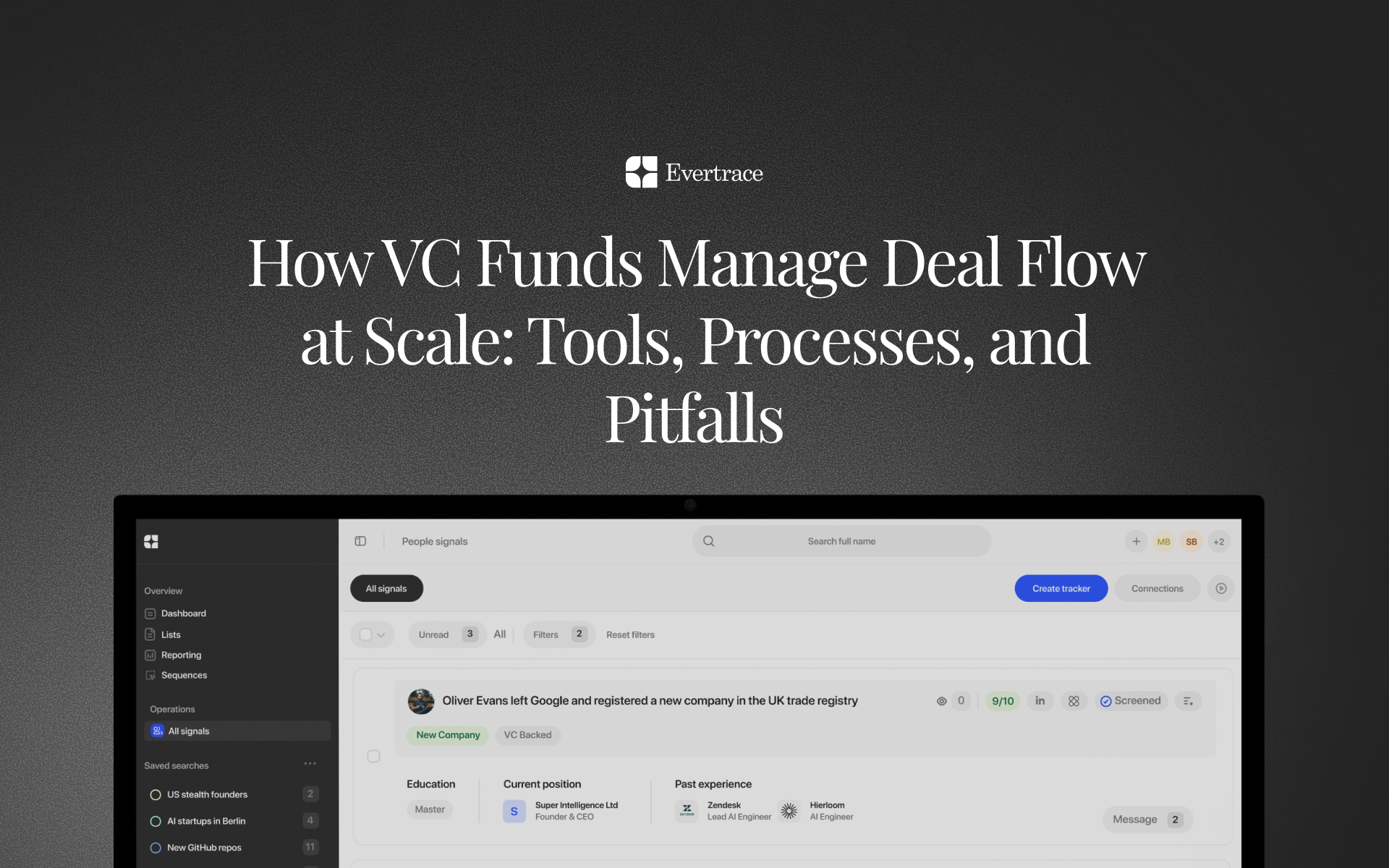
A purpose-built CRM is the anchor of any effective deal flow operation. Affinity and Attio are the two most widely used options at early-stage funds. The critical factor is not which CRM a fund chooses but how consistently it is used. Signal detection feeds provide the top of the funnel for funds that source proactively. Platforms like Evertrace deliver pre-filtered, scored signals from founding activity globally, reducing the triage burden. AI assistants are increasingly used for outreach drafting, meeting note summarisation, and flagging relationships that need follow-up.
Structuring the Deal Flow Process
Stage definitions should reflect the fund's actual workflow, including a pre-raise relationship stage for founders who have been detected but are not yet ready to fundraise. Without this stage, pre-raise relationships tend to get lost. Review cadence: a weekly pipeline review covering new signals, active pre-raise relationships, and near-term investment decisions is the recommended minimum. Ownership assignment prevents deals from falling through the cracks when multiple team members are in contact with the same founder.
Common Pitfalls
The CRM that nobody uses is the most common failure mode. The pre-raise relationship that nobody maintains is the second most common failure: a fund that sources at the formation stage and detects founders months before they are raising needs a process for maintaining those relationships. Without a structured follow-up cadence, early detections produce no advantage because the relationship fades before the investment window opens.
How Evertrace Fits Into Deal Flow Management
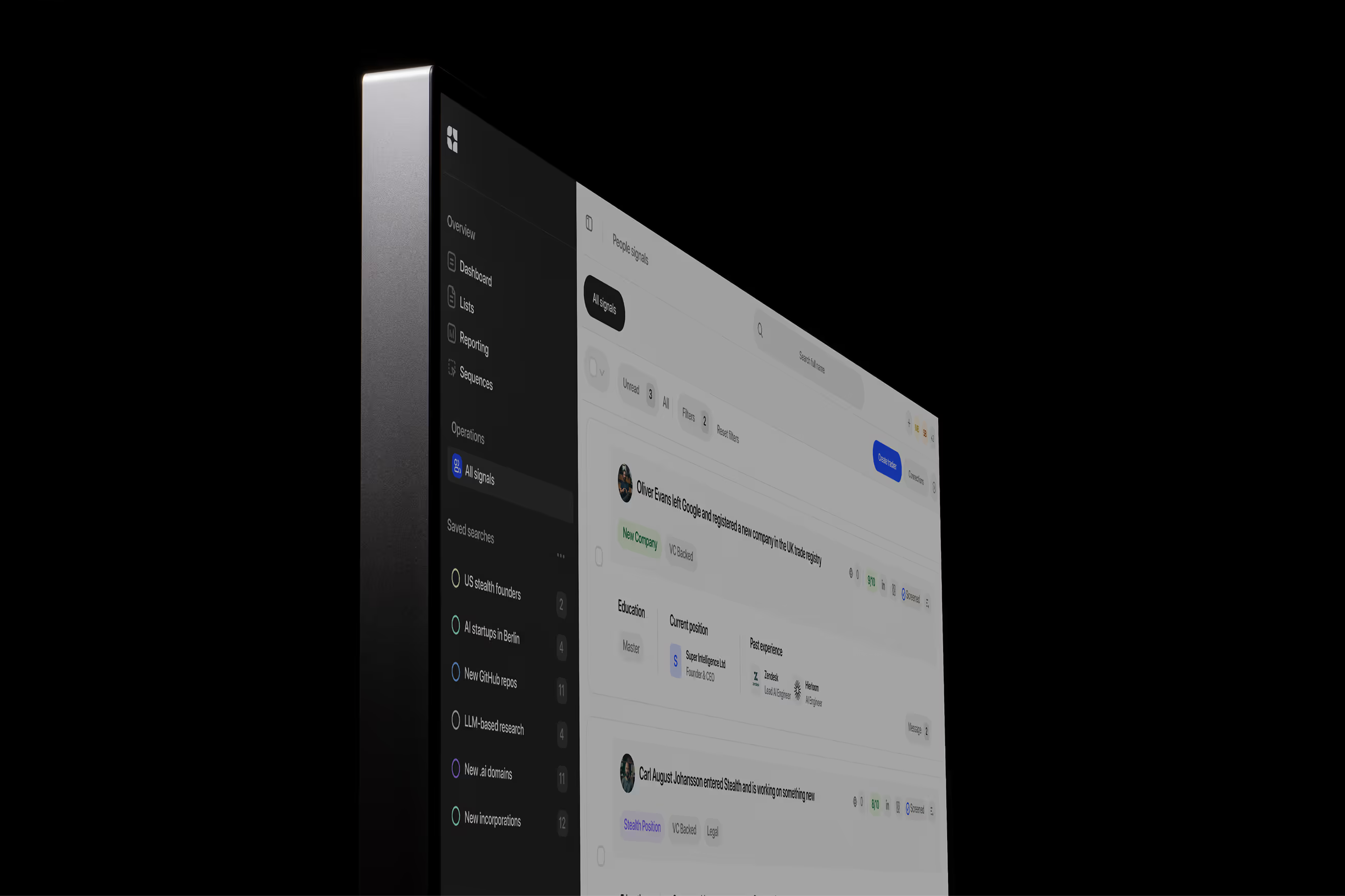
Evertrace feeds the top of the deal flow funnel with pre-filtered, scored founding signals globally. Signals integrate directly into Affinity, Attio, Slack, and connected AI agents via MCP, reducing the manual triage burden and ensuring that relevant founding activity enters the CRM without requiring a separate review process.
175+ VC firms globally use Evertrace as the signal layer in their deal flow management operations.
Book a demo to see Evertrace in action
Frequently Asked Questions
What tools do VC funds use to manage deal flow?
The core stack typically includes a purpose-built CRM such as Affinity or Attio, a signal detection platform for proactive sourcing, and integration between calendar, email, and CRM for relationship tracking.
What is the biggest challenge in managing deal flow at scale?
Maintaining pre-raise relationships is consistently cited as the hardest part. Finding founders early is valuable only if the relationship is maintained through the months between first contact and fundraising.
How often should a VC fund review its pipeline?
Weekly is the recommended minimum cadence. Reviews should cover new signals, active pre-raise relationships, and near-term investment decisions.
How do the best VC funds prevent deals from falling through the cracks?
Clear ownership assignment, consistent CRM hygiene, a structured follow-up cadence for pre-raise relationships, and a weekly pipeline review that covers the full funnel. The cultural norm of treating CRM maintenance as a team responsibility is the most important factor.
The founder detection engine for VCs
AI-powered founder detection with unmatched coverage.
 Book a demo