

For most of the last decade, the "VC tech stack" was three things: a CRM built for enterprise sales teams, a spreadsheet, and an inbox. Everything else was bent to fit. Sourcing happened in the CRM. Portfolio tracking happened in the spreadsheet. Relationships lived in someone's head, and left when they did.
That era is ending. A new generation of tools is being built specifically around how modern investment teams actually work: fast, network-driven, and increasingly AI-native. Instead of forcing venture workflows into software designed for something else, these products start from the questions investors actually ask (Who's building right now? What's happening across my portfolio? Who in my network can open this door?) and work backwards.
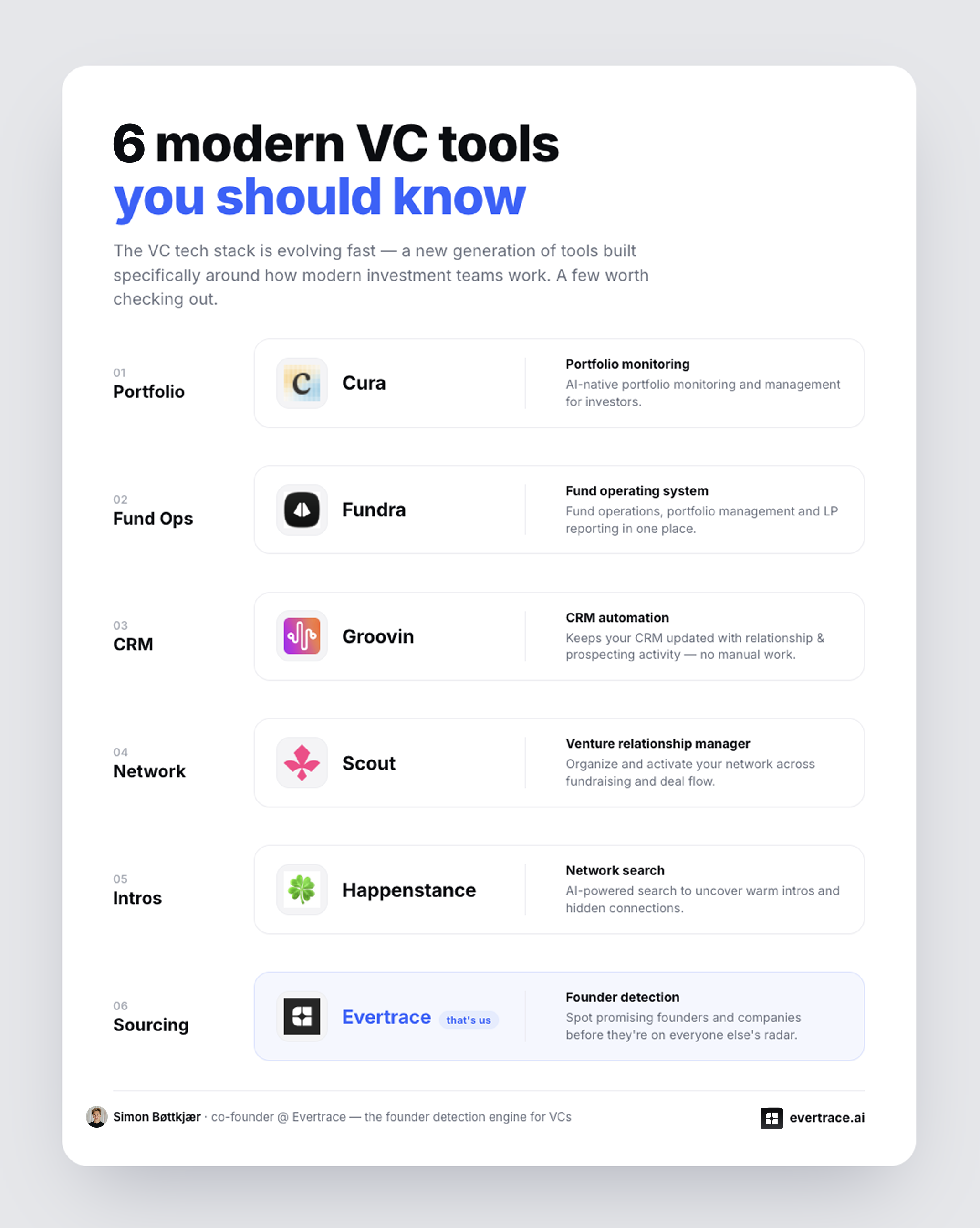
Here are six worth knowing.
How to read the modern stack
A useful way to think about the venture stack is as a set of layers, each answering a different job-to-be-done: find the opportunity, manage the money and the portfolio, remember every interaction, and activate the network that makes deals happen. The six tools below map cleanly onto those layers.
01 · Sourcing: Evertrace
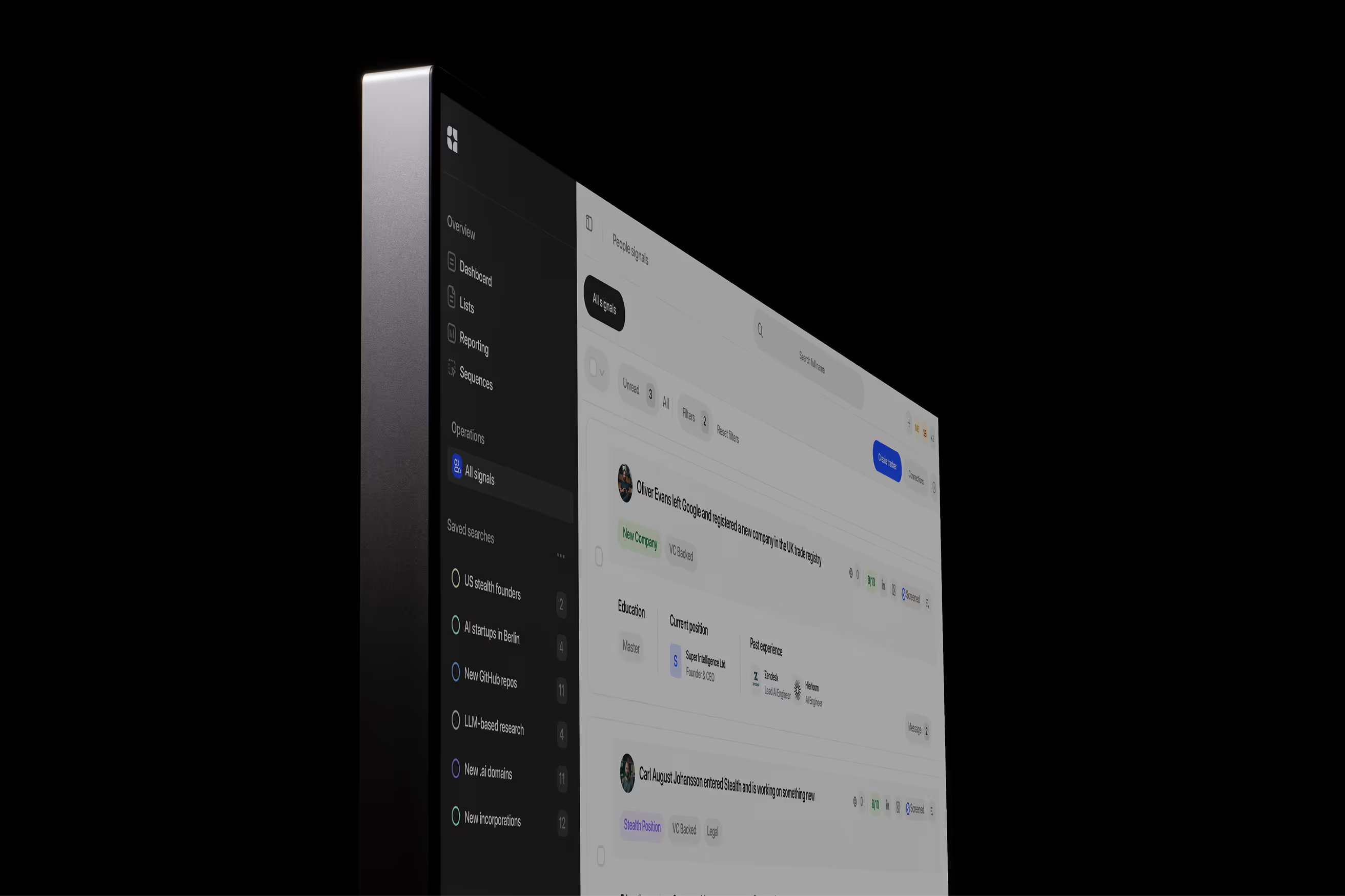
The earliest layer of the stack, and the one where advantage compounds fastest. By the time a company shows up in a startup database or announces a raise, the competitive round is often already forming. Evertrace is a founder detection engine that surfaces promising founders and companies before they appear on everyone else's radar, reading signals across trade registries, patents, research, code, domains and more to spot builders while they're still in stealth. The goal is simple: move your first touch from after the announcement to before it exists, and turn sourcing from a reactive scramble into a systematic edge.
Full disclosure: this is us. We built Evertrace because early-stage sourcing was the part of the stack still stuck in the spreadsheet era.
02 · Portfolio: Cura
Once you've invested, the job shifts from finding to monitoring, and that's historically been a mess of quarterly emails, PDFs and manually updated tabs. Cura is AI-native portfolio monitoring and management for investors, built to keep a live picture of how companies are doing without the manual data chase. For funds that want portfolio insight to be continuous rather than a scramble before every LP update, it's a modern take on a genuinely painful problem.
03 · Fund Ops: Fundra
Running a fund is its own operational discipline: capital calls, allocations, portfolio data, LP reporting. Fundra positions itself as a modern operating system for fund operations, pulling fund administration, portfolio management and LP reporting into one place instead of scattering them across a fund admin, a spreadsheet and a data room. For emerging managers especially, consolidating the back office into a single, purpose-built system removes a surprising amount of drag.
04 · CRM: Groovin
Every fund knows the CRM problem: the data is only as good as the last time someone remembered to update it. Groovin attacks that directly by keeping your CRM current automatically, capturing relevant relationship and prospecting activity without the manual entry. Instead of asking your team to be diligent data clerks, it lets the CRM reflect what's actually happening. Clean data, less busywork, and a pipeline you can actually trust.
05 · Network: Scout
In venture, your network is the product. Scout describes itself as a Venture Relationship Manager: a tool for funds to organize and activate their network across both fundraising and deal flow. Rather than treating relationships as static contacts, it's built to turn a fund's collective network into an active asset, surfacing who you know, who they know, and where those connections can move a deal or a raise forward.
06 · Intros: Happenstance
Related, but from a different angle: Happenstance is AI-powered network search. Point it at a person, company or need, and it helps you uncover warm introductions and hidden connections across your extended network, the second- and third-degree paths you'd never find by scrolling. In a business where a single warm intro can change an outcome, making your network searchable is quietly powerful.
Why this shift matters
Look across these six and a pattern emerges. Each one replaces manual effort with continuous, automated intelligence. Each starts from a venture-specific workflow rather than a generic one. And several are explicitly AI-native, not "AI features bolted on," but products whose core value only became possible recently.
The practical takeaway for fund operators isn't "adopt all six." It's to look at your own stack layer by layer and ask where you're still forcing a venture workflow into software built for something else. Those are the seams where a modern, purpose-built tool tends to pay for itself fastest, usually at the two ends of the funnel: sourcing at the top, and network activation throughout.
This list isn't exhaustive
The modern VC stack is moving quickly, and six tools barely scratch the surface. There's a growing field across company intelligence, fund modeling, diligence and more. Consider this a starting map, not the territory.
If you're rethinking the sourcing layer specifically, the part of the stack where getting there first matters most, that's exactly the problem Evertrace was built to solve. See how founder detection works →
What other modern VC tools would you add to the list? We're always compiling.
The founder detection engine for VCs
AI-powered founder detection with unmatched coverage.
 Book a demo