


Outbound deal sourcing means identifying and contacting relevant founders before they approach the fund.
It is often described as a messaging problem. It is really a selection problem. If the fund contacts the right founder at the right moment for a credible reason, the message can be simple. If the selection is poor, no amount of personalization will rescue it.
Inbound and outbound sourcing solve different problems
Inbound sourcing shows which founders already know the fund and have decided to raise.
Outbound sourcing helps the fund find founders who:
- Are not fundraising yet
- Do not know the fund
- Sit outside its immediate network
- Are building quietly
- Have not appeared in familiar databases
- Would otherwise become visible only after competitors have found them
A healthy sourcing strategy normally uses both.
Step 1: Define the target population
Do not begin with “European B2B software.” That produces a list, not a sourcing strategy.
Define:
- Countries and cities
- Investment stage
- Sector and subsector
- Founder experience
- Technical or commercial characteristics
- Company age
- Exclusion criteria
- Signals indicating that now is the right time
The tighter the definition, the easier it becomes to recognize a meaningful opportunity.
Step 2: Choose the right signal sources
Different companies become visible in different places.
A research-driven startup may first appear through a paper, grant, patent, or university commercialization program.
A software company may appear through a company registration, domain, code project, product launch, co-founder search, or founder transition.
An experienced operator may show founding intent through a combination of professional changes and social activity.
No single signal is conclusive. The strongest opportunities often emerge when several independent signals point in the same direction.
Step 3: Separate detection from qualification
Detection asks: “Is something happening?”
Qualification asks: “Does it fit our fund?”
This separation prevents two common errors:
- Dismissing an early company because insufficient information exists
- Treating a strong formation signal as proof of investment quality
Qualification should combine the signal with founder background, thesis fit, market context, and timing.
Step 4: Prioritize before researching deeply
Use three queues:
Contact now
Clear thesis fit, credible formation evidence, and a reason to believe timing matters.
Research
Potentially relevant, but important facts remain uncertain.
Watch
The person or technology is interesting, but there is not yet enough evidence of company formation.
This prevents analysts from spending an hour on every weak signal while strong opportunities wait.
Step 5: Give every outreach a reason
A credible message answers:
- Why this founder?
- Why this topic?
- Why this fund?
- Why now?
The message does not need a long description of the fund. It needs one specific observation and one credible connection to the thesis.
Avoid pretending that a scaled process is entirely handmade. Founders can recognize generic flattery immediately.
Step 6: Route the opportunity into a real workflow
Outbound sourcing breaks when interesting leads remain in personal notes or unstructured spreadsheets.
Every qualified opportunity should have:
- An owner
- An original source
- A detection date
- A reason for fit
- An action
- A deadline
- A next-review date
- A recorded outcome
The CRM should retain the original signal. Otherwise, the team loses the context that made the company interesting.
Step 7: Follow up without creating pressure
A founder who is not ready to talk today may become relevant six months later.
Use a light follow-up structure:
- One initial message
- One short reminder
- A later message only when there is a genuine reason to reconnect
Useful reasons include a product release, new research, a relevant introduction, or a material change in the market. “Bumping this” every four days is not relationship building.
Step 8: Measure the entire funnel
Track:
- Opportunities detected
- Thesis-qualified opportunities
- Time to review
- Outreach rate
- Response rate
- First meetings
- Opportunities entering diligence
- Investments by original source
- Relevant companies missed
The missed-company review is particularly important. It shows whether the system covers the intended market.
The work does not end after the first meeting
Outbound sourcing creates an early relationship, not an immediate investment.
The founder may still be choosing a co-founder, validating the problem, or deciding whether to leave a job. The fund’s advantage comes from being useful during this period without forcing the company into a fundraising timetable.
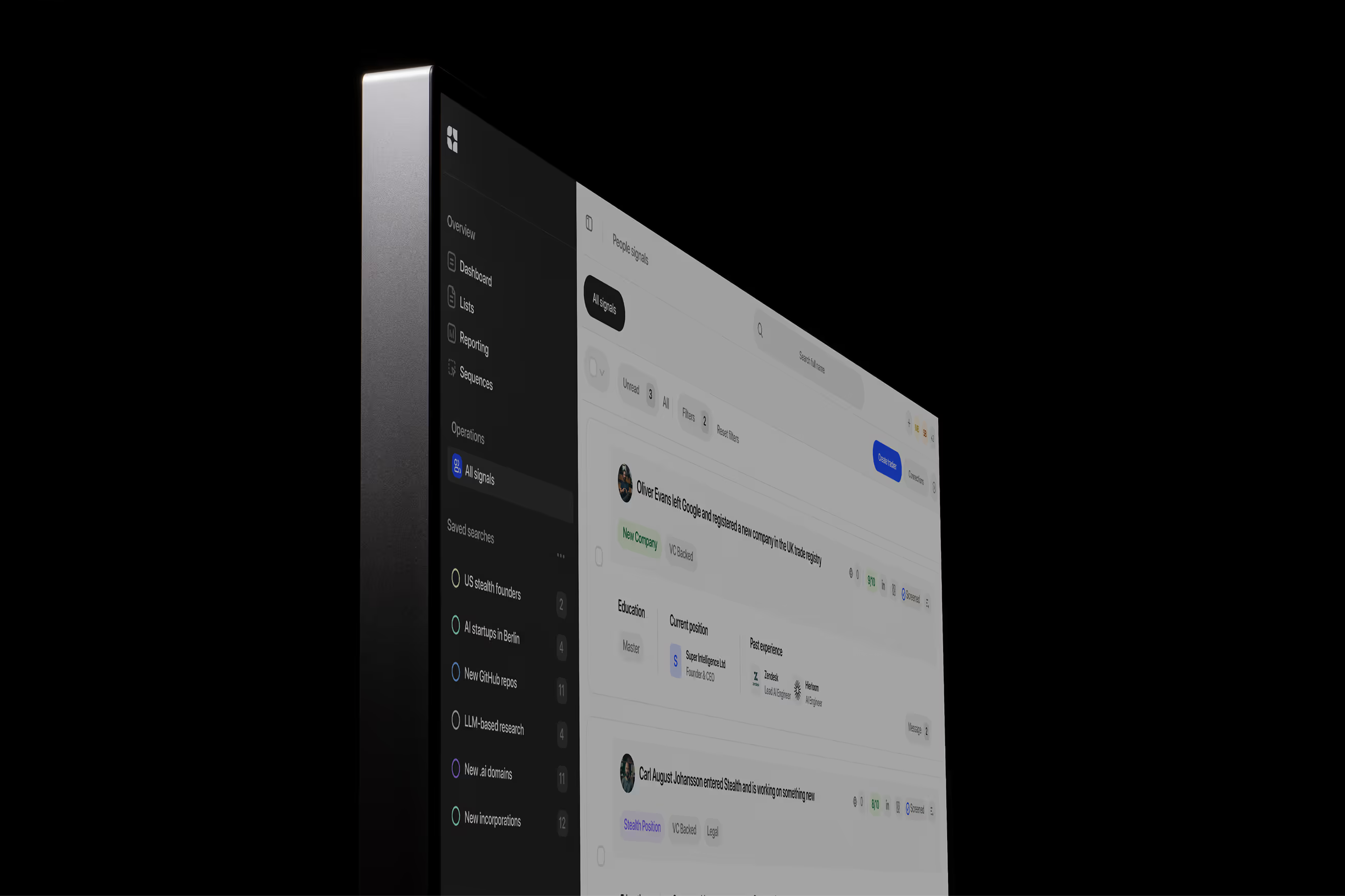
Evertrace provides the detection layer for this workflow by monitoring early founder and company signals. The fund still needs a clear thesis, quick internal decisions, thoughtful outreach, and the patience to develop relationships before a round begins.
---
The founder detection engine for VCs
AI-powered founder detection with unmatched coverage.
 Book a demo