

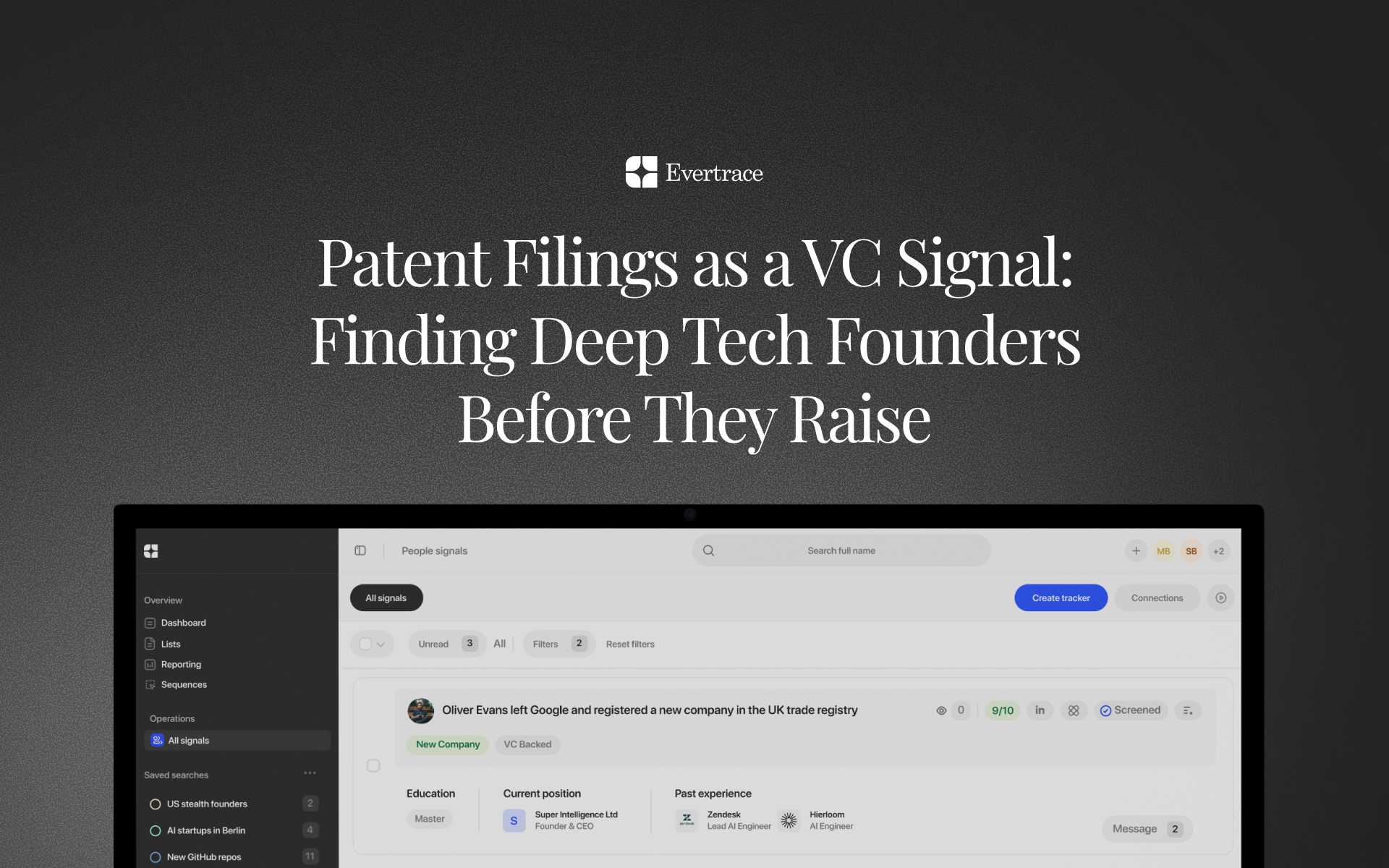
Patent Filings as a VC Signal: Finding Deep Tech Founders Before They Raise
Patent filings are one of the least used and most underrated sourcing signals in venture capital. For investors focused on deep tech, biotech, hardware, climate, and other technically intensive sectors, they are also one of the most powerful.
A patent filing is a public record. It identifies an inventor, describes a technical concept, and is timestamped at the moment of filing, which typically precedes any company announcement by months or years.
Why Patent Signals Are Different From Other Founding Indicators
Most founding signals appear at or after the point of formal company creation. Patent filings are different. They often appear before a company exists. A researcher who has developed a novel technical approach may file a patent to protect that approach while still employed at a university or a corporation. For an investor who monitors these filings, the opportunity is to approach the inventor before they have made any decision about commercialisation, before they have incorporated a company, and before they have talked to any other investor.
How Patent Filings Work
Patent applications are filed with national patent offices or with regional bodies like the European Patent Office (EPO), which grants patents valid across multiple European countries. Applications become publicly accessible approximately 18 months after the initial filing date. This means investors monitoring patent publications are seeing IP that was developed up to 18 months earlier, but still significantly earlier than any company announcement.
Which Sectors Matter Most for Patent Signals
Deep tech and hardware, biotech and life sciences, climate and energy, and materials science are the sectors where patent signals are most valuable. Enterprise software and SaaS are less relevant for patent-based sourcing, as GitHub and trade registry signals are generally more useful there.
Reading Patent Filings as a Sourcing Signal
Individual inventors without corporate assignees are significantly more likely to be building independently. Patents in commercially relevant technical areas matter more than theoretical inventions. Inventor backgrounds add critical context. Multiple filings from the same inventor in a short period can indicate a deliberate IP strategy for commercial purposes.
How Evertrace Uses Patent Signals
Evertrace monitors patent filings from the European Patent Office, national patent offices, and other major global patent databases as part of its multi-signal founder detection system. Patent signals are combined with trade registry data, GitHub activity, domain registrations, academic research, and other signal types to surface deep tech and research-driven founders before any company announcement.
175+ VC firms globally use Evertrace to find founders in deep tech and other patent-intensive sectors before their competitors do.
Book a demo to see Evertrace in action
Frequently Asked Questions
Why are patent filings a useful VC sourcing signal?
Patent filings identify inventors who have developed commercially relevant IP, often before any company exists. They appear months to years before any company announcement, making them one of the earliest available signals for deep tech and research-driven ventures.
How early do patent signals appear relative to company formation?
Patent applications become public approximately 18 months after the initial filing date. Investors monitoring patent publications are seeing IP that was developed up to 18 months earlier, often before any company has been incorporated.
Which sectors benefit most from patent-based sourcing?
Deep tech, biotech, climate technology, hardware, materials science, and other technically intensive sectors are most relevant. Software and SaaS companies file fewer patents, making patent signals less useful in those contexts.
Can you find pre-incorporation companies through patent signals?
Yes. Patent filings often appear before any company exists. A researcher who files a patent on a commercial invention may be approached by investors before they have made any decision about starting a company.
The founder detection engine for VCs
AI-powered founder detection with unmatched coverage.
 Book a demo