

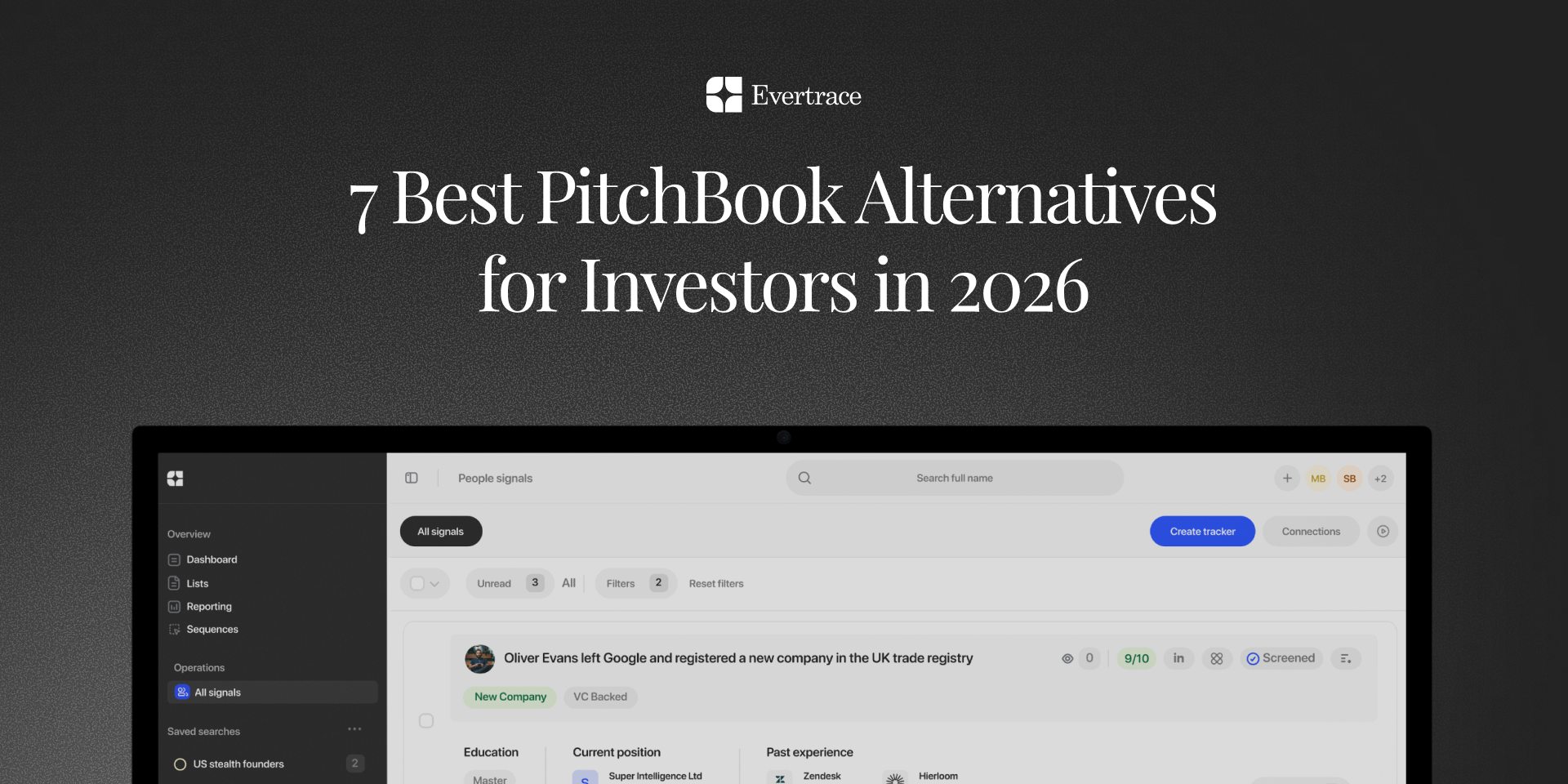
Choosing a PitchBook alternative starts with the part of the investment process you want to improve. A fund researching transactions needs different data from a pre-seed team trying to meet people who have just started building.
For early founder discovery, start with Evertrace. For a self-service company research subscription, consider Crunchbase. Harmonic and Specter combine discovery with people and company intelligence; Dealroom and Tracxn suit market mapping; CB Insights brings technology research and company analysis. These are seven useful options, with different jobs and buying models.
Published by Evertrace. We include our own product first and explain where it fits. Reviewed 1 October 2026 using official product and pricing pages. The recommendations are editorial judgments, not a benchmark of detection speed, accuracy or investment returns.
PitchBook alternatives at a glance
| Tool | Best fit in this shortlist | Public pricing or buying model |
|---|---|---|
| Evertrace | Discovering founders as they begin building | Platform and API plans: contact sales |
| Crunchbase | Self-service company and funding research | Pro: $99 per month on the monthly plan; annual offers differ |
| Harmonic | Company and people discovery with network context | Console, API and bulk data: contact sales |
| Dealroom | Startup landscapes and ecosystem research | Premium: €12,600/year, starting from three seats |
| Specter | Monitoring professional moves and market signals | Platform, API and bulk data: contact sales |
| Tracxn | Sector taxonomies and structured company research | Commercial Premium: contact sales |
| CB Insights | Technology markets and strategic company analysis | Promoted investor offer: $5,000/user annually; eligibility requires confirmation |
Prices are not directly comparable across seats, currencies or access rights. Confirm currency, tax, renewal terms, exports and integrations before comparing total cost. Pricing sources and qualifications appear with each option below.
1. Evertrace: best for early founder discovery
Evertrace focuses on the people forming new companies. Its data sources include company registries, GitHub, research, patents, domains and other signals. It is most relevant when the missing part of your process is finding founders outside the team's existing network.
Think of a fund following university spinouts. The useful starting point may be a researcher, a technical project or a new company registration. Evertrace is a candidate for building that discovery habit; the subsequent investment decision still needs conversations and diligence.
Tradeoff: Choose it for founder discovery, rather than expecting one subscription to reproduce PitchBook's fund research, deal analysis and private-market datasets. Some teams will need both roles covered.
Pricing: Both plans require a quote on Evertrace's pricing page. Ask for the platform or API scope your team needs.
2. Crunchbase: best for self-service company research
Crunchbase Pro brings company profiles, funding history, investor information, alerts and a workspace for tracking opportunities together. It suits an investor who wants to start researching companies without first designing an enterprise data project.
A useful trial is to take a company already in your pipeline and build a credible first briefing: what it does, who has funded it, which peers matter and what changed recently. Measure the work left after you read the profile.
Tradeoff: An accessible research workflow does not establish that every fund, transaction or historical field you use in PitchBook will transfer. Check a sample of the records you rely on.
Pricing: Official support lists $99 per month for Pro's monthly subscription. Annual checkout offers differ; verify the initial and renewal amounts. The Evertrace and Crunchbase comparison covers discovery versus company research.
3. Harmonic: best for company and people discovery
Harmonic's VC offering includes company discovery, founder and role-change alerts, network context and Scout, its AI product. It explicitly addresses stealth founders. It belongs in an early-stage sourcing evaluation, alongside broader startup research tools.
The fit is a team that wants to move between a company, its people and possible introduction paths. Test a narrow thesis with your own examples: a particular technical background, market and geography. Then inspect why each result matched.
Tradeoff: A sourcing product's usefulness depends on relevance and workflow fit, not the size of its database alone. Test those before assuming it can replace the financial research your team currently does.
Pricing: Harmonic publishes quote-based access options. Confirm which console, API, MCP and data packages the proposal includes. Read our Harmonic comparison for a closer sourcing discussion.
4. Dealroom: best for startup landscapes
Dealroom supports company discovery, market mapping and ecosystem analysis. Its use cases span investors, corporates, governments and universities; it also markets founder alerts for early-stage teams.
Consider it when the research question concerns a whole landscape: which businesses sit in a category, where they are based and how that market is developing. A regional investment mandate gives you a concrete way to assess the product.
Tradeoff: The published entry package starts at three seats. For a solo investor, compare the total commitment with how much of the platform you will actually use. Test your particular geography rather than assuming coverage is uniform.
Pricing: Premium is €12,600/year; Premium Plus is €17,000/year, both starting from three seats. Enterprise and API packages require a quote.
5. Specter: best for professional moves and signals
Specter's Talent Signals covers new founders, stealth activity and career changes. Its broader platform also includes company data and other market signals. It is a candidate when an investor's thesis begins with particular people or operator backgrounds.
For example, a fund following alumni of several technical companies can test whether the feed turns those interests into a manageable research queue. Inspect the evidence behind a move before deciding whether it warrants outreach.
Tradeoff: A role change is a reason to investigate, not proof that a person is building a venture-scale business or wants investment. Your team still needs to qualify the opportunity.
Pricing: Contact sales for Platform, API or bulk data. The Evertrace and Specter comparison looks at the sourcing choice.
6. Tracxn: best for structured sector research
Tracxn combines company research, sector classification and investor workflows. It is worth evaluating when analysts spend substantial time building comparable company sets and breaking broad sectors into specific business models.
Bring a category that is difficult to define. Check whether the classification separates business models that matter to your thesis, then examine the companies on both sides of that boundary. A taxonomy is useful only if it improves the decisions your team makes.
Tradeoff: Free access is not the commercial plan. Also confirm export and data-delivery allowances before planning recurring research around them.
Pricing: Premium requires a sales quote. Tracxn describes its free, usage-limited Lite plan as being for personal use.
7. CB Insights: best for technology-market analysis
CB Insights combines technology-company search with market analysis and research. It is relevant when the investment question is as much about a market's direction and competitive structure as it is about finding an individual company.
Give it a real research assignment: assess an emerging category, identify the companies that matter and explain what evidence would change your view. Compare the resulting work with what your investment committee actually needs.
Tradeoff: Analyst research and predictive scores still require interpretation. Check definitions, source evidence and relevance to your stage before treating a ranking as an investment conclusion.
Pricing: Its promoted investor offer lists $5,000 annually for a user or $20,400 for team access. Confirm eligibility, seats and renewal terms; other packages require a quote.
When keeping PitchBook is the better choice
Keep PitchBook on the shortlist if you depend on its particular combination of transaction, fund, investor and financial research. Its deal-sourcing tools also serve broad private-capital workflows. A narrower product may improve one part of sourcing without replacing those requirements.
Before switching, list the five tasks your team performs most often. Run the same tasks in each finalist, check a small set of known records and compare the complete quote, including data access. PitchBook's pricing varies with seats, firm type and additional products, so use your actual proposal rather than a third-party estimate.
If meeting founders earlier is the priority, request an Evertrace walkthrough around your fund's markets. If the priority is research depth, let those research assignments determine the shortlist.
The founder detection engine for VCs
AI-powered founder detection with unmatched coverage.
 Book a demo