

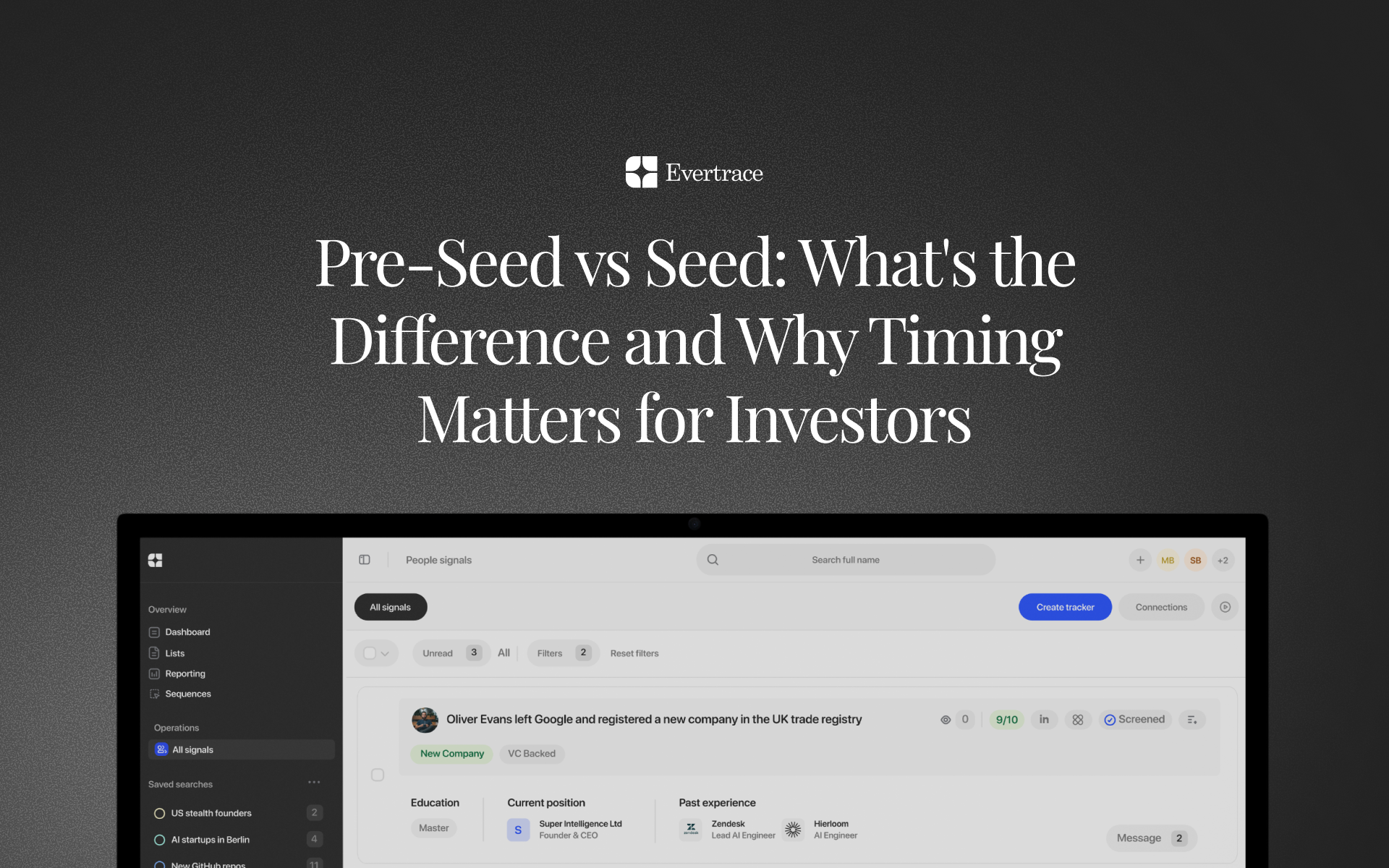
Pre-Seed vs Seed: What's the Difference and Why Timing Matters for Investors
The distinction between pre-seed and seed is one of the most commonly misunderstood in venture capital. The labels are used inconsistently across funds, geographies, and time periods, which creates confusion for both founders trying to navigate the fundraising landscape and investors trying to define their own positioning.
Defining Pre-Seed
Pre-seed is the earliest stage of institutional investment in a company. At pre-seed, the company is typically an idea, a team, an early prototype, or some combination of these. The decision to invest at pre-seed is almost entirely a judgment about the founding team. There is rarely enough product, customer, or market evidence to make a data-driven investment case.
Defining Seed
Seed is the first round where there is some evidence of early traction, product direction, or market validation. At seed, the company has typically built a version of the product, has some early customers or users, and has a clearer hypothesis about the market it is addressing. At seed, investment decisions are still heavily team-weighted, but there is increasing reliance on early data: revenue trends, user retention, customer interview evidence, and product metrics.
Why Timing Matters
Competitive dynamics
At seed, there is typically a competitive process. Multiple funds are aware of the company, the founder is taking meetings, and the round may be oversubscribed. At pre-seed, especially at the genuine earliest stage, there is often no competitive process. The investor may be the first person outside the founding team to understand what is being built. There is time to develop a real relationship before the transaction, to add genuine value before asking for anything, and to negotiate from a position of genuine partnership rather than competition.
Pricing and ownership
Earlier rounds are priced lower, in part because the risk is higher and in part because there is no competitive market to drive valuation up. An investor who leads a pre-seed round at a company that goes on to raise a seed round at a significantly higher valuation has both a financial advantage and a relationship advantage.
Relationship quality
At pre-seed, the investor is often a genuine thinking partner, helping the founder work through early product decisions, hiring challenges, and market questions. The relationship is built over time, before any competitive pressure exists. At seed, the investor relationship often begins in the context of a fundraising process, with less time for relationship development.
How Stage Affects Sourcing Strategy
The earlier the stage an investor targets, the more their competitive advantage depends on finding founders before anyone else knows they exist. At pre-seed, reputation helps but is not sufficient on its own. The best pre-seed opportunities are often with founders who have not yet told anyone they are building, who have not yet applied to an accelerator, and who have not yet been introduced to any investors. Reaching those founders requires active, systematic detection of early founding signals, not passive waiting for them to appear.
How Evertrace Helps Pre-Seed Investors
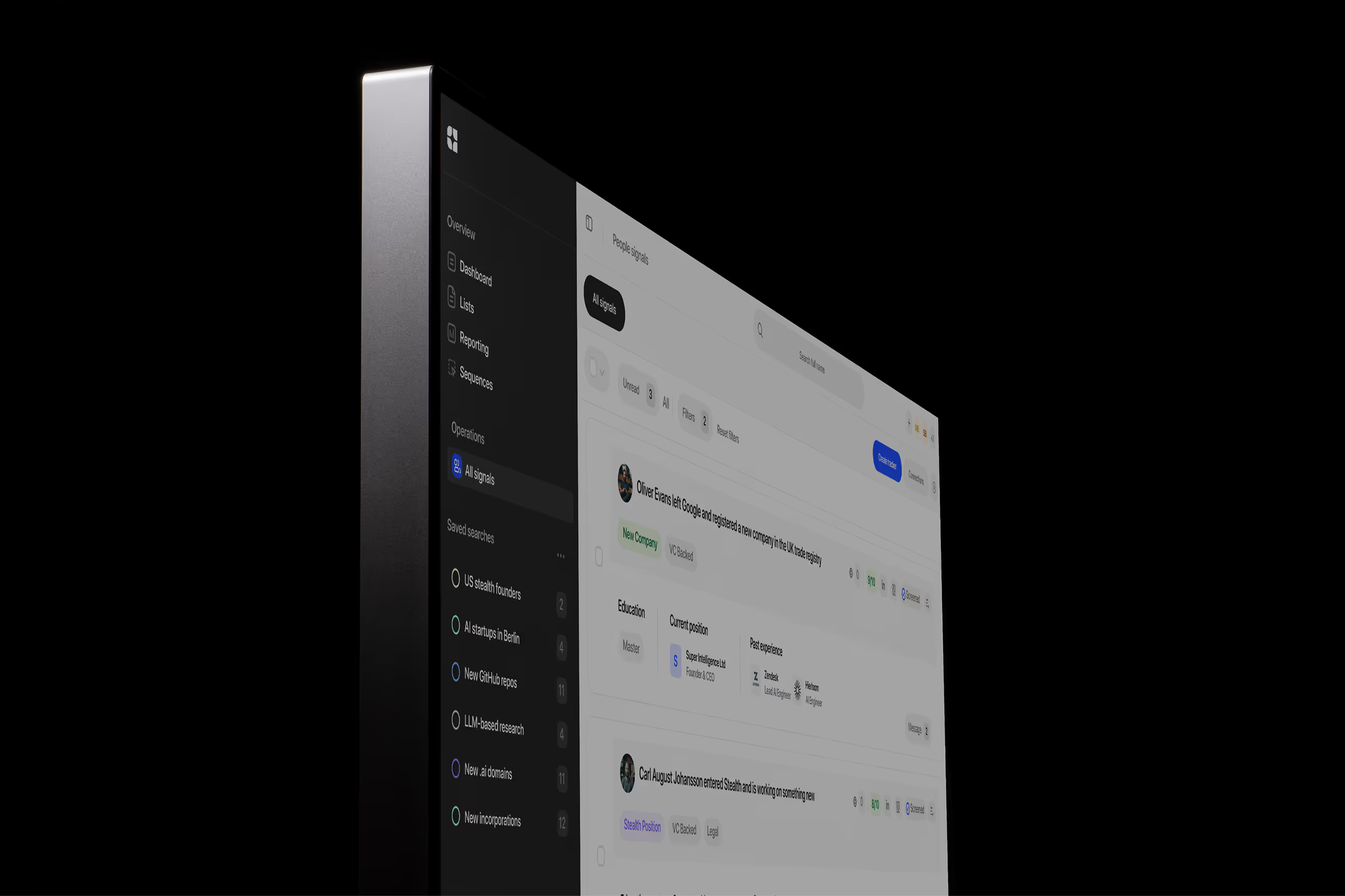
Evertrace is built for investors who want to compete at the earliest stage of the venture lifecycle. By detecting founders through trade registry filings, GitHub activity, patent filings, domain registrations, and other real-time signals, Evertrace surfaces the companies that are too early for any other sourcing channel.
Signals are scored and filtered by geography, sector, and founding profile, and flow directly into Affinity, Attio, or connected AI agents via MCP. 175+ VC firms globally use Evertrace to find founders at pre-seed stage before their competitors do.
Book a demo to see Evertrace in action
Frequently Asked Questions
What is the difference between pre-seed and seed?
Pre-seed is the earliest stage of institutional investment, typically before meaningful product-market fit evidence exists. Seed is the stage where a company has some early traction and a clearer product direction. Pre-seed bets are heavily team-weighted; seed bets combine team quality with early data.
What is a typical pre-seed round size?
Pre-seed rounds typically range from a few hundred thousand to two or three million euros or dollars, though this varies by market, sector, and the specific fund.
How do pre-seed investors find companies before there is any public evidence of them?
The most effective approach is monitoring the observable signals that appear at the point of company formation: trade registry filings, code activity, domain registrations, patent filings, and other public data sources. These signals precede any public announcement and allow investors to reach founders before any competitive process begins.
The founder detection engine for VCs
AI-powered founder detection with unmatched coverage.
 Book a demo