

.png)
Sourcing Software for VCs: The Complete Guide to Deal Flow Technology
The market for VC sourcing software has matured significantly over the past five years. What was once a collection of general-purpose databases and manually maintained spreadsheets has become a specialised category of tools purpose-built for the specific workflows of early-stage investors. Understanding what each tool type does, where each one fits in a sourcing stack, and how they combine is increasingly a source of competitive advantage for funds that get it right and a source of missed opportunities for those that do not.
The Core Problem Sourcing Software Tries to Solve
Venture capital is a search problem with unusual characteristics: the highest-value opportunities are often the least visible, the best time to find them is before they have any public presence, and the population of potential investments is constantly changing as new companies form. Most software that VCs use was not built for this problem. CRM systems were built for sales. Databases were built for research. The category of software explicitly designed for VC sourcing, from first-signal detection through relationship management to pipeline tracking, is relatively recent and still maturing.
Founder Detection and Signal Monitoring Platforms
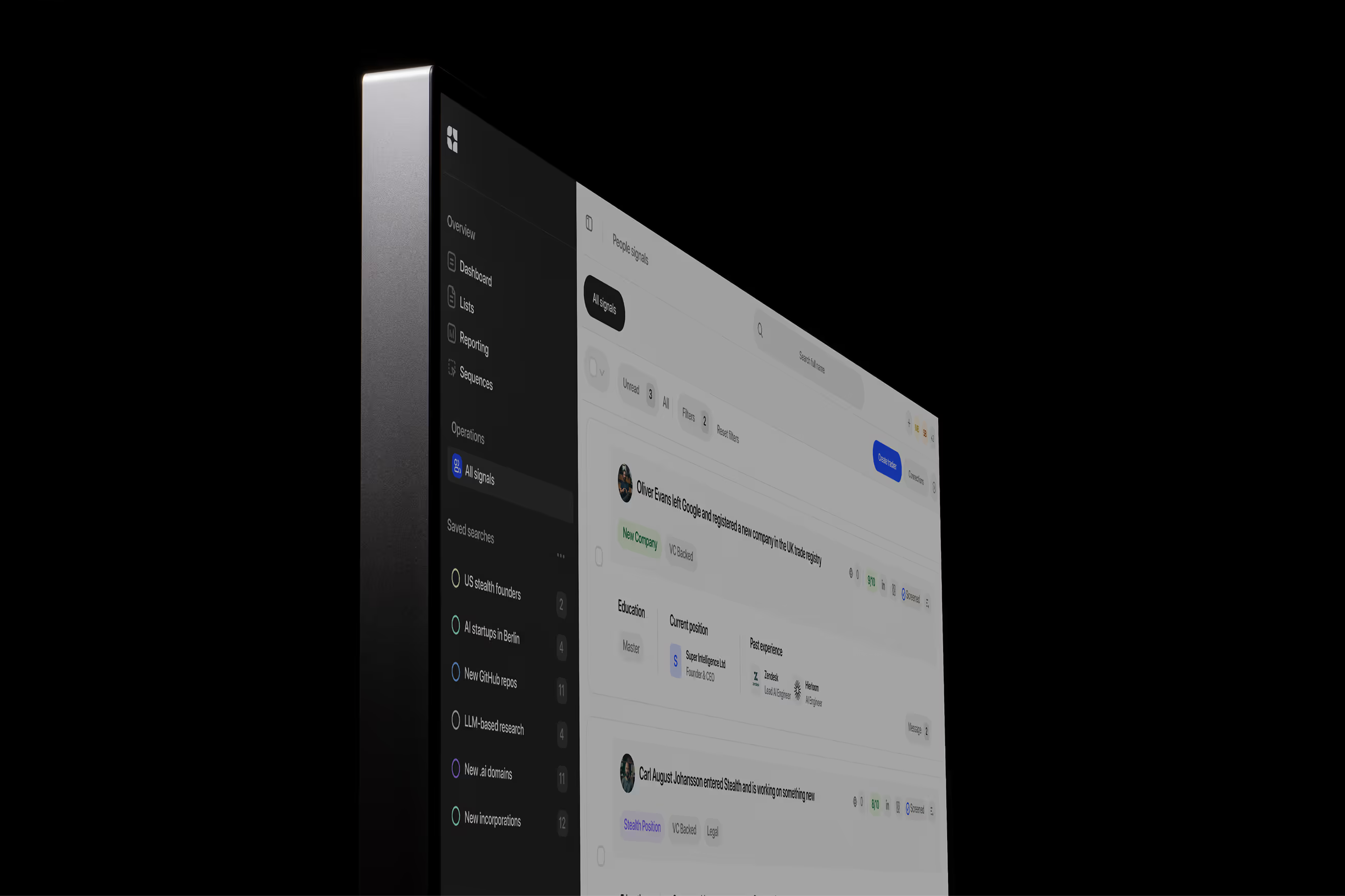
These platforms are built specifically to surface founders at the earliest observable stage, before any public announcement, funding round, or database entry. They monitor public data sources including company registries, code repositories, patent databases, domain registration records, academic research, and social platforms for signals that indicate a person is in the process of forming a company. The best platforms combine multiple signal types, apply scoring models to rank signals by quality, enrich them with background information on the founding individual, and deliver them into a CRM or workflow tool in real time.
Who they are for: pre-seed and seed investors who compete on timing and whose primary competitive advantage is reaching founders before other funds do.
What they do well: finding the population of founders who have not announced anything yet. A company that incorporated yesterday, whose founder has the right background and is showing corroborating signals, is a category of lead that simply does not exist in any startup database.
Evertrace is a founder detection platform focused on the earliest stage of company formation, monitoring trade registries, GitHub, patent filings, academic research, domain registrations, app stores, Product Hunt, and social platforms globally. Signals are scored against the profiles of previously successful venture-backed founders and integrate directly into Affinity, Attio, and AI agents via MCP. Used by 175+ VC funds globally.
Startup Databases
Startup databases are retrospective catalogues of companies that have already formed, raised funding, and established some level of public visibility. They do well at providing comprehensive information about companies that are already visible, making them essential for due diligence, market landscape analysis, and later-stage deal flow. They do not find companies before they are publicly known.
Crunchbase is the most widely used global startup database, with strong coverage across major markets and comprehensive funding data. Dealroom has particularly deep coverage of European startup ecosystems and is widely used for market intelligence. PitchBook provides the most comprehensive financial data, including cap table information and detailed round data, primarily used by larger funds for in-depth deal analysis.
CRM and Relationship Intelligence Platforms
These platforms manage the relationship layer of deal flow, tracking interactions, mapping networks, and maintaining the ongoing relationship context that is essential for early-stage investing. The best VC-focused CRMs are built for the non-linear, long-horizon nature of early-stage investing, with features for tracking companies across multiple stages of development, managing relationship health, and surfacing warm introduction paths.
Affinity is the leading CRM for venture capital, with built-in relationship intelligence that automatically maps team connections and surfaces warm introduction paths. Widely adopted across pre-seed and growth-stage funds. Attio is a newer CRM with a more flexible data model well-suited to the complex, customised workflows of early-stage investing, growing rapidly at seed and pre-seed funds. Both integrate with founder detection platforms to create a unified sourcing and relationship management workflow.
Data Enrichment and Intelligence Tools
These platforms add context to existing leads, filling in background information on founding teams and providing the professional history context that makes a raw signal useful. A tool that automatically enriches a company registration signal with the founder's professional background, prior companies, and contact information transforms a raw data point into an actionable lead without requiring manual research.
Harmonic builds comprehensive startup and founder profiles once companies have reached some level of visibility. Strong complement to earlier-stage signal detection: particularly useful for enriching leads detected through signal monitoring with deeper context once the company is more established. Apollo provides contact data and professional history at scale. Clay allows custom enrichment workflows that pull from multiple data sources.
AI-Powered Sourcing Agents and MCP Integration
This is the newest and fastest-evolving category in VC sourcing technology. AI sourcing agents allow investment teams to query deal flow data, draft outreach, summarise signals, and update CRM records through natural language interfaces rather than navigating multiple separate tools. Model Context Protocol (MCP) is the emerging standard for connecting AI agents to external data sources. Platforms including Evertrace support MCP integration, enabling investment analysts to run natural language queries against real-time founder detection data, draft personalised outreach, and update CRM records through a single interface.
How to Build the Right Stack
The right combination of sourcing tools depends on stage, strategy, and team size. Think of the stack in layers. The detection layer surfaces new opportunities: for pre-seed investors, this should include a founder detection platform as the primary proactive sourcing mechanism. The enrichment layer adds context to detected leads. The relationship layer tracks and manages ongoing investor-founder relationships using a purpose-built VC CRM. The workflow layer connects these components and reduces manual overhead through AI agent integration.
The most important single decision in building a sourcing stack for a pre-seed fund is whether the detection layer includes systematic pre-announcement signal monitoring. Funds that rely entirely on startup databases, inbound, and relationship-based sourcing for deal flow are structurally disadvantaged relative to those that have built proactive early detection capability.
Book a demo to see how Evertrace fits into your sourcing stack
Frequently Asked Questions
What is the most important sourcing tool for a pre-seed VC fund?
For a fund that competes on timing, the most important investment is in proactive signal detection: a platform that monitors founding activity before any announcement. Everything else manages deals that are already visible to the market.
Do I need all these tools or can I start with fewer?
A minimal effective stack for a pre-seed fund is a founder detection platform and a CRM. Enrichment tools and AI workflow layers add efficiency at scale. Startup databases are useful for research and due diligence but should not be the primary sourcing mechanism at pre-seed.
What is the difference between Crunchbase, Dealroom, and PitchBook?
Crunchbase provides broad global coverage with a lower price point. Dealroom has particularly deep coverage of European ecosystems. PitchBook provides the most comprehensive financial and cap table data and is primarily used by larger funds for detailed deal analysis. All three are retrospective databases rather than prospective detection tools.
How do AI sourcing agents work in practice?
Through MCP or similar integration standards, AI agents connect to external data sources including founder detection platforms and CRMs. An investment analyst can ask the agent to surface relevant recent signals, research specific founders, draft personalised outreach messages, and log all activity to the CRM through a natural language interface.
How much does VC sourcing software cost?
Pricing varies widely. Startup databases range from free tiers to tens of thousands of dollars per year. Founder detection platforms are typically priced based on team size and signal volume. CRMs for VC are typically priced per user per month. The total cost of a comprehensive sourcing stack for a small fund typically ranges from tens of thousands to over a hundred thousand dollars annually.
Is it worth investing in sourcing software for a small fund?
Yes. The leverage of systematic early detection on fund performance compounds significantly over time. A fund that consistently reaches founders before competitive processes begin, over multiple years, builds a sourcing advantage that is genuinely difficult for competitors to replicate.
The founder detection engine for VCs
AI-powered founder detection with unmatched coverage.
 Book a demo