

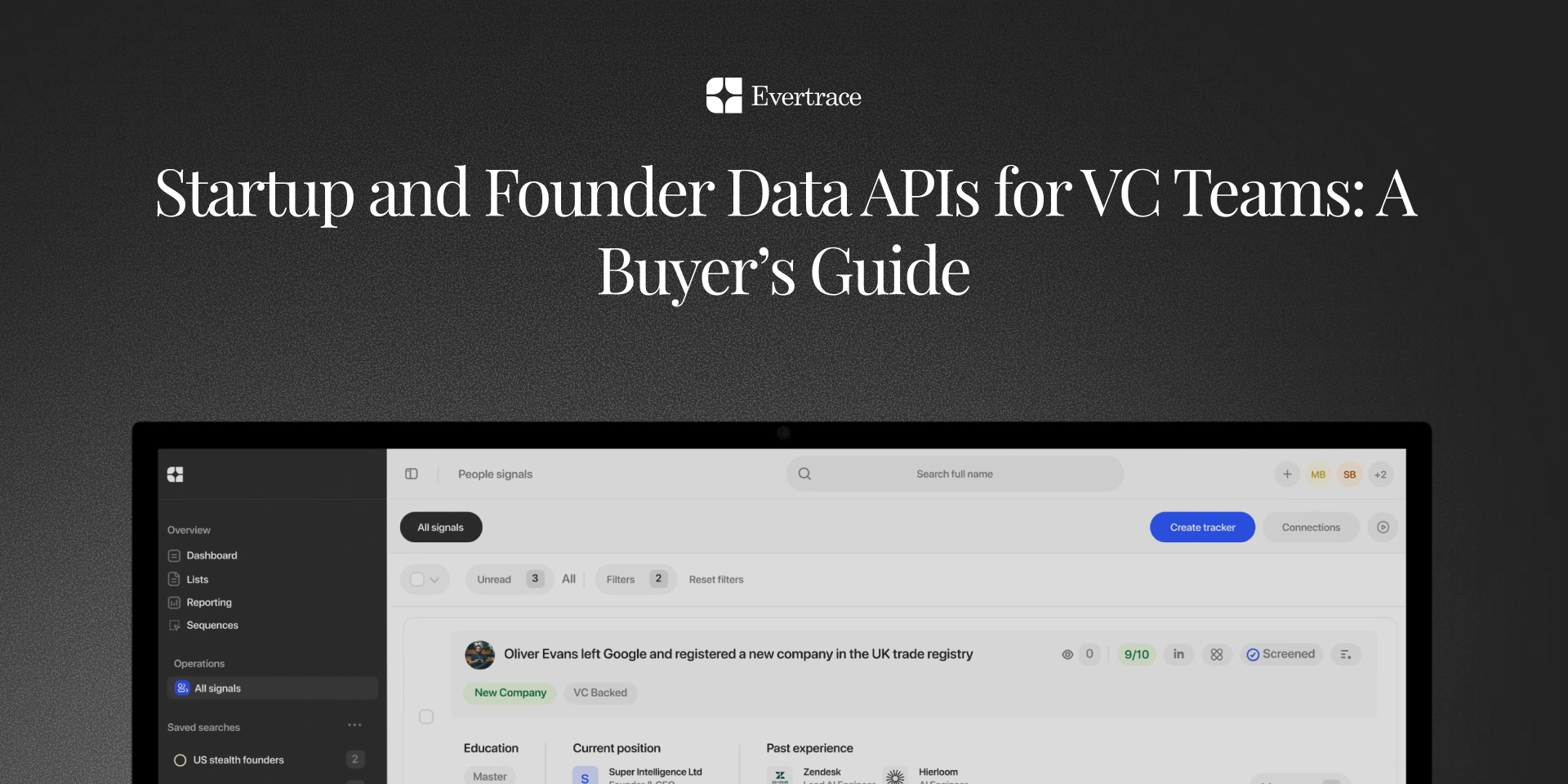
A founder turns up in a sourcing platform. An analyst opens their profile, finds the company website, checks the CRM, copies a few details and leaves a note for a colleague. The research may be interesting. Moving the information between tools is less so.
Repeat that process across a week of sourcing and the administrative work becomes part of the job. It also decides what gets followed up. The founder who was worth a closer look can disappear into an open tab because nobody had time to finish the handover.
This is where a startup or founder data API becomes useful. It brings information directly into the systems a fund uses to make decisions, so discovery can lead to a record, an owner and a conversation.
Company data and founder signals answer different questions
A company database is useful when there is already a business to look up. An investor has a name or a domain and wants to understand the team, market or financing history.
Early-stage sourcing can begin with much less. There may be a person leaving a role, a new technical project or a recently registered business with no website. The question is who is starting something, what it might become and whether it fits the fund.
That distinction matters when choosing an API. A service that enriches known companies could fit a diligence workflow perfectly while leaving the fund’s early discovery problem untouched. Founder signals give an internal system something new to investigate.
What changes when the data reaches your own tools
Consider a fund focused on industrial software. Its sourcing criteria live partly in saved searches, partly in an analyst’s judgment and partly in what the partners have learned from portfolio companies.
With data arriving through an API, the fund can bring those inputs together. New signals can be matched against its own criteria, checked against existing relationships and routed to the person covering that market. A partner opening the CRM sees the founder alongside the reason they appeared and the source that prompted the research.
The useful part is the continuity. The context survives the move from discovery to discussion, and the analyst can spend the next ten minutes understanding the opportunity.
The details that make a feed dependable
A name alone is a fragile way to connect records. People change roles, companies change domains and two founders can share a name. Stable identifiers help an integration recognise the same person when another signal arrives.
Dates matter for a similar reason. The day a founder started a company, the day a provider noticed it and the day your system downloaded the record are different events. An alert labelled “new” should have a clear meaning to the analyst reading it.
Then there is the source. A short summary is convenient, but a link to the underlying filing, project or announcement lets someone follow the thread. That is especially valuable when the opportunity is early and the public information is still sparse.
These details rarely dominate a demo. They become important once the feed runs every day and the investment team starts relying on it.
A good integration can begin with one workflow
There is no need to rebuild the entire sourcing process around a new API. One feed into a review queue is enough to see whether the data adds useful founders and whether the team can act on them.
The operational questions then become concrete: how the next batch arrives, how duplicates are handled, what happens when a request fails and who maintains the connection. Costs become clearer too, because the fund is pricing a real pattern of use.
Evertrace’s API gives funds access to founder signals for their own tools, dashboards and CRM workflows. Existing integrations offer a simpler route where the destination is already supported.
For a fund building its own sourcing process, the API is a way to bring discovery closer to the place where relationships are managed. The result should be visible in the analyst’s day: fewer records to move, more founders to understand.
The founder detection engine for VCs
AI-powered founder detection with unmatched coverage.
 Book a demo