

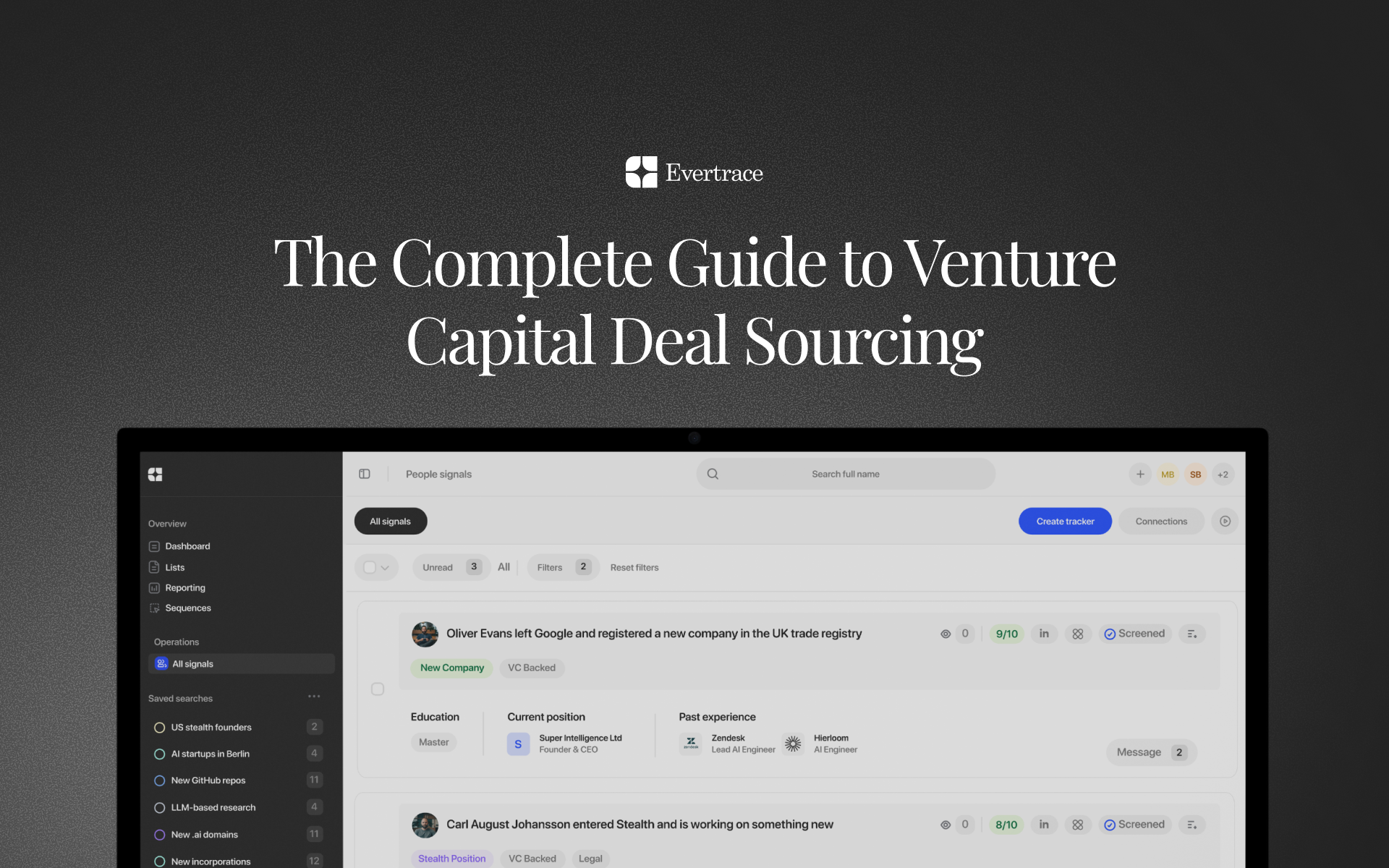
The Complete Guide to Venture Capital Deal Sourcing
Deal sourcing is the most consequential activity in venture capital. Every investment a fund makes was sourced from somewhere. The quality, timing, and breadth of a fund's sourcing determines the universe of opportunities it can invest in, and no amount of evaluation skill, negotiation ability, or portfolio support creates returns from deals that were never seen.
Yet sourcing receives less systematic attention than almost any other part of the investment process. Most funds have documented investment criteria, defined due diligence frameworks, and structured portfolio reviews. Very few have a written sourcing strategy, a defined process for how signals are found and acted on, or a clear understanding of which sourcing channels produce which outcomes.
What Deal Sourcing Actually Is
Deal sourcing is the process of identifying potential investment opportunities before making a decision to evaluate them. It is everything that happens between a company existing in the world and an investor becoming aware of it. Sourcing is distinct from evaluation: evaluation assesses whether an opportunity is worth investing in. Sourcing ensures that the best opportunities are in the investor's awareness in the first place. Most investors dramatically underinvest in sourcing relative to evaluation.
The Sourcing Landscape: Three Tiers
Tier 1 is pre-announcement sourcing. The investor finds a founder before the company has made any public announcement, before any fundraising process has begun, and before any other investor is aware of the opportunity. The investor initiates contact, not the founder. This produces genuinely proprietary deal flow and is the only tier that consistently generates first-mover advantage.
Tier 2 is network-based sourcing. The investor learns about a company through a warm introduction, a conference encounter, or a referral from a portfolio founder. The company is probably known to multiple investors simultaneously. The introduction provides a relationship edge but not a timing edge.
Tier 3 is reactive sourcing. The investor receives an inbound application, sees a company in the press, or finds it through a database search. The company is already publicly visible and likely being evaluated by multiple funds.
Most VC funds operate primarily in Tier 2 and Tier 3 and describe this as proprietary deal flow because warm introductions give them an edge. In practice, a warm introduction during a fundraising process is simply a better-positioned version of Tier 3 sourcing.
The Eight Sourcing Channels
Company registrations and trade registry monitoring
Every company must incorporate somewhere, and that incorporation is recorded in a public government registry, usually within days of filing. A fund that monitors these registrations, links them to the background of the founding individual, and acts quickly on relevant new filings is consistently finding companies before any other sourcing channel surfaces them. Trade registry monitoring is the single most reliable Tier 1 sourcing channel because it is based on a formal legal act rather than an observable behaviour.
Code repository monitoring
Technical founders often begin building before they incorporate. GitHub activity from engineers transitioning from employment to independent company building, characterised by new repositories with product structure, unusual commit timing, and the creation of new organisations, is an observable signal that a company is forming at the code level.
Patent database monitoring
Patent filings are public records that identify individual inventors and describe their innovations. A patent filed outside the context of a corporate employer, by an individual with a relevant technical background, in a commercially relevant area, signals that a potential founder has developed IP worth protecting. Deep tech ventures in particular exhibit patent signals months to years before any company announcement.
Academic research and grant monitoring
Researchers who receive competitive government grants and publish work with clear commercial applications are in the pre-commercialisation pipeline. Monitoring major grant databases including SBIR, Innovate UK, Horizon Europe, and national research councils, combined with monitoring of academic publications in commercially relevant fields, surfaces potential founders at the research stage.
Domain registration monitoring
Founders typically register a domain before they incorporate and before they build. Domain registration data, cross-referenced with other signals, confirms company formation is underway.
Social platform monitoring
Departure announcements, co-founder searches, problem-space exploration posts, and technical building updates on platforms like X indicate founding intent before any formal company event. Social signals are later-stage than formal founding signals but useful as enrichment and confirmation.
Product Hunt and app store monitoring
New product launches and app store submissions surface companies at the moment of their first public product visibility, typically before press coverage and before any fundraising announcement.
Network and relationship activation
The fund's existing network, including portfolio founders, co-investors, advisors, and alumni of companies in relevant sectors, generates warm introductions. This is a valuable channel and should be systematised, but it is fundamentally Tier 2 sourcing that reaches founders at the network introduction stage rather than at the formation stage.
The Sourcing Stack
A systematic sourcing process requires tools in four layers. The detection layer surfaces new opportunities: for pre-seed funds, this means a founder detection platform that monitors the Tier 1 signal sources described above. Evertrace monitors trade registries, GitHub, patent databases, grant databases, domain registrations, academic research, app stores, Product Hunt, and social platforms globally, scoring and filtering signals by investment thesis relevance and delivering them in real time to investment teams. The enrichment layer adds context to detected leads. The relationship layer manages ongoing investor-founder relationships using CRMs like Affinity and Attio. The workflow layer connects these components via AI agents and MCP integration.
Building a Sourcing Cadence
A sourcing cadence is the set of recurring actions that keep a sourcing process operating consistently. Without a defined cadence, sourcing becomes sporadic, signals go unreviewed, and early relationships fade before investment windows open. A minimum effective cadence includes a daily review of new high-priority signals, a weekly pipeline meeting covering active relationships and near-term opportunities, and a quarterly review of sourcing channel performance.
The Compounding Advantage
Deal sourcing is a compounding activity. Founders who were reached early and treated well refer other founders. A fund known for being first and genuinely useful builds a reputation that attracts founders who prefer that kind of investor. The compounding advantage takes time to become visible: in the first year, a fund builds a watchlist. In the second year, early relationships begin converting to investments. In the third and fourth years, portfolio founders begin generating referrals. Funds that abandon systematic sourcing after twelve months never reach the compounding phase.
How Evertrace Powers Systematic Sourcing
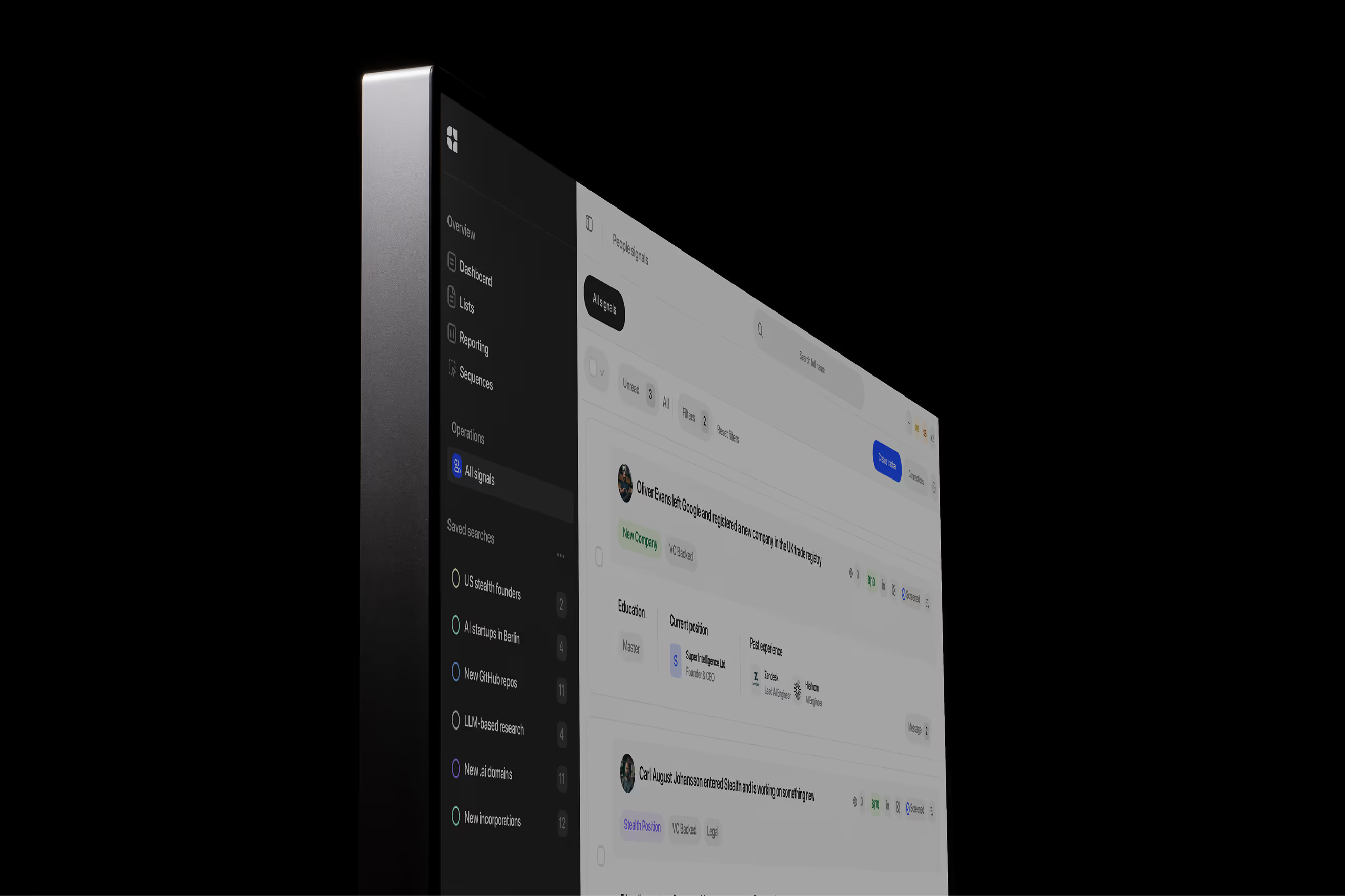
Evertrace provides the detection layer for early-stage VC funds that want to compete on timing. Real-time monitoring of trade registries, GitHub, patent databases, grant databases, academic research, domain registrations, app stores, Product Hunt, and social platforms globally produces a scored, filtered signal feed that integrates directly into Affinity, Attio, Slack, and AI agents via MCP.
175+ VC firms globally use Evertrace as the core of their Tier 1 sourcing infrastructure.
Book a demo to see Evertrace in action
Frequently Asked Questions
What is the most important thing a VC fund can do to improve its deal sourcing?
Start systematic monitoring of pre-announcement founding signals. Most funds overinvest in relationship management and evaluation and underinvest in the detection layer that determines what enters the pipeline in the first place.
What is the difference between deal sourcing and deal flow?
Deal flow is the stream of opportunities a fund sees. Deal sourcing is the process by which that stream is generated. The quality of your sourcing determines the quality of your deal flow.
How many sourcing channels should a pre-seed fund use?
At minimum, a proactive signal detection platform for Tier 1 sourcing, supplemented by structured network activation for Tier 2. Relying on a single channel creates concentration risk in the sourcing pipeline.
How do you measure the quality of your deal sourcing?
Track the stage at which companies first entered your pipeline relative to their eventual fundraising timeline. Funds with strong Tier 1 sourcing will have average first-contact dates significantly earlier than the companies' public fundraising announcements.
Is systematic deal sourcing only relevant for pre-seed funds?
The earlier the stage, the higher the competitive value of systematic sourcing. But seed-stage and early Series A funds also benefit, particularly for building relationships with companies they want to follow into later rounds.
The founder detection engine for VCs
AI-powered founder detection with unmatched coverage.
 Book a demo