
The German Startup Ecosystem: A VC Sourcing Guide
Germany is the largest economy in Europe and the second largest source of venture-backed companies after the United Kingdom. Berlin has established itself as one of Europe's two or three dominant startup cities, but the German ecosystem is meaningfully different from the UK's: it is more geographically distributed, more engineering-driven, more export-oriented, and it has a deeper industrial base that creates specific sourcing opportunities in deep tech, hardware, and B2B software that are less prominent elsewhere.
Why Germany Matters for VC Sourcing
Engineering and technical talent density is exceptionally high. Germany's network of technical universities, including TU Munich, KIT Karlsruhe, TU Berlin, RWTH Aachen, and Stuttgart, produces deep engineering expertise in mechanical, electrical, software, and materials engineering. This talent base is disproportionately represented among founders building hard tech, industrial software, and advanced manufacturing ventures.
Mittelstand adjacency creates sourcing opportunities. The Mittelstand, Germany's network of mid-sized manufacturing and industrial companies, is a source of deep domain expertise that is increasingly being monetised through new software and technology ventures. Engineers and operators with ten to twenty years of experience in specific industrial verticals are forming companies to modernise the industries they know from the inside.
The B2B orientation of the German market creates a specific kind of founder population. Founders building enterprise software, industrial automation tools, and business process platforms are more common in Germany than in markets that skew toward consumer technology.
The Handelsregister: Germany's Company Formation Database
The Handelsregister is Germany's commercial register, maintained at the regional court level across the country. Unlike the UK's centralised Companies House, it is federated across regional courts. A national search portal (handelsregister.de) provides access to all regional registers. Germany incorporates approximately 70,000 to 80,000 new companies per year, making it one of the highest-volume incorporation markets in Europe. The predominant legal entity for German startups is the GmbH, though the recently introduced FlexGmbH and UG forms are also used by early-stage founders. A new filing includes the company name, registered office, legal entity type, managing directors, and sometimes shareholder information.
EXIST and Government Innovation Programs
EXIST (Existenzgrundungen aus der Wissenschaft) is the primary German federal program supporting the transition from research to commercial venture, offering grants of up to 250,000 euros to founding teams from German universities. High-Tech Grunderfonds (HTGF) is Germany's largest early-stage VC fund, operating partly as a government-backed vehicle and co-investing with private investors at pre-seed and seed stage. The Fraunhofer Society, Helmholtz Association, Leibniz Association, and Max Planck Society collectively employ tens of thousands of researchers and produce commercially relevant research across virtually every technical domain. Monitoring spinout activity from these institutions is a high-quality sourcing channel for deep tech German ventures.
Key City Ecosystems
Berlin is Germany's startup capital by deal volume and media attention, with diversity across consumer technology, fintech, health technology, and B2B software. Munich is Germany's deep tech and engineering hub. Proximity to BMW, Siemens, Allianz, and other major industrial companies, combined with TU Munich's exceptional engineering output, creates a unique environment for hardware, deep tech, and enterprise software ventures. Hamburg has strength in media technology, logistics, and maritime technology. The Rhine-Ruhr region has a growing ecosystem with particular strength in retail technology, HR software, and enterprise applications.
Sourcing German Founders Before Announcement
German technical founders tend to be less publicly visible on social platforms than their counterparts in the UK or US, making social platform monitoring less effective as a primary signal source. Trade registry and patent data are comparatively more important. Patent data from the German Patent and Trade Mark Office (DPMA) and the EPO provides valuable signals for deep tech and hardware ventures. German universities and research institutions are among Europe's most active patent filers, and tracking individual inventors at these institutions produces early detection of potential spinout activity.
How Evertrace Covers Germany
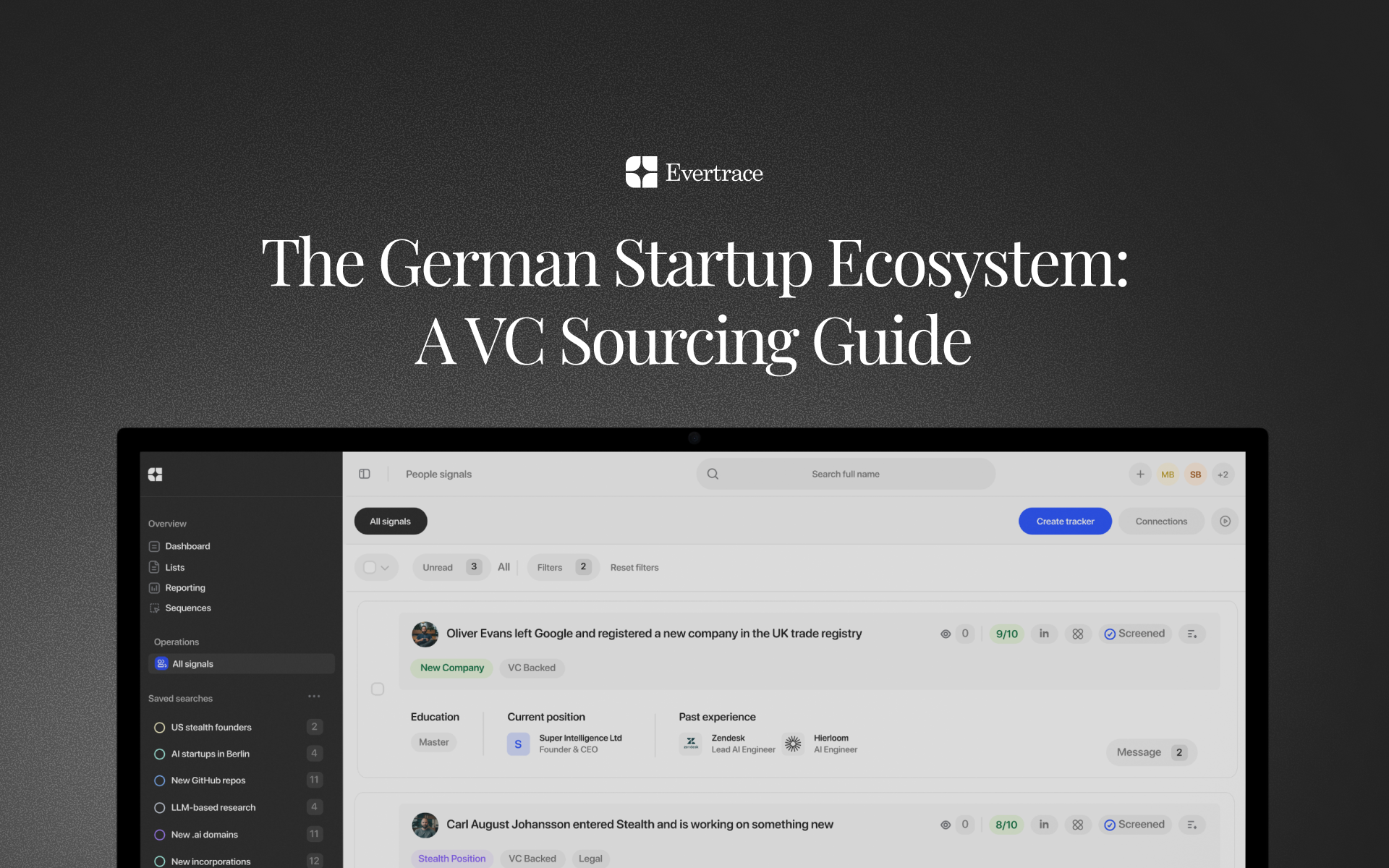
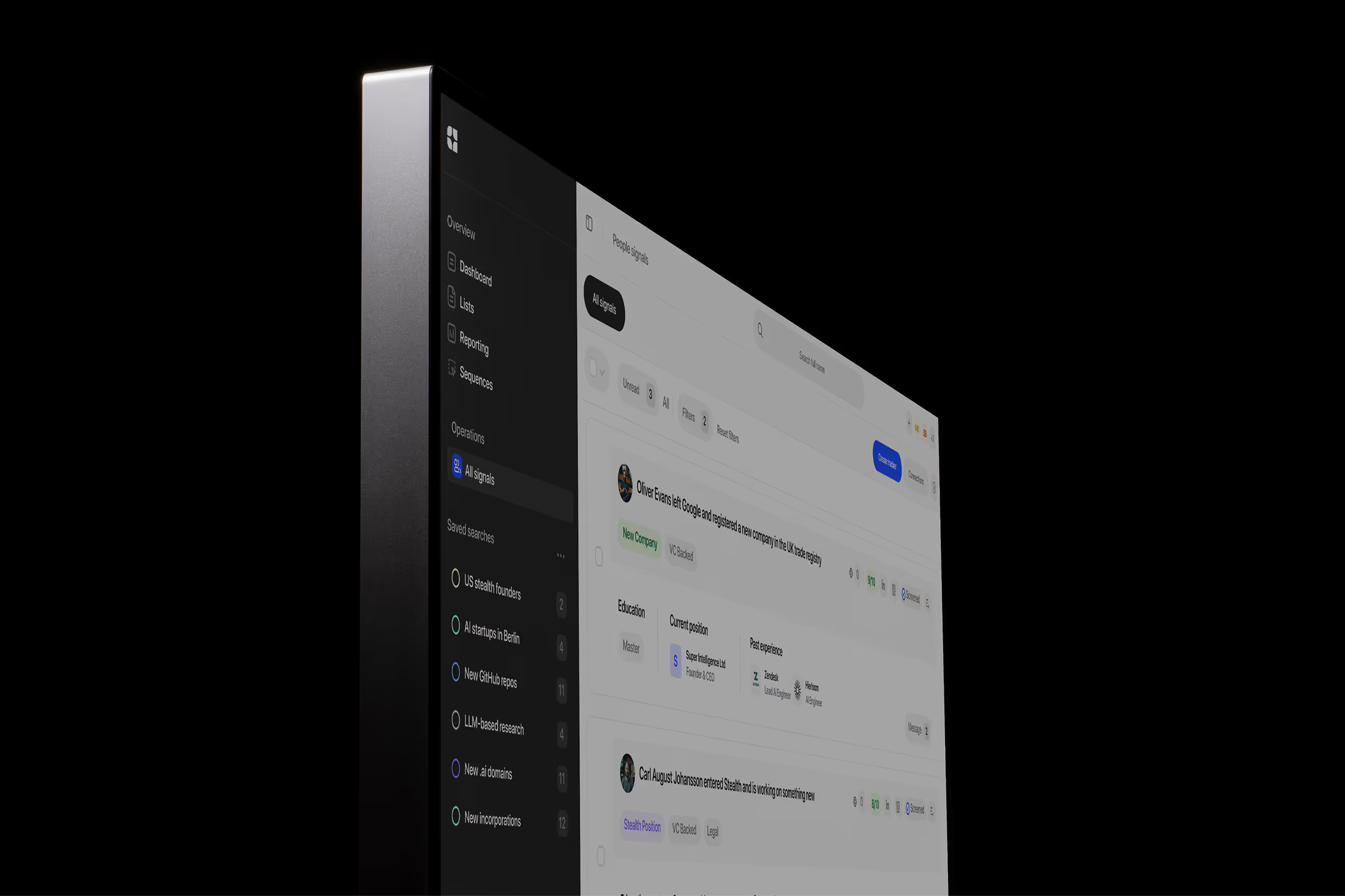
Evertrace monitors the Handelsregister and German company formation data in real time, linking new registrations to individual founders through background enrichment. German patent filings from the DPMA and EPO, EXIST-related grant data, and GitHub activity from German technical founders are combined to surface high-confidence founding signals before any public announcement.
175+ VC firms globally use Evertrace to find German founders across Berlin, Munich, Hamburg, and beyond.
Book a demo to see Evertrace in action
Frequently Asked Questions
How does German startup sourcing differ from UK sourcing?
Germany's ecosystem is more geographically distributed and more engineering-driven. The federated trade registries are more complex to monitor than Companies House. Social platform monitoring is less effective. Patent and trade registry data are more important as primary signals. B2B, industrial, and deep tech sectors are more prominent relative to consumer and fintech.
Which German cities have the strongest startup ecosystems?
Berlin for volume and diversity, Munich for deep tech and engineering, Hamburg for logistics and media technology, and the Rhine-Ruhr region for enterprise applications. Each has distinct sector strengths.
What are the strongest sectors for finding early-stage German founders?
B2B enterprise software, industrial automation and manufacturing technology, fintech infrastructure, health technology, and deep tech hardware. Climate technology is growing rapidly, with Munich and the broader Bayern ecosystem particularly active.
Are German founders typically contactable before they raise?
Yes, though outreach requires demonstrating genuine understanding of the technical or market domain they are building in. German founders tend to be more conservative about investor contact, making specific, technically credible outreach significantly more effective than generic introductions.
The founder detection engine for VCs
AI-powered founder detection with unmatched coverage.
 Book a demo