


Most funds can tell you how many companies they reviewed last quarter. Far fewer can tell you whether their sourcing process is improving.
Volume alone is a poor measure. A fund can add thousands of companies to its CRM without finding more companies that fit its thesis. Good VC sourcing metrics measure coverage, timing, quality, and conversion.
1. New opportunities identified
Count the number of genuinely new companies or founders entering the pipeline.
This is a useful baseline, but not a measure of success on its own. If the number rises while thesis fit and conversion fall, the team has created more screening work rather than better deal flow.
Track the figure by:
- Source
- Sector
- Geography
- Investment stage
- Team member
- Signal type
2. Thesis-qualified opportunities
A thesis-qualified opportunity meets the fund’s minimum requirements for sector, stage, geography, founder profile, and company type.
The ratio of qualified opportunities to total opportunities is more informative than total volume.
A low ratio may mean that the sourcing filters are too broad. An implausibly high ratio may mean that qualification standards are vague or inconsistently applied.
3. Unique founder coverage
How much of the relevant founding population is the fund actually seeing?
This is difficult to measure perfectly because the total population is unknown. A practical proxy is to compare the fund’s pipeline with newly announced and newly funded companies in its target market.
For every relevant company that appears publicly, ask:
- Did we know about it before the announcement?
- If so, when did it enter our system?
- Did anyone review it?
- Did we contact the founder?
- If not, which signal did we miss?
This turns missed opportunities into improvements to the sourcing system.
4. Pre-announcement detection rate
The pre-announcement detection rate is the percentage of relevant companies identified before their first major public launch, financing announcement, or database appearance.
This is one of the clearest measures of whether a fund has a genuine timing advantage.
It should be defined carefully. Finding a company two hours before a press release is technically early but commercially meaningless. Track the number of days or weeks between detection and public visibility as well.
5. Median detection lead time
Detection lead time measures how early a fund identifies a company relative to a defined event.
Possible reference events include:
- Public launch
- First financing announcement
- First appearance in a major startup database
- First institutional fundraising process
- First press coverage
Use the median rather than the average. A handful of companies detected unusually early can make the average look better than the typical result.
6. Signal-to-review time
How long does it take for a relevant signal to reach an investor?
A good detection system can still fail if opportunities sit untouched for a week. For competitive pre-seed deals, operational delay can erase the advantage created by early detection.
Measure the time between:
- The signal appearing
- The opportunity entering the system
- The first investor review
- The first action
7. Review-to-outreach rate
This is the percentage of reviewed opportunities that lead to founder contact.
A low rate is not automatically bad. It may indicate strong filtering. But if team members repeatedly save companies without taking action, the fund may be using its pipeline as a reading list rather than a sourcing tool.
Require a clear disposition:
- Contact now
- Add to watchlist
- Reject
- Request more research
- Already known
8. Founder response rate
Response rate helps assess whether the fund’s timing, relevance, and outreach quality are working.
Break it down by:
- Signal type
- Founder seniority
- Warm versus cold contact
- Sector
- Geography
- Message format
- Time from detection to outreach
Do not treat every reply equally. A polite decline and an invitation to meet are different outcomes.
9. Opportunity-to-first-meeting conversion
This metric shows how much of the sourced pipeline becomes an actual founder relationship.
It is best calculated using thesis-qualified opportunities as the denominator. Including thousands of unqualified companies makes the figure hard to interpret.
10. First-meeting-to-diligence conversion
This is partly a sourcing metric and partly an investment judgment metric.
If the conversion rate is consistently low, possible causes include:
- Weak qualification before outreach
- Poor data about the founding team
- A thesis that is too broad
- A gap between stated and actual investment preferences
- Meetings being accepted because a company looks interesting, rather than investable
11. Source-to-investment conversion
Attribute every investment back to its original source.
Common source categories include:
- Founder detection
- Portfolio referral
- Co-investor referral
- Inbound
- Event
- Accelerator
- Direct research
- Social media
- Existing relationship
This reveals which channels produce investments—not merely activity.
Be careful with attribution. The first source and the decisive source may differ. A fund may detect a founder through a registry signal and later receive a warm introduction. Record both.
12. Proprietary opportunity rate
Define what proprietary means before measuring it.
A useful definition is: an opportunity identified and contacted before the founder begins a broad fundraising process.
Warm introductions can be valuable, but they should not automatically be classified as proprietary. If five funds receive the same introduction, the opportunity is relationship-led, not exclusive.
Build a sourcing dashboard that changes decisions
A useful dashboard should answer four questions:
- Are we covering our thesis?
- Are we finding companies early?
- Are we acting quickly?
- Which sources produce real investment opportunities?
Avoid turning the dashboard into a contest over who added the most companies. The purpose of measurement is to improve the system, not reward CRM activity.
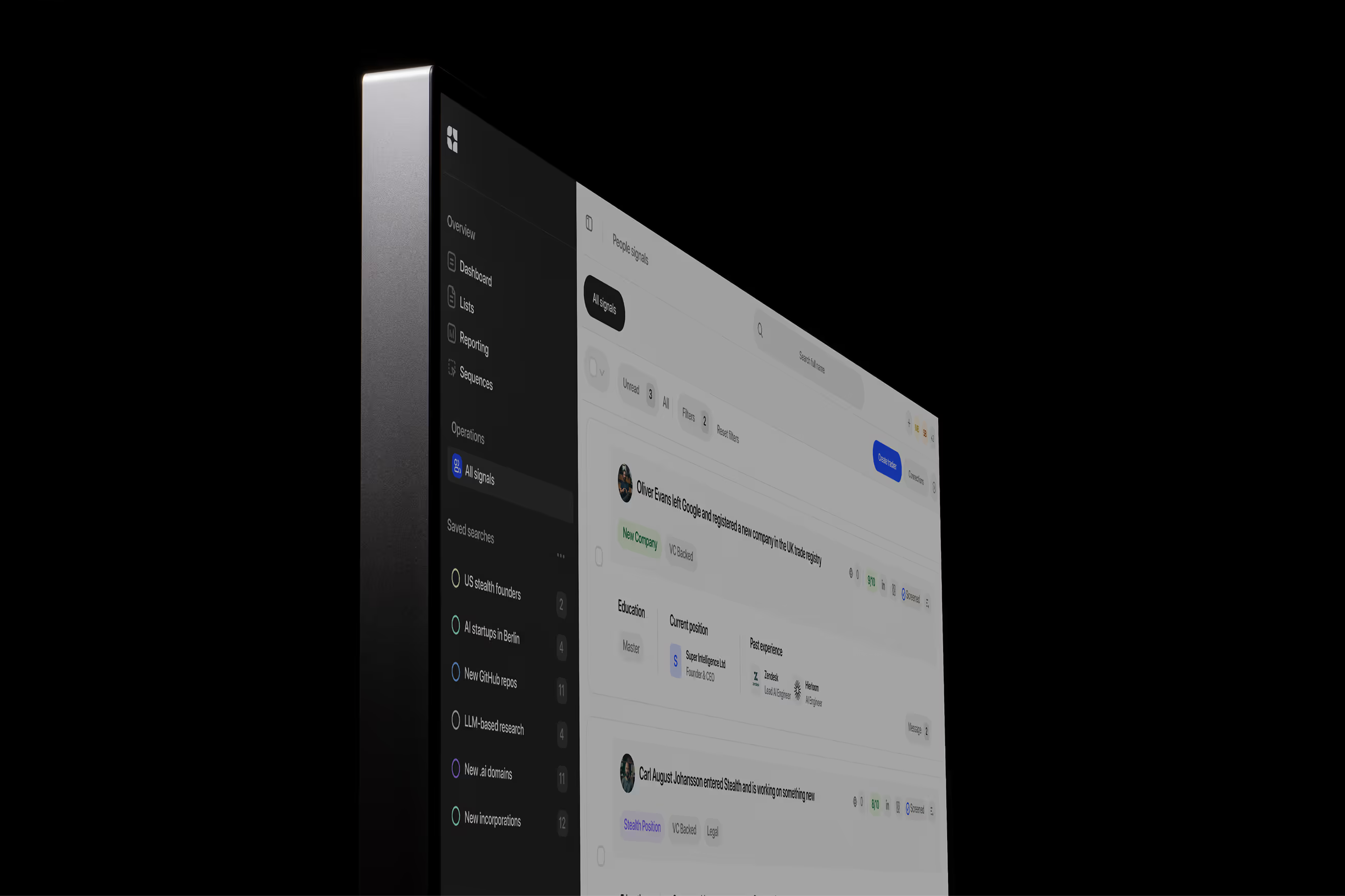
Evertrace helps funds monitor the detection side of this process by surfacing founder and company signals before conventional financing and announcement data appears. The investment team still decides what matters, who to contact, and which relationships deserve time.
---
Related reading
The founder detection engine for VCs
AI-powered founder detection with unmatched coverage.
 Book a demo