
What Are Founder Signals? The 8 Data Points That Predict Company Formation
A founder signal is a piece of observable data that indicates a person is in the process of forming a company. Founder signals appear before any public announcement, before a fundraise, and often before the founder has told anyone outside their immediate circle what they are building. They are the earliest detectable evidence that a new venture is taking shape.
This guide defines the eight most reliable founder signal types, explains what makes each one meaningful, and describes how investors use them systematically to find founders at the earliest possible stage.
Why Signals Matter More Than Announcements
Most sourcing in venture capital is announcement-driven. A company raises a pre-seed round and appears in the press. A startup launches on Product Hunt and gets noticed. A founder announces they are building something new. These are all announcements, and by the time they happen, the company is no longer early.
Founder signals are different. They are behavioral and transactional traces that appear as a byproduct of starting a company, not as a deliberate act of communication. A founder who incorporates a company in a government registry is not announcing anything. A researcher who files a patent outside the context of an employer is not broadcasting intent. An engineer who starts pushing code to new repositories at unusual hours is not making a public statement. Yet all three of these actions are observable, and all three are meaningful.
The investors who find founders earliest are not faster at reading announcements. They have built infrastructure that detects signals before any announcement is made.
The 8 Founder Signal Types
1. Company incorporation
Registering a new company is one of the most reliable founding signals available. In most countries, new company registrations are filed with a public government registry. A new registration from an individual with a relevant technical or commercial background, in a geography associated with startup activity, is a strong signal. The challenge is filtering: hundreds of thousands of companies are registered each year, and the vast majority are not venture-backable startups. Effective signal detection requires linking registration records to individual founders, cross-referencing their backgrounds, and filtering out holding structures, freelance entities, and inactive registrations.
2. GitHub activity patterns
Engineers who are transitioning from employment into independent company building leave detectable patterns in their code activity. New repositories appearing outside working hours, shifts in commit frequency and timing, changes in the type and scale of work being built, and early repository structures that suggest product intent rather than hobby projects are all observable signals.
3. Patent filings
A new patent filing from an individual inventor, especially one filed outside the context of a current employer, can indicate the early stages of a deep tech venture. Patent filings are public records, typically surfacing in patent office databases several weeks or months before any company announcement. This signal is particularly relevant for deep tech, biotech, hardware, climate, and materials science ventures.
4. Domain registration
Registering a domain is often one of the first steps a founder takes, before hiring, before building, and sometimes before incorporating. A domain registration alone is a weak signal. But one that occurs in close proximity to a company incorporation and increased code activity from the same individual becomes a meaningful confirming signal.
5. Academic research with commercial potential
Researchers whose published work has clear commercial applications represent a specific and valuable signal category. Tracking authors who are producing commercially relevant research, and then monitoring whether they transition from purely academic activity toward company formation, gives investors a lead time measured in months rather than weeks.
6. Co-founder searches
Founders who are looking for co-founders are, by definition, in the early stages of building something. A developer looking for a commercial co-founder, or a researcher looking for a technical partner, is signaling intent to build a company before any company formally exists.
7. Social intent signals
Behavioral patterns on public platforms can indicate that someone is moving from employment toward venture creation. These signals are the weakest of the eight and should almost never be used in isolation. Their value is in adding behavioral and social context to stronger signal combinations.
8. App store and Product Hunt activity
Early product activity on distribution platforms can surface stealth ventures before any press or fundraising announcement. App store signals are most valuable when combined with company registration data.
How Signals Combine to Create Confidence
Individual signals vary in strength. A company incorporation is relatively strong on its own. A domain registration alone is weak. The real power of signal-based sourcing comes from combining multiple signal types about the same individual within a tight time window. A person who incorporates a company, registers a matching domain, and starts pushing code to new repositories within the same two-week period is exhibiting a pattern that is highly predictive of a new venture.
What Signals Do Not Tell You
Founder signals are early detection tools, not evaluation tools. They tell you that someone is probably forming a company. They do not tell you whether the company will be worth investing in. The role of signals is to get investors into the conversation early enough for proper evaluation to begin.
How Evertrace Monitors Founder Signals
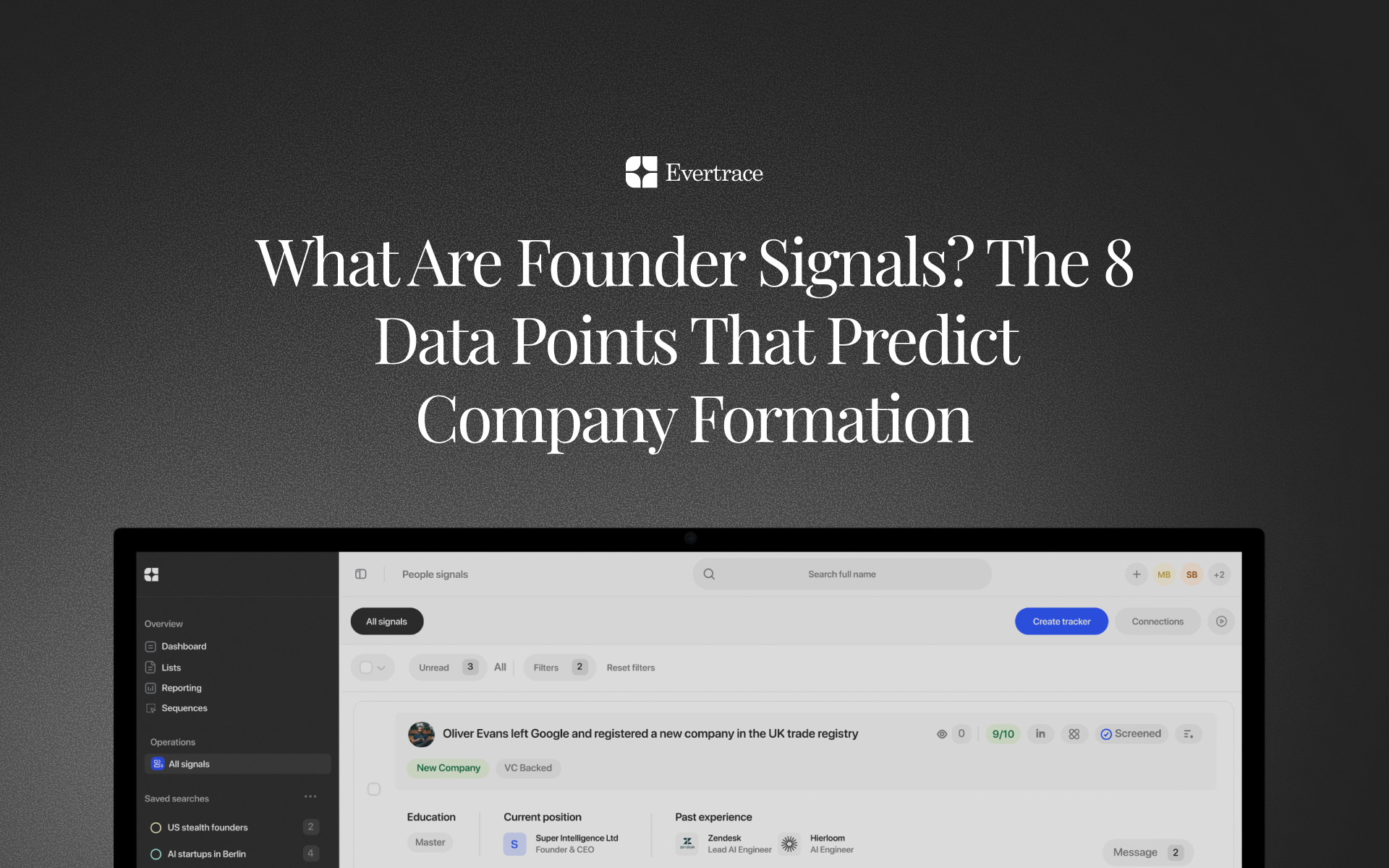
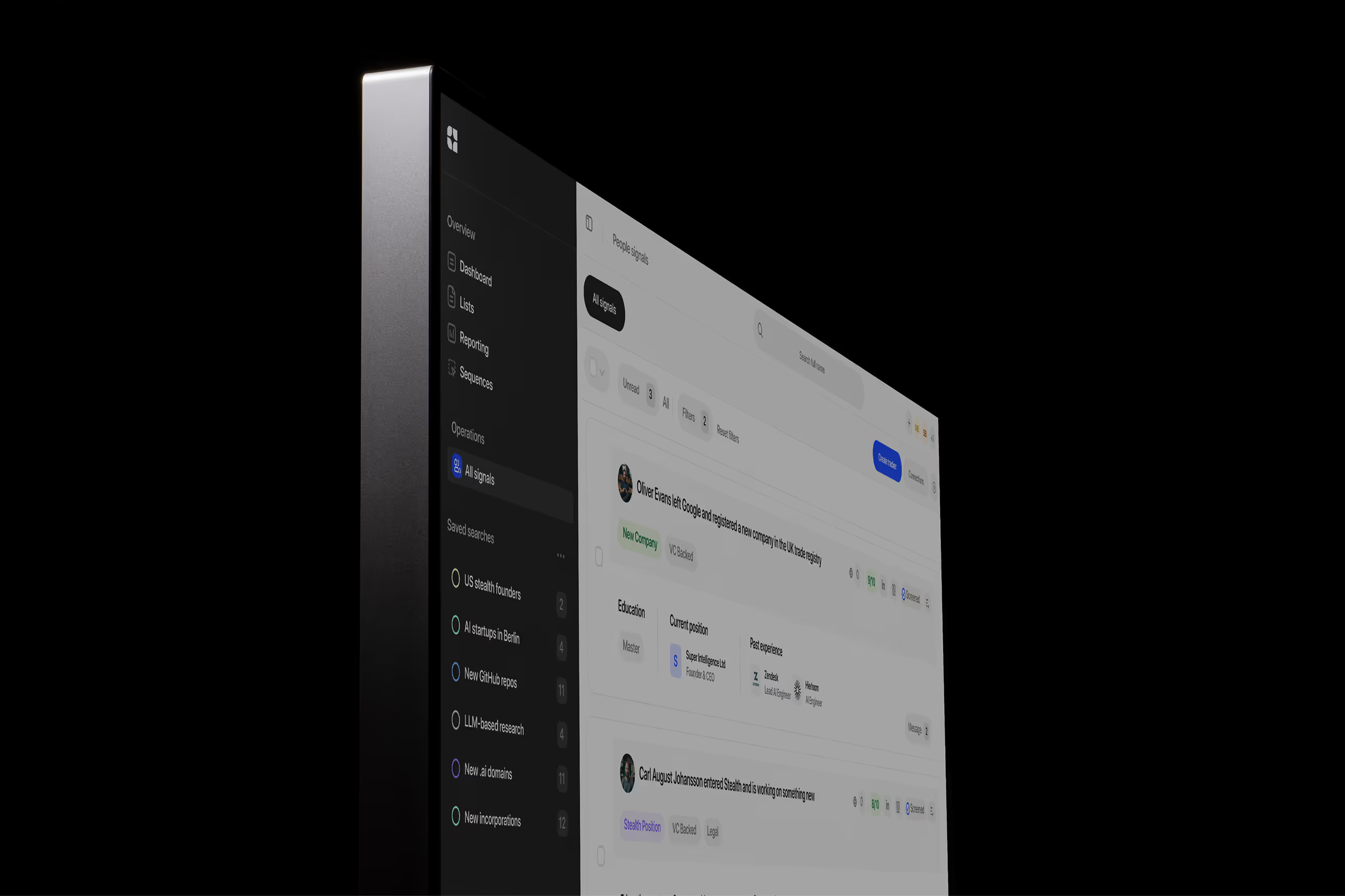
Evertrace monitors all eight signal types in real time globally, combining them to surface founders before any public announcement. Signals are scored based on similarity to the historical profiles of venture-backed founders and can be filtered by geography, sector, signal type, and investment thesis. New signals flow directly into Affinity or Attio, and the platform connects to AI agents via MCP.
175+ VC firms use Evertrace to find founders before their competitors do.
Book a demo to see Evertrace in action
Frequently Asked Questions
What is a founder signal?
A founder signal is an observable data point that indicates a person is in the process of forming a company, appearing before any public announcement or fundraising activity. Common examples include company incorporation records, GitHub activity patterns, patent filings, and domain registrations.
Which founder signals are most reliable?
Company incorporations and patent filings are among the strongest individual signals because they are formal, verifiable records. GitHub activity and co-founder searches are weaker individually but become powerful when combined with other signal types from the same person.
How many signals does it take to confirm a founder?
There is no fixed threshold, but a combination of three or more correlated signals from the same individual within a short time window is generally considered high confidence. Most founder detection systems use scoring to rank signal combinations by predictive strength.
Can signals predict whether a startup will succeed?
No. Founder signals indicate that someone is forming a company. They do not predict the quality of the opportunity, the founder's ability, or the likelihood of success. Signals are sourcing tools, not evaluation tools.
How do investors act on founder signals?
Investors who use founder signals typically reach out to detected founders with a conversational, non-transactional message shortly after detection. The goal at that stage is relationship, not evaluation.
Are founder signals only useful for pre-seed investors?
They are most valuable at pre-seed and seed stage, where the competitive advantage of early access is greatest. Some seed-stage and Series A funds also use them to build awareness of companies earlier in their lifecycle.
The founder detection engine for VCs
AI-powered founder detection with unmatched coverage.
 Book a demo