

What Is a Founder Detection Engine?
A founder detection engine is a software platform that identifies people in the process of forming a company. They have no website, pitch deck, or public presence yet. Rather than tracking startups once they are visible, a founder detection engine monitors behavioral signals across multiple data sources to surface founders at the earliest possible stage.
The category emerged as a response to a specific problem in early-stage venture capital: by the time a startup appears in a database, it is rarely early anymore.
Why Timing Is the Core Problem in VC Sourcing
In early-stage investing, a few weeks of lead time can separate a fund that leads a round from one that misses it entirely. The best pre-seed founders, the ones who go on to raise Series A rounds from top-tier firms, are not sitting in CRMs waiting to be discovered. They are often heads-down building, before they have told anyone what they are doing.
Traditional sourcing methods, including inbound referrals, conference networks, and database searches, all have the same structural flaw: they activate after a founder has made themselves visible. By that point, other investors are already in the conversation.
The question a founder detection engine is designed to answer is not "which companies exist?" but "who is about to start one?"
How a Founder Detection Engine Works
A founder detection engine aggregates signals from data sources where founder activity leaves a trace before any public announcement. These signals are behavioral and transactional. They reflect what people do, not what companies are.
The most common signal types include:
Trade registry filings
When a new company is incorporated, it triggers a filing with a government commercial registry. In Europe, these registries are public. A founder detection engine monitors these filings in real time and attempts to link them to real individuals, filtering out shell companies, holding structures, and non-operational entities to surface actual founders.
GitHub activity
Engineers who are transitioning from employment or side projects into building a startup often exhibit detectable patterns in their code behavior: new repositories, shifts in commit volume, and changes in the types of projects they are working on. Founder detection engines monitor these signals to identify when an engineer may be moving from tinkering to building.
Patent filings
When an inventor files a new patent, especially outside the context of an established employer, it can indicate the early formation of a deep tech venture. Filing patterns from individual inventors and small teams can surface spinouts and research-driven startups well before any company formation.
Domain registrations
Registering a domain is often one of the first steps a founder takes before building anything. Linking new domain registrations to individuals, cross-referenced with other signal types, can reveal early intent to build a company.
Academic research and grants
Researchers whose published work has commercial potential, or who receive research grants in areas likely to produce spinouts, represent an early-stage signal. Tracking when academics begin moving toward company formation, before any formal announcement, gives investors a meaningful head start.
Social and co-founder search signals
Founders looking for co-founders, posting in startup communities, or signaling venture intent through social behavior leave detectable traces. Monitoring these patterns at scale adds another layer of early detection.
The distinguishing characteristic of a founder detection engine is that it combines these signals across sources to build a picture of a person in the process of forming a company, not a company that already exists.
What Makes This Different from a Startup Database
Startup databases like Crunchbase, Dealroom, or PitchBook are built around companies that are already visible. They are excellent tools for research, due diligence, and market mapping. But they are structured around an entity, the company, that has already formed and surfaced.
By the time a startup appears in a company database, it has typically been incorporated for several months or more, raised its first external funding or at least sought it, built some public presence, and been introduced into investor networks through other channels.
A founder detection engine operates upstream of all of this. It is not a company database. It is an intent-detection system, identifying individuals at the moment they begin the process of company formation, not after that process has produced a visible result.
The practical implication is that investors using a founder detection engine are often the first people outside the founding team to know a company is being built.
Who Uses Founder Detection Engines
Early-stage and pre-seed VC funds
Funds investing at pre-seed and seed stage derive the most value from founder detection. Their edge depends on proprietary access to founders before competitors arrive. A founder detection engine systematizes what used to rely on personal networks and luck.
Angel investors
Individual angels, particularly those who invest in a specific geography or sector, use founder detection to surface relevant opportunities before institutional funds arrive. An angel in the Nordic region, for example, can monitor trade registry filings, GitHub activity, and grant recipients across Denmark, Sweden, Norway, and Finland to build an early pipeline.
University technology transfer offices
Academic institutions use founder detection tools to track their own researchers, identifying when faculty or PhD students show signals of venture formation, enabling earlier engagement and potential support.
Startups targeting other startups
Some early-stage B2B companies, including banks, legal firms, and tool providers, use founder detection to find their first customers: new companies at the moment they are most likely to be evaluating which tools and partners to work with.
The Signal-to-Noise Challenge
One reason founder detection engines are difficult to build is that the underlying data sources produce enormous volume. Hundreds of thousands of companies are incorporated in Europe each year. The majority are not venture-backable startups: they are holding structures, freelance entities, small local businesses, and inactive registrations.
A founder detection engine is not just a data aggregation tool. Its core value is in filtering and scoring: identifying which signals represent genuine founder intent, and which are noise.
This typically involves three things. First, cross-signal validation: a person who incorporates a company, registers a domain, and starts a new GitHub repository within the same period is a stronger signal than any one of those actions alone. Second, founder scoring: ranking signals by how closely a founder's profile matches the historical characteristics of venture-backed founders, based on education, prior experience, and technical background. Third, geographic and sector filtering: allowing investors to narrow detection to the markets and categories they focus on.
The output is not a raw data feed. It is a curated, prioritised list of people who appear to be starting companies that match a given investment thesis.
How Investor Workflows Change
For funds that have adopted founder detection, sourcing workflows look materially different from those built around inbound deal flow and network introductions.
Before: A partner hears about a company through a mutual connection. By the time they reach out, the founder has spoken to several other investors. The round may already be soft-circled.
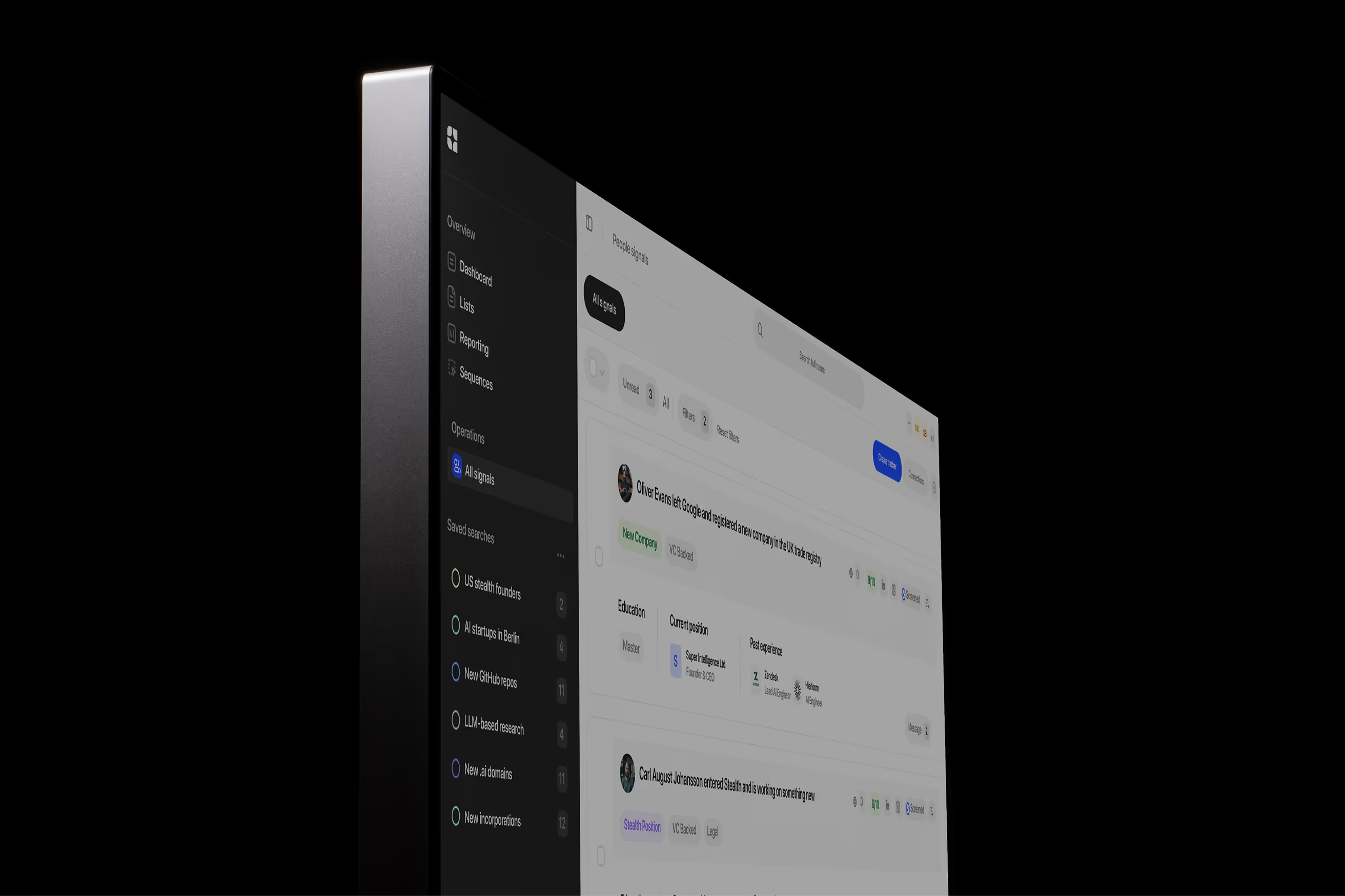
After: A signal fires when a founder registers a company and a domain, and starts pushing code to a new repository. The investor reaches out within days of the company being formed, often before the founder has decided to raise, before they have a deck, and before any competitive process exists.
The quality of those early conversations is different. The investor is not competing on valuation or brand. They are arriving as a genuine partner at a moment when the founder still has questions, not answers.
Key Metrics to Evaluate a Founder Detection Platform
If you are evaluating whether a founder detection engine fits your fund's sourcing process, the most relevant questions are:
Signal timing: How early does the platform detect activity? Is it real-time, or is there a lag of days or weeks between a signal occurring and appearing in the platform?
Signal breadth: How many distinct data source types does the platform monitor? A platform monitoring only trade registries will miss founders who are building in stealth without yet incorporating.
Geographic coverage: Which countries and registries does the platform monitor? Coverage varies significantly. Some focus on North America, others on Europe.
Scoring and filtering: How does the platform help you separate high-potential signals from noise? Can you filter by sector, geography, technical background, or other criteria relevant to your thesis?
CRM integration: Can signals flow directly into your existing deal flow CRM, such as Affinity or Attio, without manual data entry?
AI and workflow automation: Can the platform connect to AI tools and agents, enabling automated outreach drafts, enrichment, or filtering based on your thesis?
The Broader Shift: From Reactive to Proactive Sourcing
The emergence of founder detection as a category reflects a broader shift in how the most competitive early-stage funds think about deal flow. Waiting for founders to come to you, through warm introductions, conference meetings, or inbound applications, is a sourcing model that works in a world where information is scarce and networks are exclusive.
That world is changing. Founders have more options, more information about investors, and less need to rely on gatekeepers. The funds that build a systematic, signal-based approach to finding founders early are building a structural advantage that compounds over time.
A founder detection engine is not a replacement for the relationship and judgment that make a great investor. It is the infrastructure that ensures you are in the conversation early enough for those qualities to matter.
How Evertrace Approaches Founder Detection
Evertrace is a founder detection engine built specifically for data-driven VC investors. It monitors real-time signals across trade registries in Europe, GitHub, patent filings, academic research, domain registrations, app stores, Product Hunt, and social platforms, connecting disparate signals to surface founders who have not yet announced what they are building.
Signals are scored based on similarity to the profiles of previously successful venture-backed founders, and can be filtered by geography, sector, and signal type. Evertrace integrates directly with Affinity and Attio, and supports workflow automation and AI agent access via MCP.
175+ VC firms across Europe and beyond use Evertrace to find founders before their competitors do.
Book a demo to see Evertrace in action
Frequently Asked Questions
What is a founder detection engine?
A founder detection engine is a platform that identifies individuals in the early stages of forming a company, using behavioral signals like trade registry filings, GitHub activity, patent applications, and domain registrations, before the company has any public presence.
How is a founder detection engine different from a startup database?
Startup databases catalog companies that are already visible and have some public presence. A founder detection engine operates earlier, identifying people at the point of company formation, often before incorporation, funding, or any public announcement.
What signals does a founder detection engine monitor?
The most common signal types include company registry filings, GitHub activity patterns, patent filings, domain registrations, academic research and grant awards, and social signals such as co-founder searches. The strongest signals combine multiple data points about the same person.
Who benefits most from a founder detection engine?
Pre-seed and seed-stage VC funds derive the most value, since their competitive advantage depends on reaching founders before other investors. Angel investors, university tech transfer offices, and B2B companies targeting early-stage startups also use founder detection tools.
Can a founder detection engine replace a startup database?
They serve different purposes. A founder detection engine is most valuable for sourcing: finding founders before they are known. A startup database is most valuable for research and due diligence on companies that already exist. Many funds use both in combination.
How accurate are founder detection signals?
Signal accuracy varies by platform and source type. The strongest platforms combine multiple signal types to reduce false positives. A single trade registry filing means less than a filing combined with a new domain and GitHub activity from the same individual. Scoring and filtering tools help investors focus on the highest-confidence signals.
The founder detection engine for VCs
AI-powered founder detection with unmatched coverage.
 Book a demo