

What Is a Stealth Startup? How Investors Find Companies Before They Go Public
A stealth startup is a company that is operating in a deliberate state of limited public visibility. Founders building in stealth have made a conscious decision to restrict information about their company, product, or both, for a defined period before any public announcement.
What Does Building in Stealth Actually Mean?
Stealth is a spectrum rather than a binary state. At one end, a company is entirely invisible: no public website, no announced team, no disclosed funding. At the other end, a company acknowledges it exists but declines to share details about what it is building. The defining characteristic is intentional information restriction, not total invisibility.
Why Do Founders Build in Stealth?
Competitive sensitivity: In markets where first-mover advantage is significant, founders may stay quiet to prevent competitors from replicating their approach before they have built sufficient product.
Regulatory or partnership considerations: Some ventures require approvals or licensing arrangements that are sensitive to public disclosure.
Recruiting without distraction: Early-stage companies sometimes stay quiet to recruit senior hires without the noise that public attention brings.
Fundraising strategy: Some founders believe that disclosing their market too early reduces their leverage in subsequent fundraising conversations.
Preference for building over marketing: Some founders simply prefer to focus entirely on building before engaging with the external world.
What Evidence Stealth Companies Leave Behind
Even companies operating in strict stealth leave observable traces. Legal formation is not optional. A company that intends to employ people, sign contracts, or accept investment must incorporate. That incorporation is recorded in a public government registry, accessible within days of filing. Code activity leaves traces. Technical founders building in stealth are typically writing code, and that activity is partially observable. Infrastructure requires domain names. Deep tech ventures file patents. None of these traces requires any announcement.
How Investors Find Stealth Companies
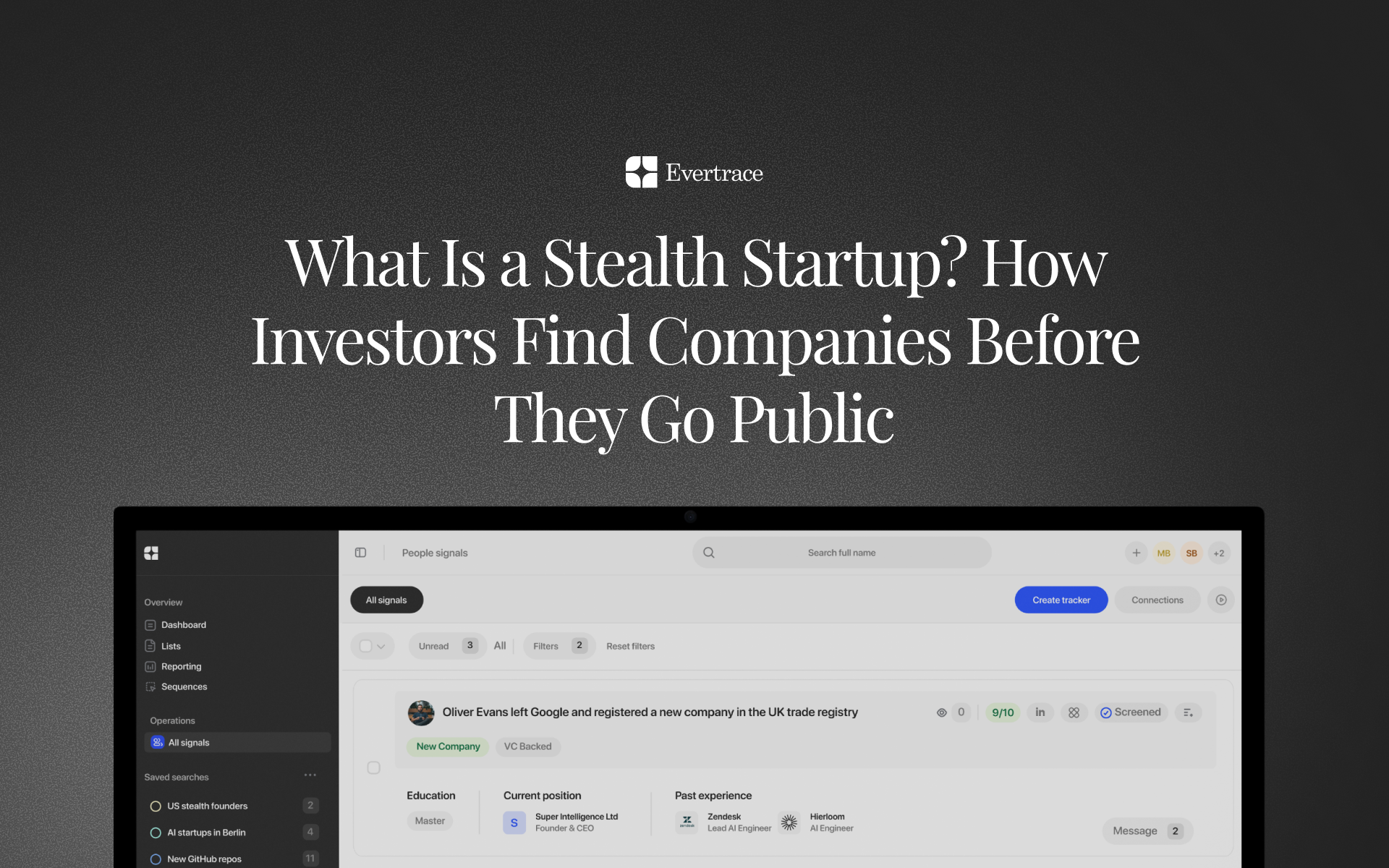
The most effective approach is systematic signal monitoring across the data sources where founding traces appear. A founder detection engine monitors trade registry filings, code activity, domain registrations, patent filings, and other signal sources in real time. When multiple signals from the same individual appear within a short time window, that combination is flagged as a high-confidence detection of founding activity.
What to Do When You Find a Stealth Founder
A stealth founder has chosen not to be public for a reason. The right approach is a brief, direct message that acknowledges the signal honestly without being intrusive. "I saw you recently incorporated and noticed your background in X, I have been following the intersection of X and Y and would love to understand what you are working on" is the right tone. The goal of the first message is a conversation, not an investment decision.
How Evertrace Detects Stealth Companies
Evertrace is built specifically to find companies that have not yet made any public announcement. By monitoring trade registries, GitHub, patent filings, domain registrations, academic research, app store activity, and other signal sources in real time globally, Evertrace surfaces founders who are building in stealth, before any press, pitch deck, or public launch exists.
Signals are combined and scored, filtered by geography and sector, and delivered into Affinity, Attio, or connected AI agents in real time. 175+ VC firms globally use Evertrace to find stealth founders before their competitors do.
Book a demo to see Evertrace in action
Frequently Asked Questions
What is a stealth startup?
A stealth startup is a company operating with intentionally limited public visibility. Founders in stealth restrict disclosure of their product, market, business model, or team for a defined period before any public announcement.
How do investors find stealth startups?
The most effective method is monitoring the observable traces that even stealth companies leave behind: trade registry filings, code repository activity, domain registrations, patent filings, and other public data sources.
Why do founders choose to build in stealth?
Common reasons include protecting competitive advantage, managing regulatory or partnership negotiations, recruiting without distraction, and a preference for focused building before public attention.
How long do stealth periods typically last?
In software, stealth periods of a few months to a year are most common. In deep tech, biotech, and hardware, stealth periods of one to three years are not unusual due to longer development timelines.
Is it appropriate to reach out to a stealth founder?
Yes, if the approach is appropriate for the stage. A brief, honest outreach message that invites a conversation rather than demands a pitch is appropriate.
The founder detection engine for VCs
AI-powered founder detection with unmatched coverage.
 Book a demo