

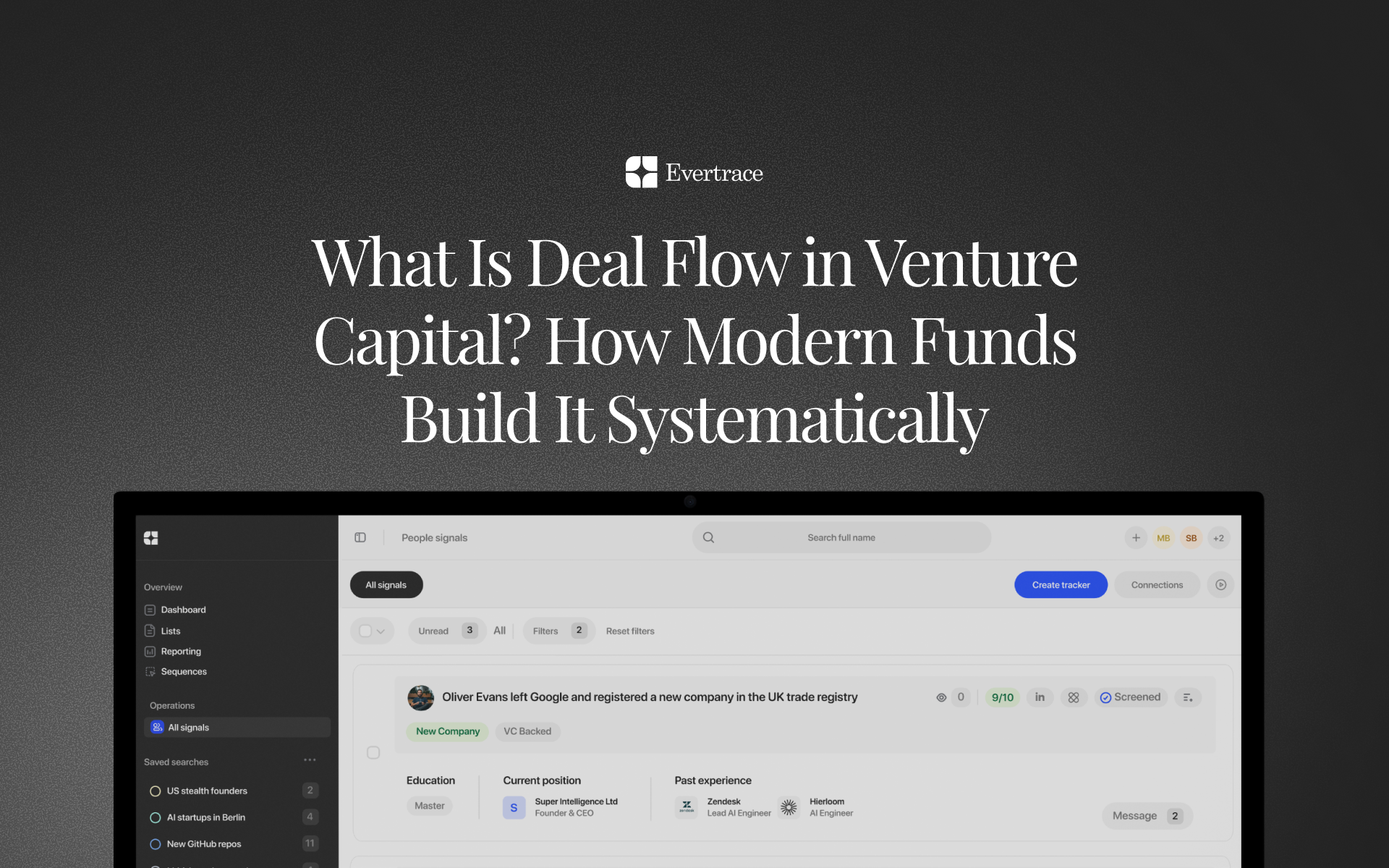
What Is Deal Flow in Venture Capital? How Modern Funds Build It Systematically
Deal flow is one of the most frequently used terms in venture capital and one of the least precisely defined. Ask ten investors what good deal flow looks like and you will get ten different answers. Ask them how they build it and you will find that most have never thought about it systematically at all.
What Is Deal Flow?
Deal flow is the stream of potential investment opportunities that a fund sees and evaluates. It has two fundamental properties: volume (how many deals a fund sees) and relevance (how well the deals match the fund's stage, sector, geography, and thesis). The goal is not maximum volume. It is maximum relevant volume, and ideally, relevant volume that other funds do not have access to.
The Three Types of Deal Flow
Inbound deal flow
Inbound deal flow is deals that come to the fund without the fund doing anything to initiate contact. Inbound is the most common form of deal flow and the least competitively advantageous. A founder who is ready to fundraise and reaches out to multiple funds simultaneously is creating shared deal flow, not proprietary deal flow.
Warm introduction deal flow
Warm introduction deal flow comes through trusted mutual contacts. This is better than cold inbound but still fundamentally reactive. The introduction happens when the founder is ready to fundraise and the same founder is typically asking for multiple introductions simultaneously.
Proprietary deal flow
Proprietary deal flow is deals that a fund sees before they are visible to the rest of the market. The fund reaches the founder before any competitive process exists, before the founder has decided to raise, and sometimes before the company has a name or a product. Proprietary deal flow is the most valuable type because it gives the investor time to develop genuine conviction and build a real relationship without competitive pressure.
Building Systematic Deal Flow
Systematic deal flow generation has four elements: signal monitoring (detecting founding activity before any announcement), structured outreach (a consistent approach to contacting founders in the signal feed), relationship management (maintaining contact with founders detected early but not yet ready for investment), and portfolio and network activation (engaging the fund's existing network as active sourcing nodes).
How Evertrace Generates Proprietary Deal Flow
Evertrace monitors real-time founding signals across trade registries, GitHub, patent filings, academic research, domain registrations, app stores, and social platforms globally. Every signal that appears in Evertrace represents a founder who has not yet announced anything publicly. Every outreach made on the basis of those signals arrives before any competitive process begins.
Signals are scored, filtered by geography, sector, and founder profile, and delivered into Affinity, Attio, Slack, or connected AI agents via MCP. 175+ VC firms globally use Evertrace to generate proprietary deal flow at the formation stage.
Book a demo to see Evertrace in action
Frequently Asked Questions
What is deal flow in venture capital?
Deal flow is the stream of potential investment opportunities that a fund sees and evaluates. The most valuable deal flow is proprietary, meaning the fund sees opportunities before they are visible to other investors.
What is the difference between proprietary and shared deal flow?
Proprietary deal flow is opportunities that a fund sees before other investors. Shared deal flow arrives simultaneously to many investors through inbound applications, warm introductions during a fundraising process, or announcements.
How do VC funds generate proprietary deal flow?
The most effective approach is systematic signal monitoring: detecting founding activity through trade registry filings, code repository activity, patent filings, domain registrations, and other data sources before any public announcement.
Why is inbound deal flow insufficient for the best early-stage opportunities?
Inbound deal flow arrives when the founder is ready to fundraise and has decided to approach investors. By that point, the founder is typically approaching multiple investors simultaneously. The best early-stage opportunities are with founders who have not yet started any process.
The founder detection engine for VCs
AI-powered founder detection with unmatched coverage.
 Book a demo