

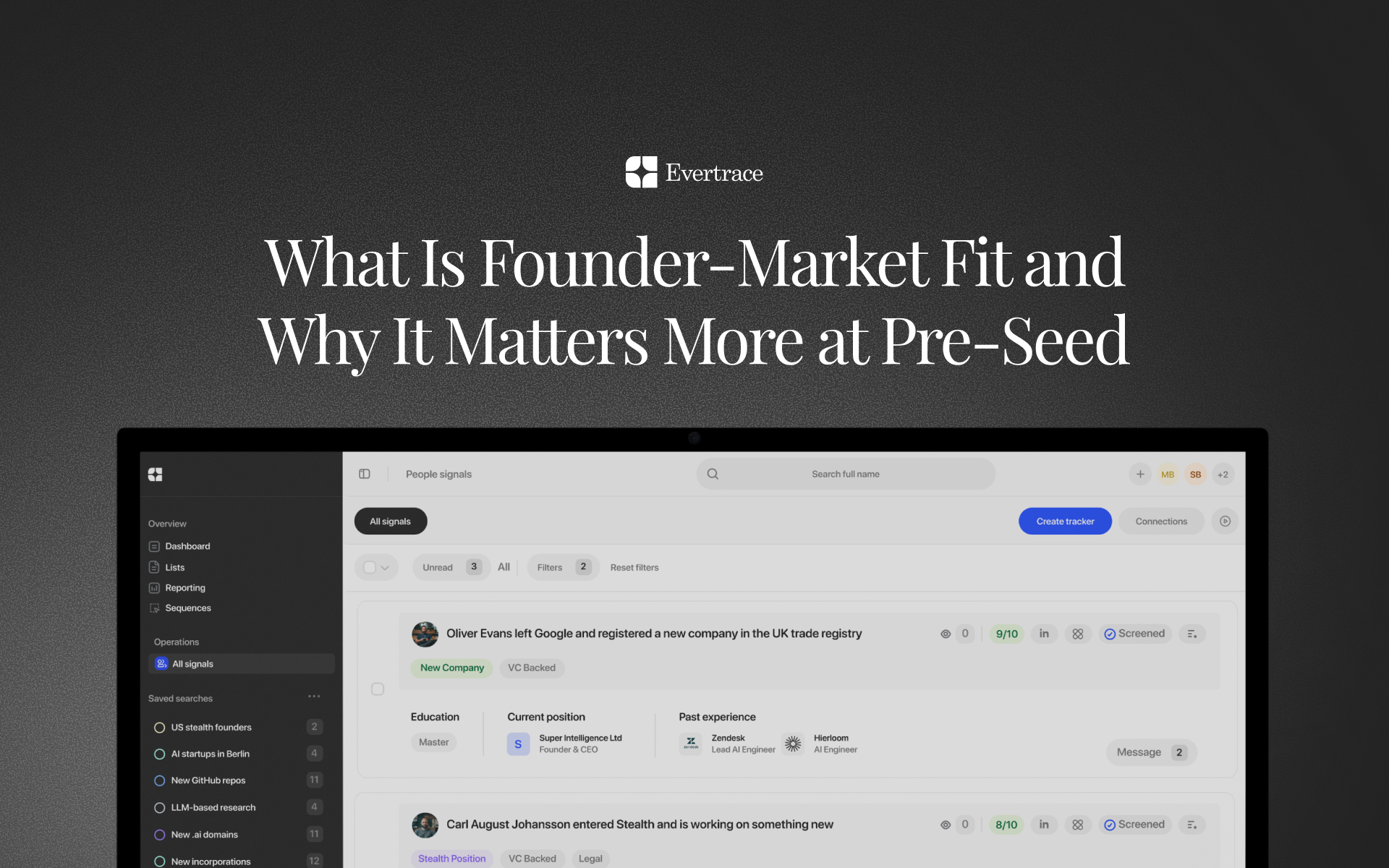
What Is Founder-Market Fit and Why It Matters More at Pre-Seed
Founder-market fit is the degree to which a founder's background, expertise, network, and personal experience make them unusually well-suited to build a company in a specific market. It is not the same as passion for a problem, though passion can be a component. It is not the same as intelligence or execution ability, though both matter. Founder-market fit is the specific combination of knowledge, credibility, and access that gives a particular founder an unfair advantage in a particular market.
Why Founder-Market Fit Matters More at Pre-Seed
At later stages, investors have evidence to evaluate: revenue growth, customer retention, gross margin, and competitive win rates. At pre-seed, almost none of this evidence exists. The investment thesis rests almost entirely on whether the founding team is the right team to build this specific company. A founder who has spent ten years in a specific industry, who has deep relationships with the potential customers they are targeting, and who is personally motivated by the problem, is a more compelling pre-seed investment than a talented generalist who has recently become interested in the same market.
The Components of Founder-Market Fit
Domain knowledge is the depth of understanding that comes from having worked inside an industry, managed a process that is broken, or developed expertise in a technically relevant area. Network and access refers to existing relationships with the customers, partners, and talent needed to build the company. A founder who personally knows the procurement leads at their five largest potential customers is in a fundamentally different position than one who will cold-outreach their way into those conversations. Personal credibility is whether potential customers, partners, and hires will take the founder seriously based on their background. Intrinsic motivation is whether the founder's history and behaviour suggest they would work on this problem even if the financial upside were lower.
How to Assess Founder-Market Fit in Practice
Founders with genuine market fit demonstrate knowledge that goes beyond what is written down. They know the specific operational realities that create the problem. They can name the specific people in their target customers who feel the pain most acutely. They understand why previous attempts to solve the problem failed. Red flags include founders who describe the market in terms of public reports and analyst estimates, and whose claimed expertise is from a brief period of research rather than sustained involvement.
Founder-Market Fit as a Sourcing Signal
For investors building systematic sourcing processes, founder-market fit can also be used as a filtering criterion for incoming signals. Background enrichment data, which links a founder's prior employment, education, and technical expertise to the new company they are forming, enables automated scoring that weights signals with strong founder-market fit indicators higher than those without.
How Evertrace Incorporates Founder Profile Scoring
Evertrace scores founder signals based in part on the alignment between a founder's background and the sector they appear to be building in. Signals from individuals whose prior employment, education, and technical expertise suggest strong founder-market fit for their apparent market are scored higher, helping investment teams focus their attention on the opportunities most likely to meet their thesis criteria.
Book a demo to see Evertrace in action
Frequently Asked Questions
What is founder-market fit?
Founder-market fit is the degree to which a founder's background, expertise, network, and personal experience make them unusually well-suited to build a company in a specific market. It focuses on the specific advantage a particular founder has in a particular market, not general capability.
Why does founder-market fit matter more at pre-seed than at later stages?
At pre-seed, there is almost no product, revenue, or market evidence to evaluate. The investment thesis rests almost entirely on whether the founding team is the right team for this specific opportunity.
What are the strongest indicators of genuine founder-market fit?
Depth of domain knowledge that goes beyond secondary research, existing relationships with potential customers, prior experience managing the specific process being improved, personal credibility in the target market, and a history of sustained involvement with the problem rather than recent interest.
How do investors use founder-market fit in early-stage signal detection?
Background enrichment data, which links a founder's prior employment and technical expertise to the company they are forming, enables automated scoring that weights signals from founders with strong market fit higher. This filters the signal queue toward opportunities most likely to meet thesis criteria.
The founder detection engine for VCs
AI-powered founder detection with unmatched coverage.
 Book a demo