

What Is Founder Scoring and How Do VC Platforms Rank Early-Stage Opportunities?
Founder scoring is a systematic method for ranking early-stage investment signals based on how closely the characteristics of a founding individual or team match the profiles of previously successful venture-backed founders. It is used by VC platforms and data-driven investment teams to prioritise incoming signals from founding activity, reducing the manual triage burden and helping analysts focus attention on the opportunities most likely to meet their investment thesis.
Why Scoring Is Necessary
A fund monitoring company registrations, GitHub activity, patent filings, and domain registrations globally can easily receive hundreds of new signals per week. Not all of them are relevant. Not all relevant ones are equally interesting. Without a way to prioritise, investment teams spend significant time triaging signals manually, which is both inefficient and inconsistent. Founder scoring addresses this by applying an automated ranking to each incoming signal.
What Founder Scoring Draws On
Educational background is one of the most consistent predictors in historical VC data: founders with technical degrees from universities known for spinout activity, doctoral qualifications in relevant fields, or credentials suggesting deep domain expertise have historically produced a disproportionate share of successful venture-backed companies. Prior employment at technology companies with track records of producing successful founders is another strong predictor. Prior founding activity, even without a successful exit, is a positive indicator. Signal combination quality affects scoring significantly: a founder whose incorporation signal is corroborated by a domain registration and GitHub activity within the same week scores higher than one whose incorporation is the only observable signal.
What Scoring Cannot Do
Founder scoring is a prioritisation tool, not an investment decision tool. It surfaces the signals most likely to be worth reviewing. It does not assess the quality of the specific company or product being built, the size of the market, or the specific execution capabilities of the founding team. These dimensions require human judgment and cannot be automated from the data available at the signal detection stage.
How Evertrace Implements Founder Scoring
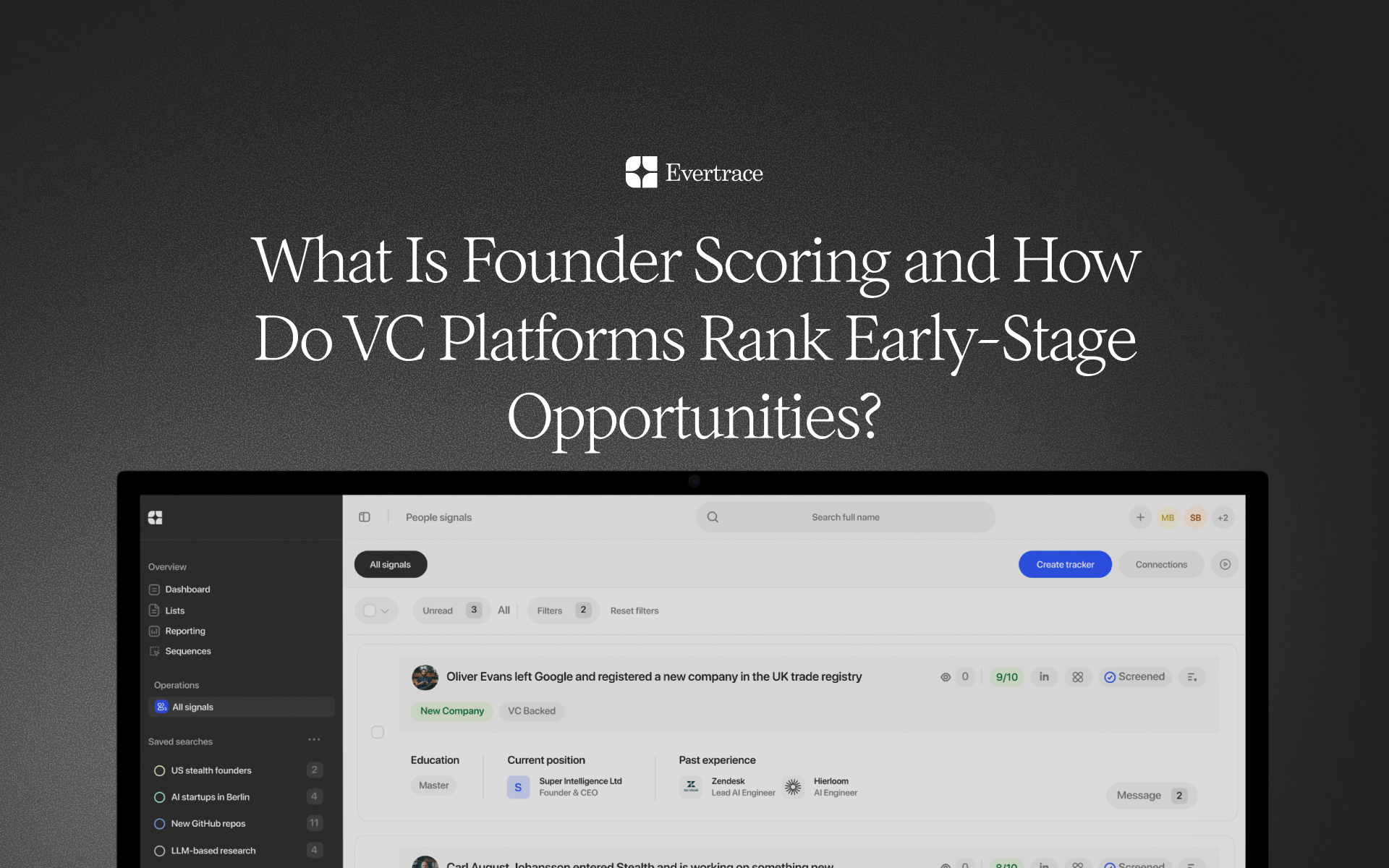
Evertrace scores all incoming founder signals based on the alignment between the founding individual's background and the characteristics of previously successful venture-backed founders, combined with signal combination quality and geography and sector filters. High-confidence signals are prioritised in the feed delivered to investment teams via Affinity, Attio, Slack, or connected AI agents.
175+ VC firms globally use Evertrace's scoring to prioritise their early-stage signal review.
Book a demo to see Evertrace in action
Frequently Asked Questions
What is founder scoring in venture capital?
Founder scoring is a method for ranking early-stage investment signals based on how closely the founding individual's characteristics match the profiles of previously successful venture-backed founders. It prioritises incoming signals and helps investment teams focus on the most relevant opportunities.
Can founder scoring replace human judgment in early-stage investment?
No. Scoring is a prioritisation tool that determines which signals receive immediate attention. It does not assess the quality of the specific company, market, or founding team in the ways that matter for investment decisions.
Should every VC fund use founder scoring?
Scoring is most valuable for funds with high signal volume. A fund reviewing five signals per week does not need automated scoring. A fund reviewing hundreds of signals per week will miss opportunities without it.
How is founder scoring different from due diligence?
Founder scoring operates at the top of the funnel, before any direct contact, to prioritise which signals are worth pursuing. Due diligence operates after initial interest is established, to assess the quality of the specific investment opportunity in detail.
The founder detection engine for VCs
AI-powered founder detection with unmatched coverage.
 Book a demo