

What Is Startup Intelligence and Why Are the Best VCs Investing in It?
Startup intelligence is the systematic collection, processing, and analysis of data about early-stage companies and the individuals forming them, with the goal of generating actionable insights for investment decisions before those companies become publicly visible. The term covers a broad range of activities and tools, from monitoring government company registries to analysing patent databases, tracking code activity, and applying machine learning to rank the resulting signals by investment relevance. What distinguishes startup intelligence from general market research is its focus on the pre-announcement stage: finding companies and founders before they have told anyone what they are building.
Why Startup Intelligence Exists as a Category
For most of venture capital's history, information advantage was primarily a function of network. As the global startup ecosystem has scaled dramatically, that model has become insufficient. More companies are being formed in more geographies across more sectors than at any previous point. Personal networks, no matter how extensive, cannot achieve comprehensive coverage. At the same time, the signals that precede startup formation, company registrations, code activity, patent filings, domain registrations, grant awards, have always existed as public records. What has changed is the ability to monitor, process, and cross-reference them systematically in real time. These two shifts together created the conditions for startup intelligence as a category.
The Components of Startup Intelligence
Founding activity signals are the most direct: company registry filings, domain registrations, and GitHub organisation creations all indicate that someone has committed to building something. Talent and transition signals track when individuals with relevant backgrounds change their professional status in ways that suggest company formation. Intellectual property signals track when commercially relevant innovations are being developed and protected. Funding and support signals include grant awards and participation in innovation programs. Market context signals provide the backdrop that makes other signals more or less meaningful.
How Startup Intelligence Differs From Startup Databases
Startup databases like Crunchbase, Dealroom, and PitchBook are retrospective: they catalogue companies that have already formed, raised funding, and established some public presence. Startup intelligence is prospective: it is designed to surface companies in the process of forming, before any public record or announcement makes them visible through a database search. A company that appears in Crunchbase has typically been visible for some time. A company that appears in a startup intelligence feed may be days old.
How Evertrace Approaches Startup Intelligence
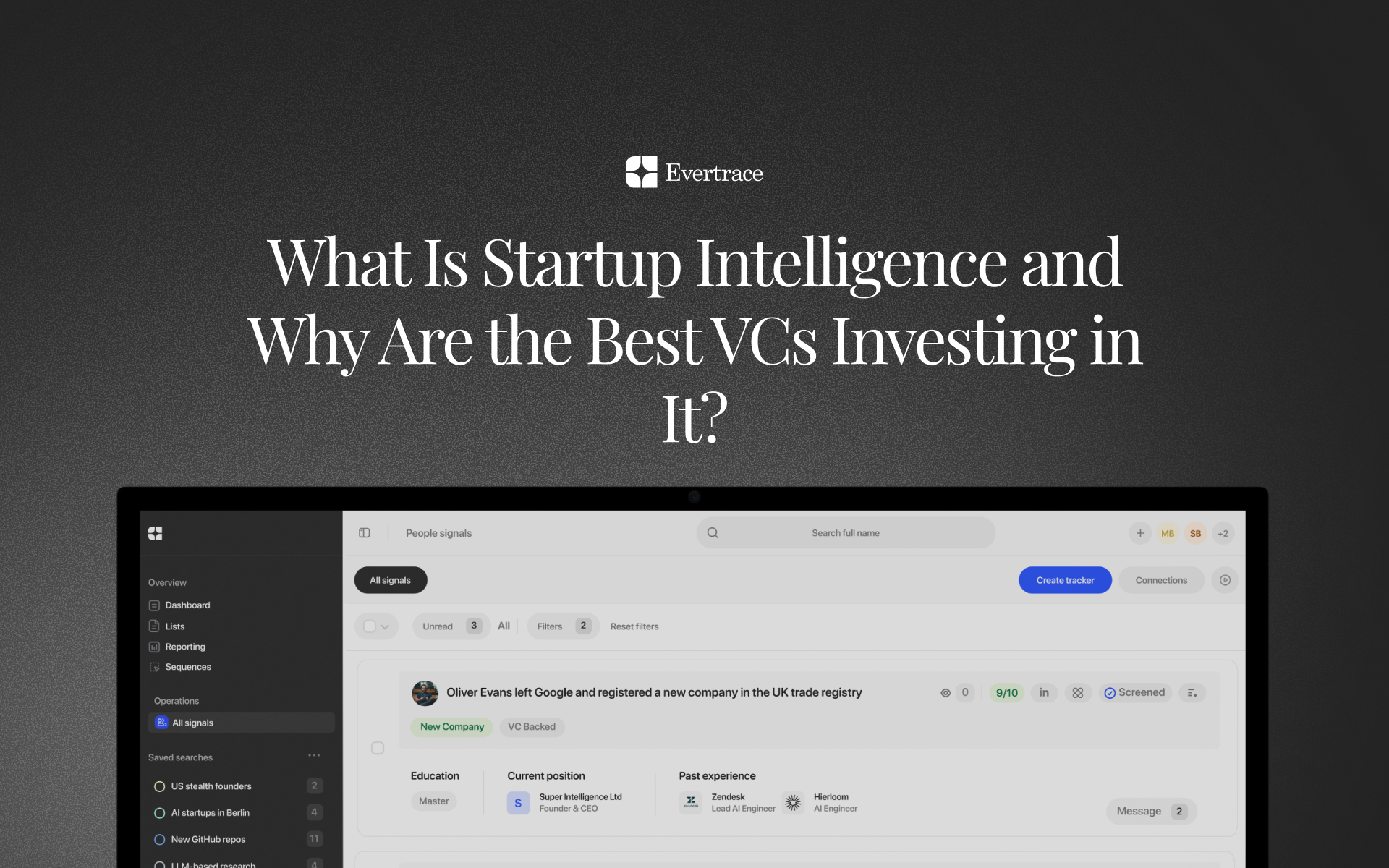
Evertrace is built as a startup intelligence platform specifically for early-stage VC investors. It combines real-time monitoring of trade registries, GitHub, patent filings, academic research, domain registrations, app stores, Product Hunt, and social platforms globally with AI-powered founder scoring and direct integration into Affinity, Attio, and connected AI agents via MCP.
175+ VC firms globally use Evertrace as their startup intelligence infrastructure for finding founders before any public announcement.
Book a demo to see Evertrace in action
Frequently Asked Questions
What is startup intelligence?
Startup intelligence is the systematic collection, processing, and analysis of data about early-stage companies and the individuals forming them, with the goal of generating actionable investment insights before those companies become publicly visible.
How is startup intelligence different from a startup database?
Startup databases catalogue companies that already exist and have public presence. Startup intelligence is designed to surface companies in the process of forming, before any public announcement or database entry. The focus is prospective detection rather than retrospective cataloguing.
Why are VC funds investing in startup intelligence infrastructure?
Because the global startup ecosystem has grown too large for personal networks to achieve comprehensive coverage, and because the data infrastructure required to monitor founding activity systematically has become commercially viable. Funds that do not invest in startup intelligence consistently miss founders who are not in anyone's network.
Can startup intelligence replace human judgment in VC?
No. Startup intelligence generates better inputs for human judgment. The evaluation of founders, assessment of markets, and development of conviction remain human activities.
The founder detection engine for VCs
AI-powered founder detection with unmatched coverage.
 Book a demo