

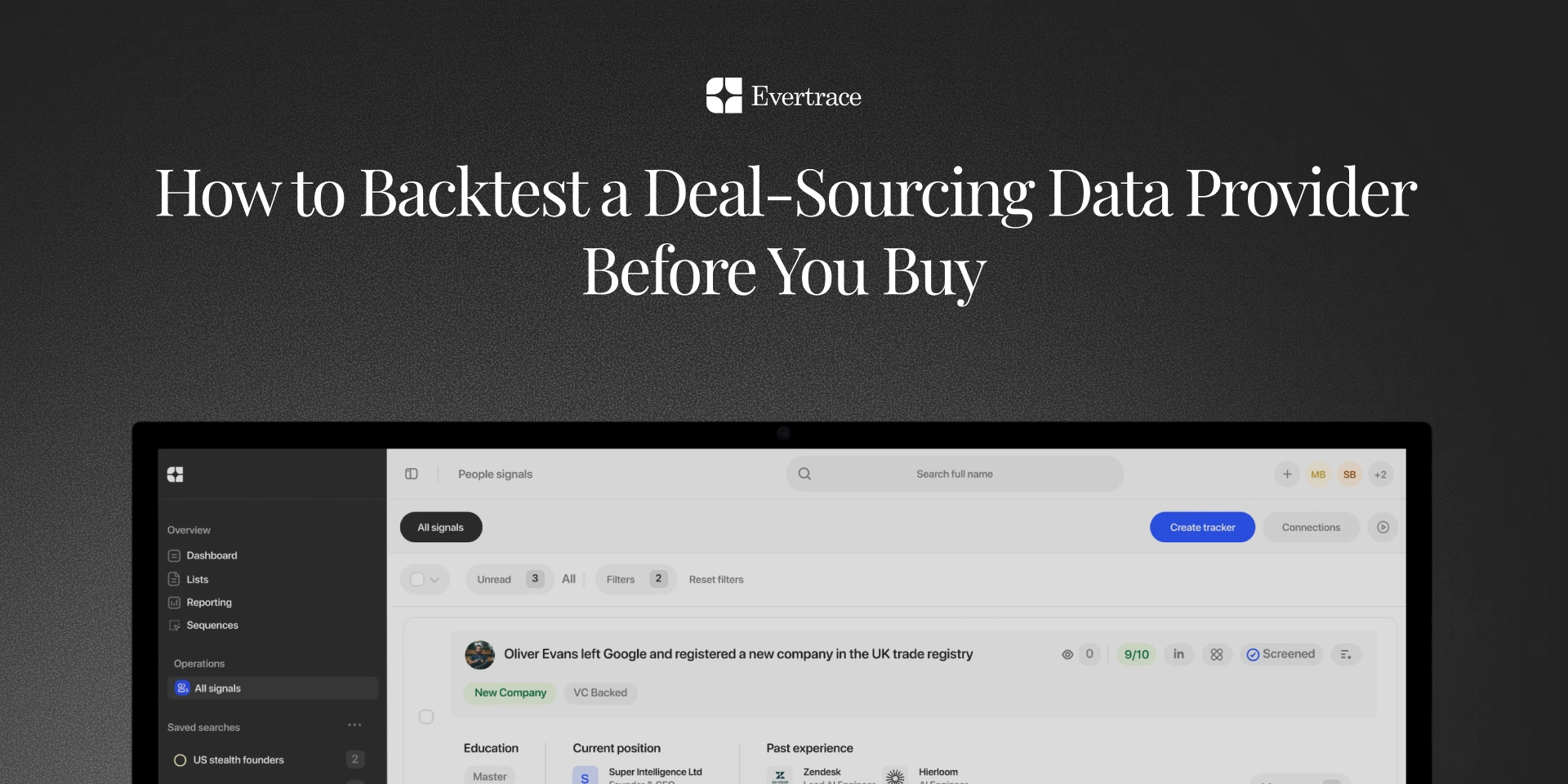
A sourcing provider looks convincing when you search for companies you already know. The founders are there, the profiles are detailed and the funding histories look complete.
For an early-stage investor, the next question is more revealing: what would the platform have shown before those companies became familiar?
That is the purpose of backtesting. It connects a provider’s coverage to a moment when the information could have changed what your fund did.
A complete profile can hide the timing
Imagine looking up a company after its seed announcement. Its website is live, the founders have updated their profiles and there is a clear description of the product. Almost everything an analyst needs is now easy to understand.
Six months earlier, the same opportunity might have consisted of a new registration, a developer’s project and a sparse personal website. Finding the company at that stage would have required different sources and more interpretation.
A database match today cannot tell you which version was available then. The useful historical record includes both a date and the information the provider held at that time. Together, they show whether there was enough for an investor to recognise a relevant person and begin a conversation.
The most useful test cases come from your own market
A fund’s past sourcing decisions give it a natural starting point. Portfolio companies, businesses it passed on and founders it discovered too late all reveal something about the opportunities it wants to find.
A representative list includes less prominent companies as well as familiar successes. Otherwise the test can become a measure of how thoroughly a provider has filled in profiles for businesses that later attracted attention.
The fund’s own discovery dates add another useful comparison. A provider might have identified a founder before the team did, at roughly the same time or only after the fund had already met them. Those differences help explain what a new source would add to the existing process.
The misses are worth discussing too. Several missed companies in the same country or technical field may matter more to a specialist investor than a strong overall result.
Coverage and timing tell only part of the story
A provider could cover many relevant founders and still create too much work for the team. If the feed also contains large numbers of unrelated businesses, an analyst has to find the useful opportunities inside it.
This is why a historical test works best alongside a live pilot. The historical list reveals known gaps. The live feed shows what an ordinary week of using the tool feels like.
During that pilot, useful measures are easy to relate to the investment process: relevant founders who were new to the fund, time spent reviewing results and conversations that followed. A record count gives much less insight into whether the source is earning a place in the team’s routine.
The first search may include months of accumulated opportunities. Subsequent reviews show the flow of genuinely new information and whether someone will continue making time for it.
What a good result looks like
A convincing evaluation produces examples the team can discuss. Here is a founder we would have wanted to meet. Here is when the information appeared. Here is what made the opportunity relevant, and how it would have reached the right person at the fund.
It also makes the weaknesses clear enough to work around. A provider can be valuable in one part of the market without replacing every other source a fund uses.
We think Evertrace should be evaluated on that basis: the founders it helps a fund discover, the timing of those signals and their usefulness to the people doing the research. A walkthrough built around your thesis is a better starting point than a generic list of impressive companies.
For the ongoing view, sourcing KPIs can connect that first evaluation to the qualified conversations the tool supports over time.
The founder detection engine for VCs
AI-powered founder detection with unmatched coverage.
 Book a demo